Filtering, email, and differences from Usenet
Yesterday I told the story of how and whyI started filtering Usenet and suggested that the same evolutionapplied (or would apply) to email. Well, maybe. Today it's time for acounter-argument:
Email is fundamentally different from Usenet in one core way. For themost part (and definitely if you were not a frequent poster), Usenet wassimply free-floating information going by. Some of it could be usefuland some of it could be interesting, but none of it was essential
The POSIX shell and the three sorts of Unixes
Avery Pennarun recently wrote Insufficiently known POSIX shellfeatures , where he talked abouta number of nice shell things that are not Bash but are instead POSIXshell features. Although he footnoted this in his entry, I want to drawyour attention to how there are three sorts of Unix machines (or, well,Unixes):
- machines on which
/bin/shis Bash. - machines on which
/bin/shis POSIX-compatible but is not Bash. - machines which have a POSIX-compatible shell, but it is
The slowdown of Solaris here
Oh, it's not that our Solaris machines have slowed down. As far as Iknow, they're still running as fast as usual. What's been slowing downis our interest in Solaris, or at least our interest in new versions ofSolaris. There was a time when I was relatively carefully tracking whatwas new in patches, Solaris updates, and OpenSolaris; nowadays I had tocheck to confirm that Solaris 11 Express was ZFS root only.
A relatively small part of this is because
The evolution of filtering (a story from the Usenet era)
When I first started reading Usenet (back in the rather old days), Iwound up hanging around some old Unix and Usenet hands. One of thethings that I noticed about how they read Usenet was that they hadreally aggressive killfiles; they would go into what I considered ahigh quality technical newsgroup like comp.unix.wizards and theirnewsreader would promptly junk all but one or two of the articles.
At the time, I did not understand this at all. Sure, there was a certainamount of
Django's forms are security-smart the way you want them to be
In reply to my desire for read-only form fields , a commentator on Reddit wrote (in part):
You don't really save much code by having read only inputs. In theexample used (inputs only editable if blank) you would still needserver side checking that these values are not modified. [...]
This is incorrect (at least for a competent implementation of read onlyfields). As a modern framework, Django is smart about this so it nevertakes the network's
A belated realization about web spiders and your page cache
Like a lot of other web applications, DWiki has various sorts ofcaching . One of its caching mechanisms is a simplebrute force cache for full pages, intended to deal with Slashdoteffect situations ; if a page has taken 'toolong' to generate it's put into the cache, and then further requests forit are served straight from the cache for a short interval.
Just today, I realized that much of what was getting put into the pagecache was actually being inserted pointlessly.
Like most any blog
Why I am not enthused about ZFS for my root filesystem
One of the changes in Oracle's recent Solaris 11 preview (and inOpenSolaris releases before it) is that your root filesystem must be aZFS filesystem; it can no longer be a UFS filesystem. While I understandwhy Oracle did this, it is not a change that leaves me feeling veryenthused.
The short version of why I do not like this is that previously, theentire ZFS subsystem could go belly-up and your system could still boot.You might think that ZFS going belly-up
A quick tour of my desktop
I've finally gotten around to creating a screenshot of my desktop, nowavailable here (500KbPNG). My desktop is two 1280x1024 LCD panels in side by side mode, sothis is a 2560x1024 picture. (You can probably easily spot the dividingline between the two panels.)
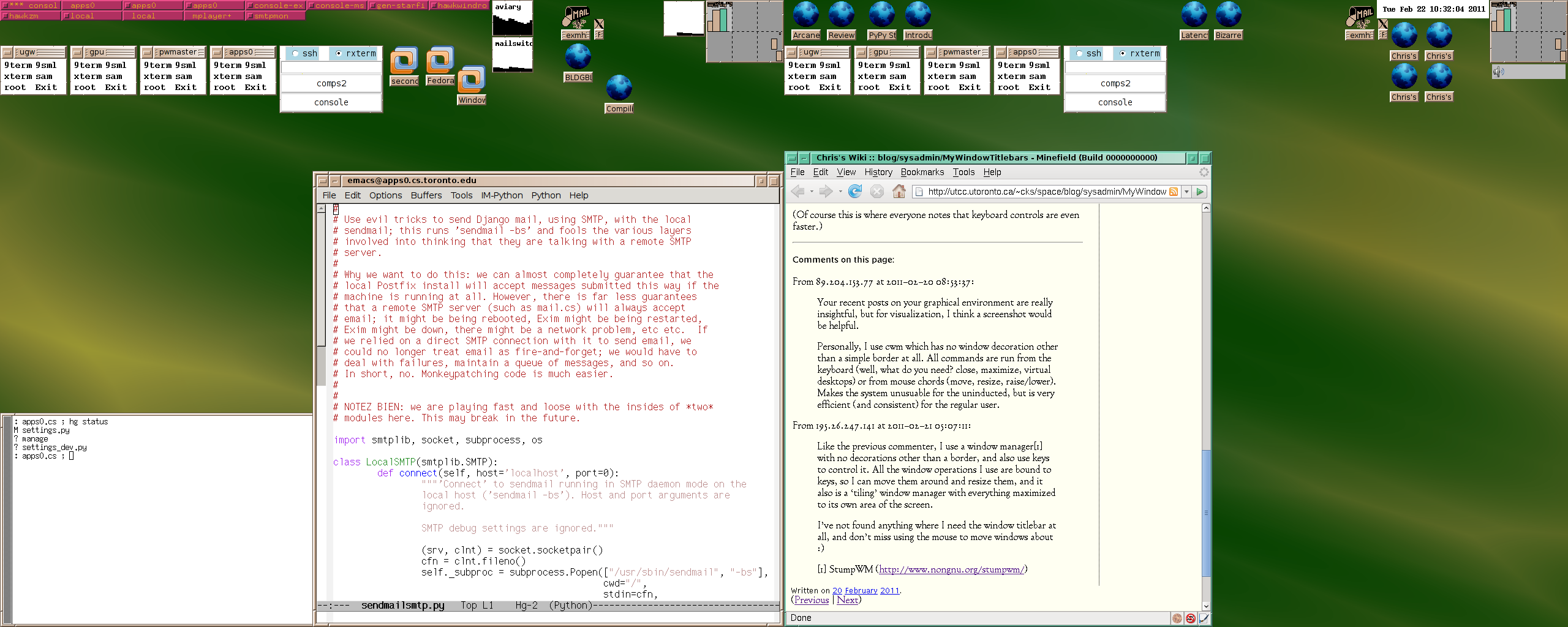
This screenshot shows a number of things that I've talked about,such as pyhosts and xrun ; alsovisible is an
Handling variations of a page (or, the revenge of REST)
Suppose that you have a web application with users, and different users(or different sorts of users) need to see slightly different versionsof various pages and forms. It's both obvious and very tempting toimplement these page and form variations with conditional logic in asingle URL's view handler; you have to retrieve the user's informationanyways (and check access permissions), so you simply put in some checksand switches based on what sort of user they are or what permissionsthey have.
(
Why I want read-only form fields in Django
One of the things that Django has is aforms handling system, especially for forms populated from your schemamodels. One of the commonly requested features for it is the ability tohave read-only form fields, things that will be displayed in your formbut cannot be changed. So far, the official Django answer is that thisis a bad idea and you don't want to do that (see for example here ).
(One reason I've read for this view is that Django people considera