Apple's desktop and notebook processors traditionally lead the pack in single-thread workloads, as industry-leading single-thread performance has been the company's focus for a long time. However, Apple's M5 Max processors not only outperform rivals by a huge margin in single-thread workloads, but beat all of them — including the 96-core AMD Ryzen Threadripper Pro 9995WX — in multi-thread workloads in the Geekbench 6 benchmark. However, when it comes to GPU compute performance, not everything is that rosy for the M5 Max.
Single-thread and multi-thread champion
Furthermore, Apple's new flagship CPU beats AMD's 96-core Ryzen Threadripper Pro 9995WX in single-thread (which is not surprising) and multi-thread workloads in Geekbench 6. It should be noted that while most Threadripper Pro 9995WX CPUs score around 26,000 GB6 points in multi-thread workloads, there is one example when this processor hits 30,170 points, which is a bit ahead of M5 Max's 29,644 points.
| Row 0 - Cell 0 | M5 Max | M4 Max | M3 Ultra | Threadripper Pro 9995WX | Threadripper Pro 9995WX | Threadripper Pro 7995WX | Ryzen 9 9950X3D | Xeon W9-3595X | Core Ultra 9 285K |
General Specification | 6SP + 12P at 4.60 GHz | 12P at 4.50 GHz + 4E | 24P at 4.05 GHz + 8E | 96P/192T at 2.50 - 5.40 GHz | 96P/192T at 2.50 - 5.40 GHz | 96P/192T at 2.50 - 5.10 GHz | 16P/32T at 4.30 - 5.70 GHz | 60C/120T at 2.0 - 4.80 GHz | 8P at 3.70 - 5.70 GHz + 16E |
Single-Core | 4353 | 4054 | 3226 | 3122 | 2800 | 2736 | 3466 | 2719 | 3165 |
Multi-Core | 29644 | 26320 | 27551 | 25992 | 30170 | 25899 | 24057 | 24206 | 21014 |
Source | https://browser.geekbench.com/v6/cpu/16894743 | https://browser.geekbench.com/v6/cpu/12812139 | https://browser.geekbench.com/v6/cpu/12809531 | https://browser.geekbench.com/v6/cpu/12797289 | https://browser.geekbench.com/v6/cpu/12773366 | https://browser.geekbench.com/v6/cpu/12802127 | https://browser.geekbench.com/v6/cpu/12807125 | Row 4 - Cell 8 | https://browser.geekbench.com/v6/cpu/12813645 |
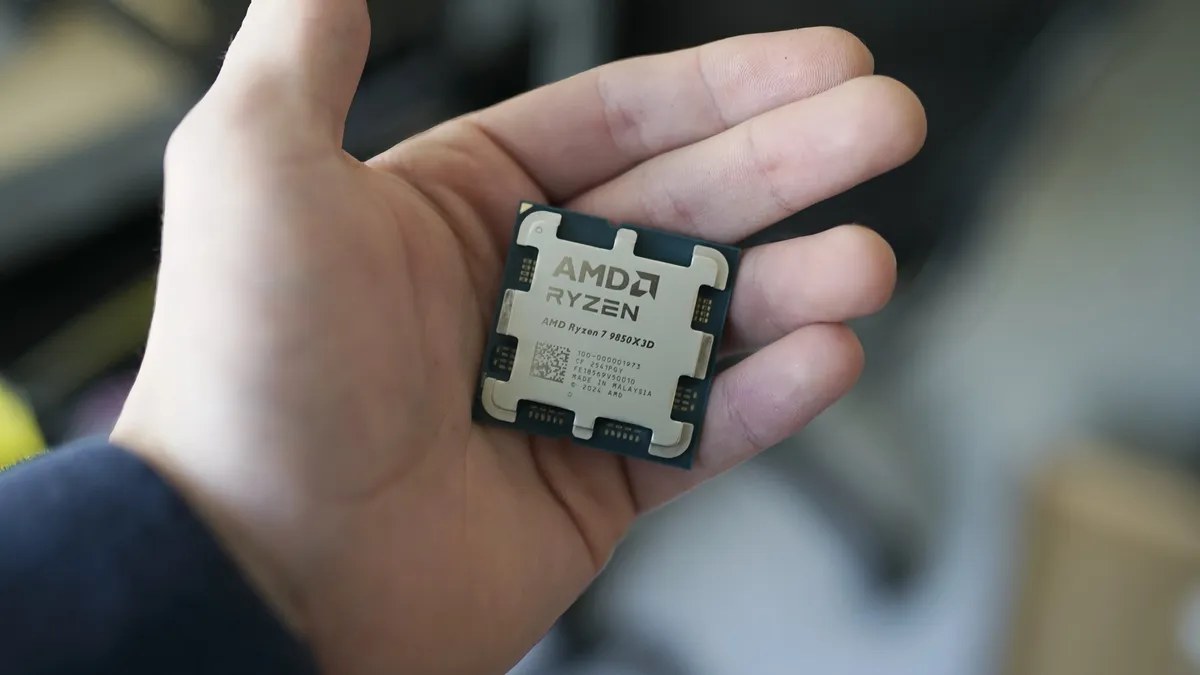
There is a major catch here as the Geekbench 6 multi-thread benchmark is a brief, bursty test intended to mimic common consumer tasks such as archive compression, PDF processing, and image editing. Its short runtime and bursty nature prevent it from fully stressing ultra-high-core-count processors like the Ryzen Threadripper Pro 9995WX.
Furthermore, many of the suite’s multi-threaded subtests scale efficiently only to roughly 8 – 32 threads, which leaves much of such CPUs' parallel capacity idle, but which creates an almost perfect environment for Apple's CPUs that feature a relatively modest number of cores, but which evolve noticeably in terms of per-core performance from one generation to another. Also, keep in mind that Geekbench 6 is a synthetic benchmark that reflects the potential of the tested hardware but may not reflect its performance in real-world applications.
Apple's M5 Max processor in its maximum configuration packs six 'super' performance (SP) cores featuring increased front-end bandwidth (i.e., wider decoder?), enhanced branch prediction, and a new cache hierarchy to deliver unbeatable single-thread performance as well as 12 new performance (P) cores designed to deliver power-efficient multithreaded performance in professional applications, up from 16 cores (12P + 4E cores) offered by the M4 Max. We do not know details about microarchitectures of Apple's 'super' performance and performance cores, though the 12% single-thread performance difference between M5 Max's SP and M4 Max's P cores is evident.
As for the memory subsystem, the M5 Max features up to 128 GB of LPDDR5X-9600 memory connected to the host via a 512-bit interface, offering 614 GB/s of bandwidth, up 12% from M4 Max (546 GB/s). For now, no workstation processor can match the memory bandwidth of M5 Max or M4 Max. Efficient cache and memory subsystems are crucial for single-thread performance, so this part of the M5 Max also played a significant role in its performance boost compared to the predecessor.
Not quite a GeForce RTX 5090
In addition to its revamped CPU subsystem, Apple's M5 Max also boasts a new GPU that is based on a PowerVR-derived microarchitecture developed by Apple. As it turns out, a big integrated GPU and plenty of memory bandwidth can deliver serious GPU compute oomph: the M5 Max scores 232,718 points on the GeekBench 6 GPU compute benchmark when using the Metal API. Apple's previous-generation M4 Max scores up to 204,453 points in the same tests. Evidently, the new GPU is better than the predecessor, but not that significantly.
| Row 0 - Cell 0 | M5 Max | Ryzen AI Max+ 395 | GeForce RTX 5070 | GeForce RTX 5070 Ti | RTX Pro 6000 WE | GeForce RTX 5090 |
Score | 228,081 | 133,447 | 207,061 | 253,890 | 368,219 | 376,858 |
Background Blur | 103,297 | 70,030 | 92,405 | 104,494 | 63,762 | 75,075 |
Background Blur | 427.5 images/sec | 289.8 images/sec | 382.4 images/sec | 432.5 images/sec | 263.9 images/sec | 310.7 images/sec |
Face Detection | 150,790 | 45,779 | 82,638 | 95,969 | 60,254 | 73,968 |
Face Detection | 492.3 images/sec | 149.5 images/sec | 269.8 images/sec | 313.3 images/sec | 196.7 images/sec | 241.5 images/sec |
Horizon Detection | 187,002 | 135,939 | 261,064 | 332,704 | 684,753 | 637,294 |
Horizon Detection | 5.82 Gpixels/sec | 4.23 Gpixels/sec | 8.12 Gpixels/sec | 10.4 Gpixels/sec | 21.3 Gpixels/sec | 19.8 Gpixels/sec |
Edge Detection | 285,273 | 142,598 | 302,787 | 408,073 | 864,739 | 838,261 |
Edge Detection | 10.6 Gpixels/sec | 5.29 Gpixels/sec | 11.2 Gpixels/sec | 15.1 Gpixels/sec | 32.1 Gpixels/sec | 31.1 Gpixels/sec |
Gaussian Blur | 401,667 | 161,926 | 227,152 | 281,342 | 832,815 | 795,994 |
Gaussian Blur | 17.5 Gpixels/sec | 7.06 Gpixels/sec | 9.9 Gpixels/sec | 12.3 Gpixels/sec | 36.3 Gpixels/sec | 34.7 Gpixels/sec |
Feature Matching | 59,861 | 33,663 | 45,780 | 47,976 | 57,199 | 57,464 |
Feature Matching | 2.36 Gpixels/sec | 1.33 Gpixels/sec | 1.80 Gpixels/sec | 1.89 Gpixels/sec | 2.25 Gpixels/sec | 2.27 Gpixels/sec |
Stereo Matching | 694,884 | 572,700 | 1,030,792 | 1,394,629 | 2,797,728 | 2,802,350 |
Stereo Matching | 660.6 Gpixels/sec | 544,4 Gpixels/sec | 979.9 Gpixels/sec | 1.33 Tpixels/sec | 2.66 Tpixels/sec | 2.66 Tpixels/sec |
Particle Physics | 527,500 | 518,413 | 522,239 | 673,633 | 1,114,648 | 1,069,886 |
Particle Physics | 23215.7 FPS | 22,815,8 FPS | 22984.2 FPS | 29647.2 FPS | 49056.6 FPS | 47086.6 FPS |
When compared to non-Apple GPUs, the one inside the M5 Max easily beats the iGPU inside the Ryzen AI Max+ 395, which scores 133,447 points when unconstrained by thermals. When it comes to discrete graphics cards, Apple's flagship iGPU is ahead of Nvidia's GeForce RTX 5070 ( 207,061 points , Vulkan ), but trails the GeForce RTX 5070 Ti ( 253,890 points, Vulkan) and has no chance against the GeForce RTX 5090. Still, building an integrated GPU that delivers compute performance comparable to one of the best graphics cards is a breakthrough.

Follow Tom's Hardware on Google News , or add us as a preferred source , to get our latest news, analysis, & reviews in your feeds.