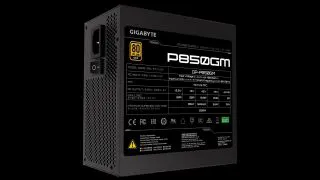
Gigabyte's GP-P850GM and GP-P750GM power supplies have been making rounds around hardware circles for all the bad reasons. Apparently, these two models have high failure rates and may be ticking time bombs for owners. Gigabyte has released its statement detailing the solution in regards to the reported failures from users and news outlets.
Consumers who managed to purchase a GeForce RTX 30-series (Ampere) graphics card from Newegg in the last couple of months probably heard of or own the GP-P850GM or GP-P750GM. The retailer paired Nvidia's RTX 30-series graphics card with one of the aforementioned power supplies as part of bundles so Ampere adopters forcibly had to buy a power supply with the graphics card even if they needed it or not.
Neither the GP-P850GM or the GP-P750GM has a good reputation on Newegg. Out of the 92 consumers who bought the GP-P850GM, 39% of the user base left a one egg rating. The feedback for the GP-P750GM is even more alarming. According to Newegg, 53% of the 305 buyers left the lowest rating. The two most common complaints were defective upon arrival and premature failures, which in some occasions suffer a quick death and took out other components with it
According to Gamers Nexus , 50% of the 10 power supplies failed during or after over power protection (OPP) tests. Some units failed at 60% load just after the first pass. The publication also conducted a survey with its community where 16% of the users claim their power supplies failed and were no longer operational.
Gigabyte GP-P850GM and GP-P750GM Modifications
| Previous OPP Trigger Point | New OPP Trigger Point | |
|---|---|---|
| GP-P850GM | 120% ~ 150% (1,020W ~ 1,300W) | 110% ~ 120% (950W ~ 1,050W) |
| GP-P750GM | 120% ~ 150% (900W ~ 1,125W) | 110% ~ 120% (825W ~ 925W) |
Aris Mpitziopoulos, our resident power supply guru, reviewed the GP-P750GM on his Hardware Busters YouTube channel, and his sample had exploded with fireworks. Mpitziopoulos concluded that the OPP and OCP protections were set too high and the questionable FETs simply couldn't deal with the load.
Gigabyte's solution consists in lowering the OPP trigger point for the GP-P850GM and GP-P750GM. The manufactuer lowered the threshold from 120% to 150% down to 110% and 120%. In its statement, Gigabyte reaffirms that "the potential issues that were reported, only seemed to occur after very long time periods of extreme load testing via DC Electronic load equipment and would not be typical of any real world usage."
Gigabyte claims that the old and new OPP thresholds are suitable for everyday usage. Nonetheless, the company is willing to offer owners the revised unit if it fits the criteria. GP-P850GM with a serial number between SN20343G031011 to SN20513G022635 and GP-P750GM with the serial number from SN20243G001301 to SN20453G025430 are eligible for the exchange.
However, we're not convinced that adjusting the OPP protection is the answer to the GP-P850GM and GP-P750GM's problems. The majority of the user feedback on Newegg involves DOA (dead on arrival) units so this may be problem with the design or perhaps the quality assurance department dropped the ball for a few and a bad lot escaped the factory.