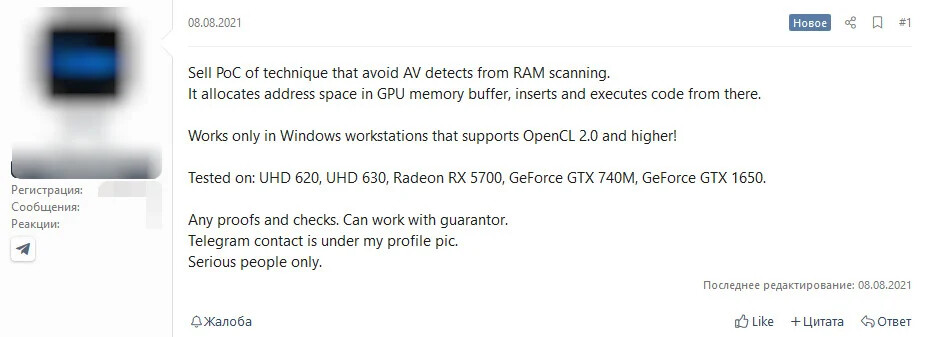
Cybercriminals have innovated a way to store malware code inside GPU dedicated memory (video memory), and execute code directly from there. Execution from video memory may not be new, but they've mostly been confined to the academic space, and unrefined. This would be the first time a proof-of-concept of a working tool that injects executables to video memory, surfaced on a hacker forum.
The tool relies on OpenCL 2.0, and its developers claim to have successfully tested it on Intel Gen9, AMD RDNA, NVIDIA Kepler, and NVIDIA Turing graphics architectures (i.e. UHD 620, UHD 630, Radeon RX 5700, GeForce GTX 740M, and GTX 1650). What makes this ingenious is that the malware binary is stored entirely in GPU memory address-space and is executed by the GPU, rather than the CPUs. Conventional anti-malware software are only known to scan the system memory, disks, and network traffic for malware; but not video memory. Hopefully this will change.