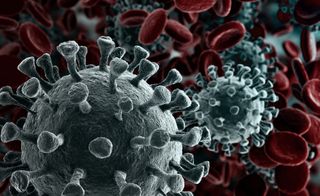
Imagine if the compute power of all the world's estimated 3.5 billion smartphones were simultaneously crunching away to search for a cure for the coronavirus. Today, that's at least theoretically possible as the Rosetta@Home project announced that is has enabled COVID-fighting research to run on Arm64 devices, which means you can now help researchers find a cure or vaccine for the coronavirus on both Raspberry Pi devices and your smartphone, both through the BOINC program.
The Rosetta@Home project works much like the now-famous Folding@Home project that has reached superstar status . The distributed computing program allows researchers to define massive problems used to research treatments and cures for diseases -- COVID-19 in this case -- that typically require supercomputer-class levels of compute to solve. The program then takes those large problems and breaks them down into smaller chunks that are crunched by volunteers on their desktop PCs, and to astonishing affect; the Folding@Home project recently passed 1.5 ExaFLOPS of compute, which is the equivalent of the raw power of the top 103 supercomputers in the world , combined.
Unfortunately, Folding@Home is limited to x86 computers, meaning it only runs on desktop PCs and standard servers, and not on Linux/ARM-powered devices like Raspberry Pi or smartphones. However, the BOINC project hosts workloads for several different computing projects, and it has both a program for Raspberry Pi devices and an app that you can run on your smartphone.
Until today, you couldn't run COVID-fighting workloads on the BOINC application, but the new update enables 64-bit Linux-ARM platforms to expand the roster to both Raspberry Pi and smartphones.
He made a Video about it. https://t.co/r42vRiulZO April 3, 2020
Here's a video tutorial on how to get the BOINC client up and running on Raspberry Pi, but we're working on a more concise set of instructions.
As you can see below, BOINC also updated its smartphone app today (Android only), and we were able to get the program up and running with a minimum of fuss.

We did notice that the program slowed down our phone's performance considerably, but you can adjust how much system resources the program consumes, along with other variables, like assigning it to work only when the phone is connected to a charger and/or a Wi-Fi connection. That reduces the impact of the program on performance, all while still fighting the coronavirus in the background.
Raspberry Pi boards and smartphones may not come with the horsepower of the CPUs and GPUs found in desktop PCs, but they are incredibly power efficient and very numerous. In big numbers, even smaller contributions will help researchers as they race to find a cure for the coronavirus.
We're not sure if the Rosetta@Home network can reach the massive power we've seen with the Folding@Home resurgence. But given that Raspberry Pis power some of the world's supercomputers , and there are roughly 3.5 billion smartphones in use around the planet, the cure for the coronavirus could come from a small workload running on a Pi or someone's unassuming smartphone.