Following a report that the Taiwan Semiconductor Manufacturing Company (TSMC) is sitting on a billion dollars' worth of inventory of Apple chips, an expert from Taiwan believes that the company can reallocate capacity to products that contribute more to its revenue. The rapid AI infrastructure buildout and the corresponding uptick in demand for the latest chips have led to a reshaping of TSMC's income statement, as most of the firm's revenue comes from high-performance computing chips.
Just as the AI race has reshaped NVIDIA's business from being a gaming GPU designer to a high-performance computing (HPC) chip provider, it has also transformed TSMC's business model. Before heavy spending on AI infrastructure became the norm, TSMC's largest customer was believed to be Apple, with the firm's partnerships with consumer electronics and AMD also believed to have played a key role in establishing it as the world's leading contact chip manufacturer.
However, as big tech continues to fork out billions in capital expenditure for AI infrastructure, TSMC's revenue percentages have drastically changed. For instance, during 2024's fourth quarter, HPC products accounted for 46% for the firm's revenue while smartphone products accounted for 38%. Smartphones' proportion was higher in Q3 2022 when it accounted for 41% of the revenue, while HPC stood at 39%.
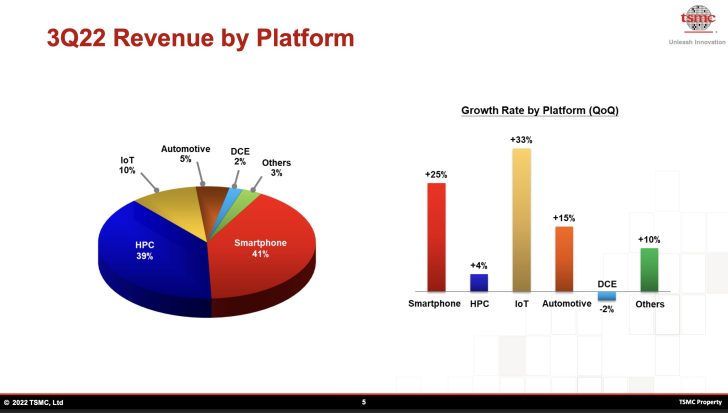
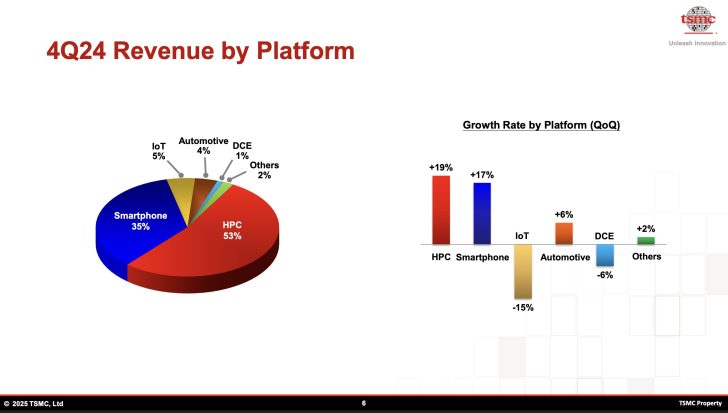
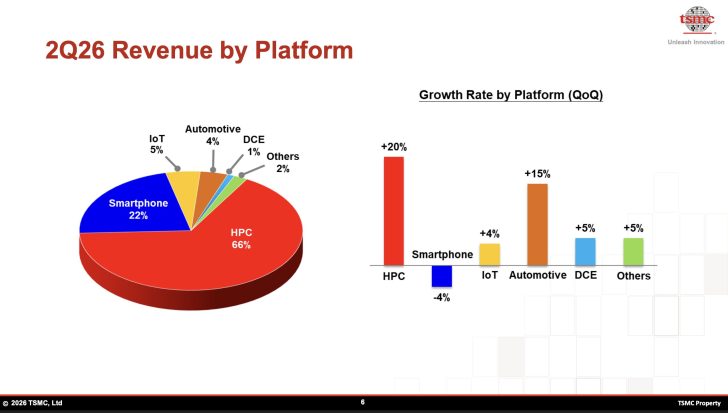
However, TSMC's latest revenue breakdown for the second quarter of. 2026 shows that the HPC products accounted for 66% of the firm's revenue. With a recent report claiming that the firm was sitting on $1 billion worth of inventory for Apple due to memory shortages, an expert from Taiwan believes that the updated revenue breakdown and TSMC's bread-and-butter HPC products will enable the firm to withstand the latest crisis as well.
According to Liu Pei-chen, Director at the Taiwan Institute of Economic Research, TSMC can manage the glut created by the Apple chips by refocusing its production lines on other products. As quoted by the Economic Daily, Liu noted that while the firm's revenue and fundamentals were supported by HPC computing and flagship products, its reliance on short-supply memory chips could affect its production line delivery cycle and, in turn, its capital turnover efficiency.
However, he https://udn.com/news/story/7240/9676875 that while the shortages in the memory industry are out of TSMC's control, the firm can dynamically allocate its production lines in collaboration with the broader industrial ecosystem. According to the expert, the Taiwanese fab could shift its production capacity to AI or HPC products that are less affected by the memory shortages.
AI and HPC chips rely on high bandwidth memory (HBM), with manufacturers such as Micron and Samsung having shifted their focus to these chips due to their high prices. Consequently, standard DRAM chips used in consumer electronics have experienced short supply .
Follow Wccftech on Google to get more of our news coverage in your feeds.