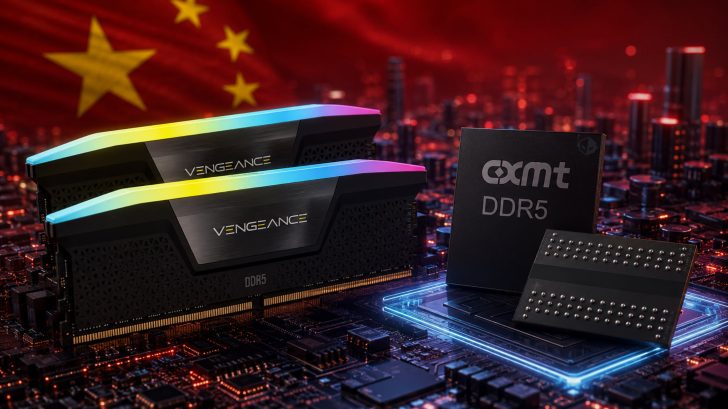
Chinese memory upstart CXMT is making important progress with its DDR5 memory chips, according to a report in the Chinese media. The firm has become a regular part of industry news as it grows in importance due to high demand from the local industry and Apple's interest in buying its chips to ease the pressure of the global memory chip shortage.
Now, today's report suggests that CXMT's DDR5 memory chips, marketed as being manufactured on the 17-nanometer manufacturing process, have reached a 90% yield to allow the firm to make major progress in its ability to ship large volumes.
According to the details , CXMT's 17-nanometer DDR5 memory chips have achieved a 90% yield. These chips are manufactured with a 17-nanometer class manufacturing process technology node. Other firms, such as Micron, produce DDR5 chips on the more advanced 10-nanometer class nodes that are called 1-gamma nodes and rely on extreme ultraviolet (EUV) lithography machines.
The report, courtesy of China's MyDrivers, adds that several PC manufacturers have started to use CXMT's memory chips. Among these, Acer and ASUS are leading the pack, with the two firms primarily selling the products with these chips in Mainland China and emerging markets.
Additionally, it adds that US firms such as Dell and HP are more restrictive in their use of the Chinese memory chips. Specifically, Dell has completely banned the use of CXMT's chips, while HP only uses the chips in products that are used in Mainland China. The latter's strategy mirrors that of Apple, as per earlier media reports. These reports have claimed that the consumer electronics firm has lobbied the US government to allow it to use CXMT's chips for its Chinese products.
However, the sources behind today's report also claim that while ASUS and Acer are using CXMT's chips, the use is limited in nature. The limitations stem from worries about the reaction of the three big memory manufacturers, namely SK hynix, Micron and Samsung Electronics.
While CXMT has emerged as a potential player in the global memory market, its ability to ship in volume to match the big memory firms remains limited. Additionally, while the big three can use EUV machines to make the memory chips, CXMT, due to US sanctions, can be limited in utilizing the latest lithography technologies to manufacture its products.
Follow Wccftech on Google to get more of our news coverage in your feeds.