Qualcomm is finally disclosing the first specifications and performance benchmarks of its entry-tier Snapdragon C SoCs.
Snapdragon C SoCs Are Qualcomm's Bet In The Entry-Tier PC Segment, Leveraging LPDDR4 & LPDDR5 Memory Standards For $300 Laptops
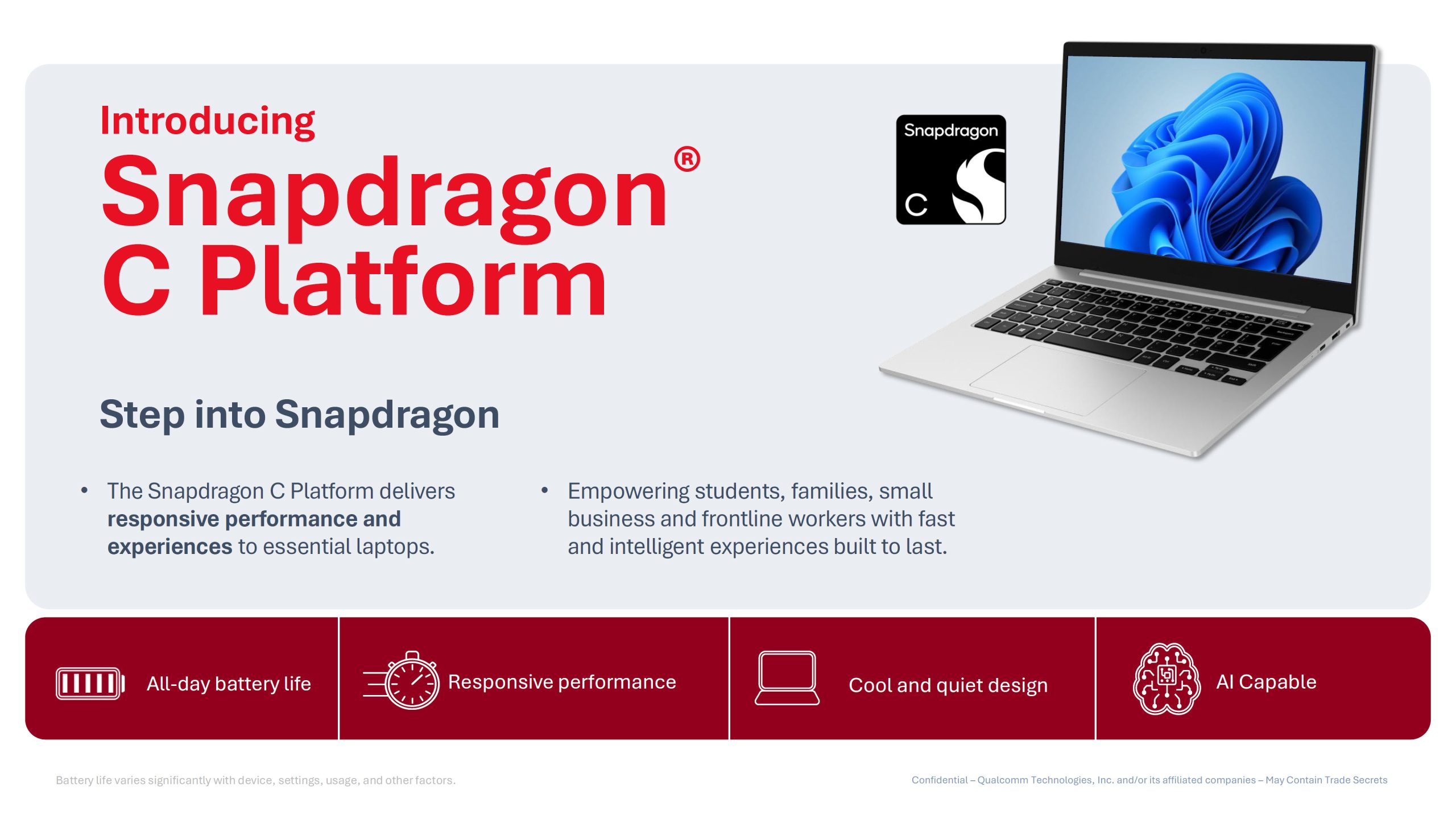
At Computex 2026, Qualcomm unveiled its latest Snapdragon family called Snapdragon C . The SoCs were pitched as an entry-tier PC offering with platforms starting at $300 and offering all-day battery life. During the announcement, Qualcomm was tight-lipped on the specs & benchmarks, but today, the company is now ready to share them.
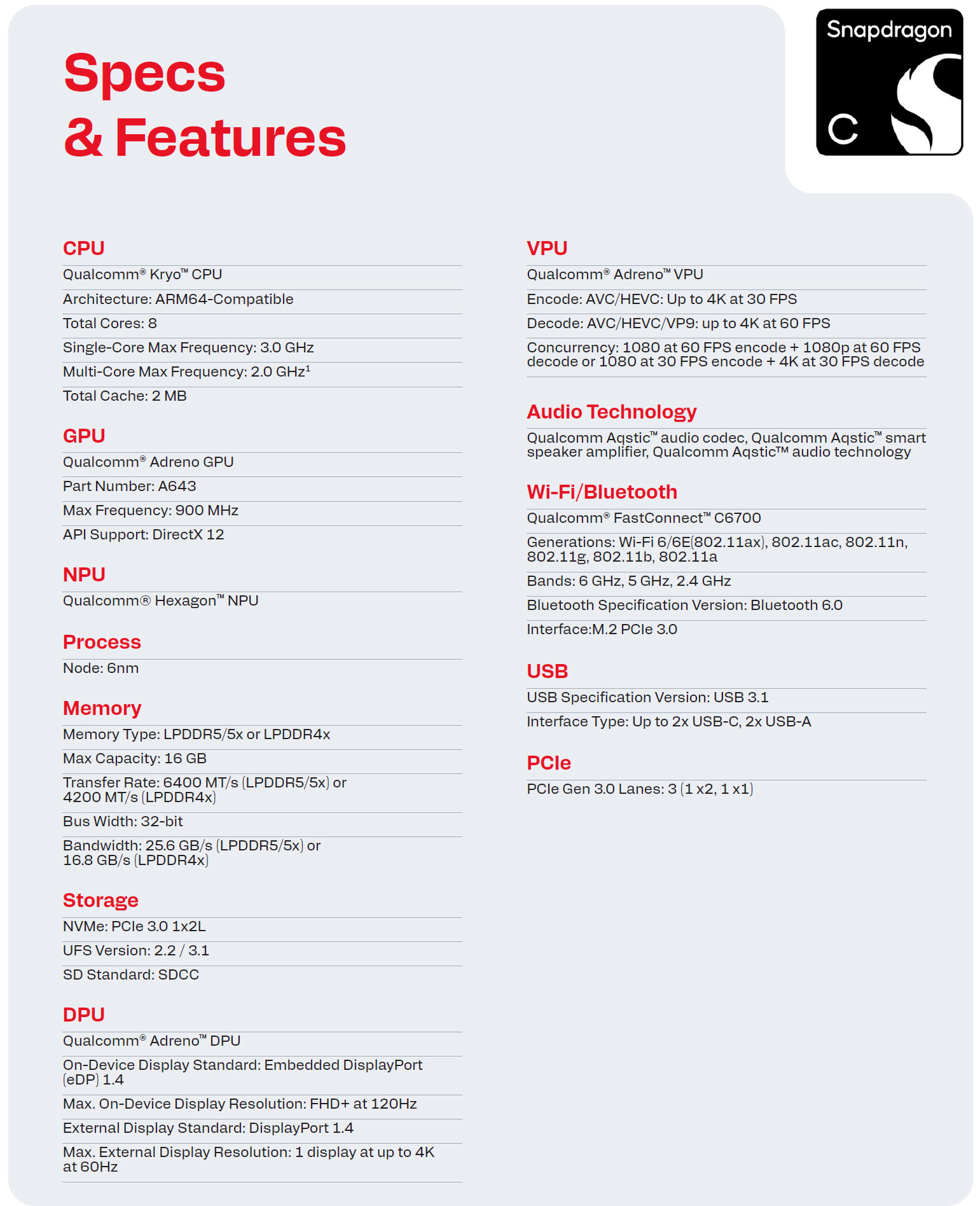
Starting with the specifications, the Qualcomm Snapdragon C SoCs are based on the Qualcomm Kryo CPU architecture (ARM64-Compatible) and feature up to 8 cores with 2 MB of cache. These cores clock in at up to 2.0 GHz multi-core and 3.0 GHz single-core frequencies. A 3-Core clock of 2.6 GHz is also mentioned. The chip is fabricated on a 6nm process node.
For the GPU, Qualcomm is leveraging an Adreno A643 chip with a max frequency of 900 MHz and support for the DX12 API. Even in such an entry-tier chip, Qualcomm is retaining a Hexagon-tier NPU, & the DPU carries support for eDP 1.4, resolution of up to FHD+ @ 120Hz, an external DP1.4 output, and a max external resolution support of up to 4K @ 60Hz. The onboard Adreno VPU offers AVC / HEVC up to 4K @ 30 FPS in Encode, and AVC / HEVC / VP9 up to 4K @ 60 FPS in Decode.
Moving over to memory support, Qualcomm is making sure that the C Series SoCs are backed by a diverse set of LPDDR standards. The chip supports LPDDR4x, LPDDR5, and LPDDR5x standards with up to 16 GB capacities, a 32-bit wide bus (single-channel), and transfer rates of up to 6400 MT/s (LP5/X = 25.6 GB/s) or 4200 MT/s (LP4x = 16.8 GB/s). Storage solution includes support for a single PCIe 3.0 NVMe SSD, UFS 3.1 / 2.2 support, and a standard SDCC card.
Laptops equipped with the Qualcomm Snapdragon C SoCs will offer Qualcomm's Aqstic audio codec with smart amplifier technology, a C6700 wireless controller with WIFI6/6E and BT 6.0 capabilities. The laptops will also feature two USB 3.1 Type-C and two USB 3.1 Type-A ports. A single chip carries 3 PCIe Gen 3.0 lanes (1x2, 1x1).
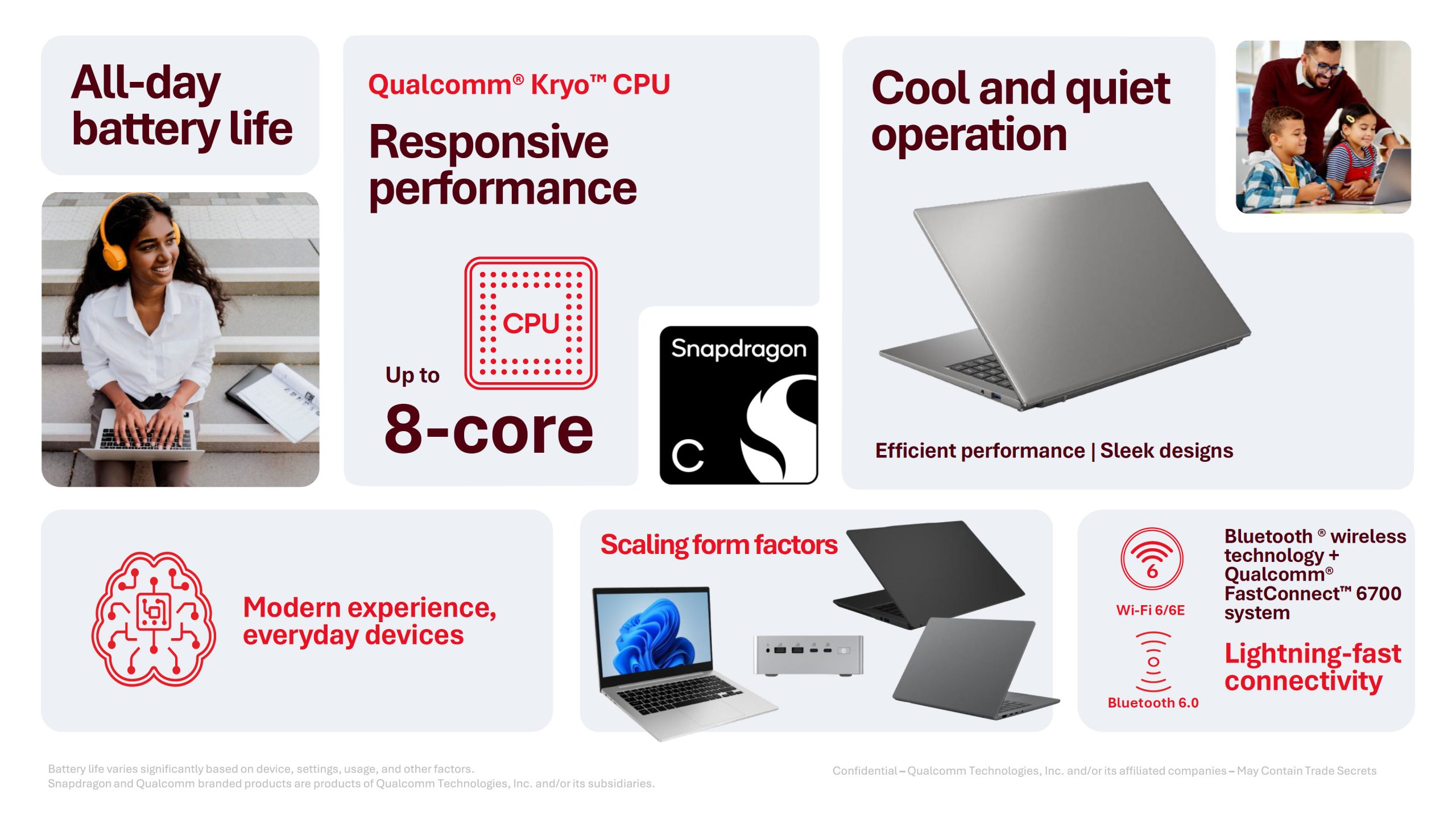
As I said, Qualcomm is sharing the first C-series benchmarks too, and the company makes it clear that this isn't a high-end chip, but a solution to empower students, families, small offices, and business spaces. As such, the core focus was on four capabilities:
- All-Day Battery Life
- Responsive Performance
- Cool & Quiet Design
- AI Capable
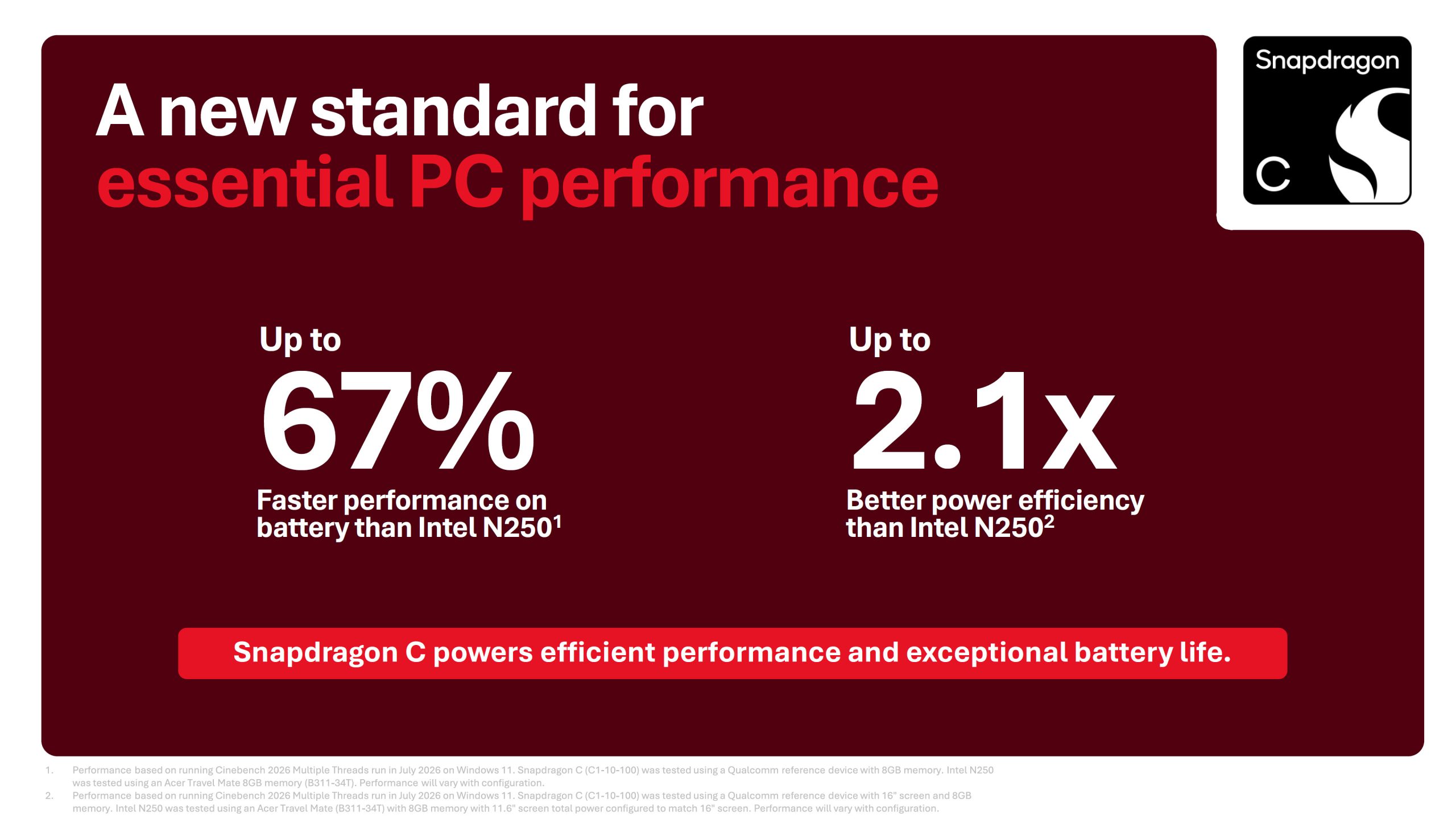
In its benchmarks, Qualcomm is pitting the Snapdragon C series platforms against Intel's N200 "Twin Lake" platform. These are entry-tier chips with only E-Cores. The N250 is used in the tests, and Qualcomm claims 67% faster performance on battery and up to 2.1x the power efficiency.
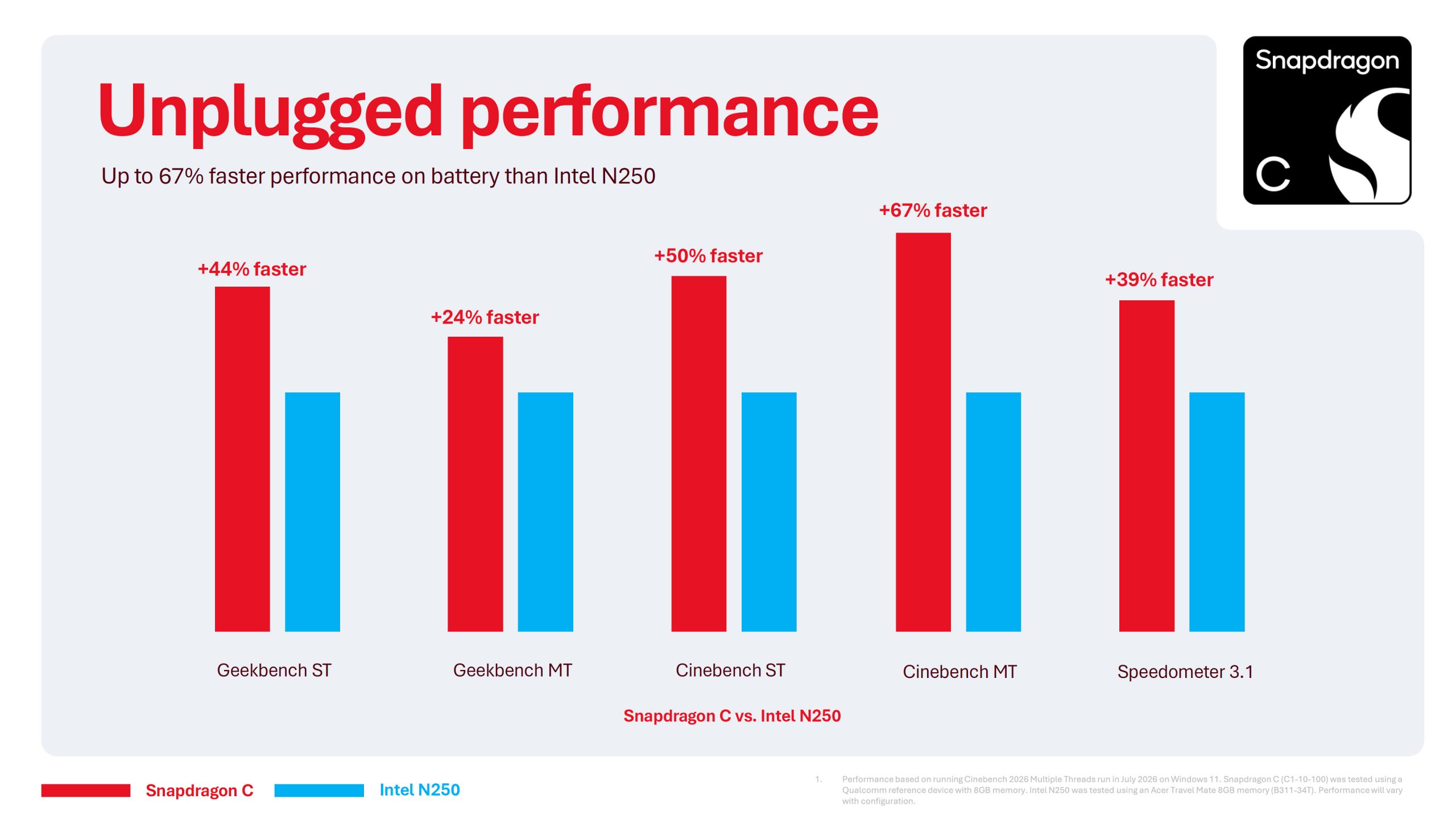
The benchmarks used by Qualcomm include Geekbench, Cinebench, and Speedometer, with the Snapdragon C SoCs being anywhere from 24% to up to 67% faster. The biggest gains are reported in Cinebench, where the chip is 50% faster in single-threaded & 67% faster in multi-threaded tests.
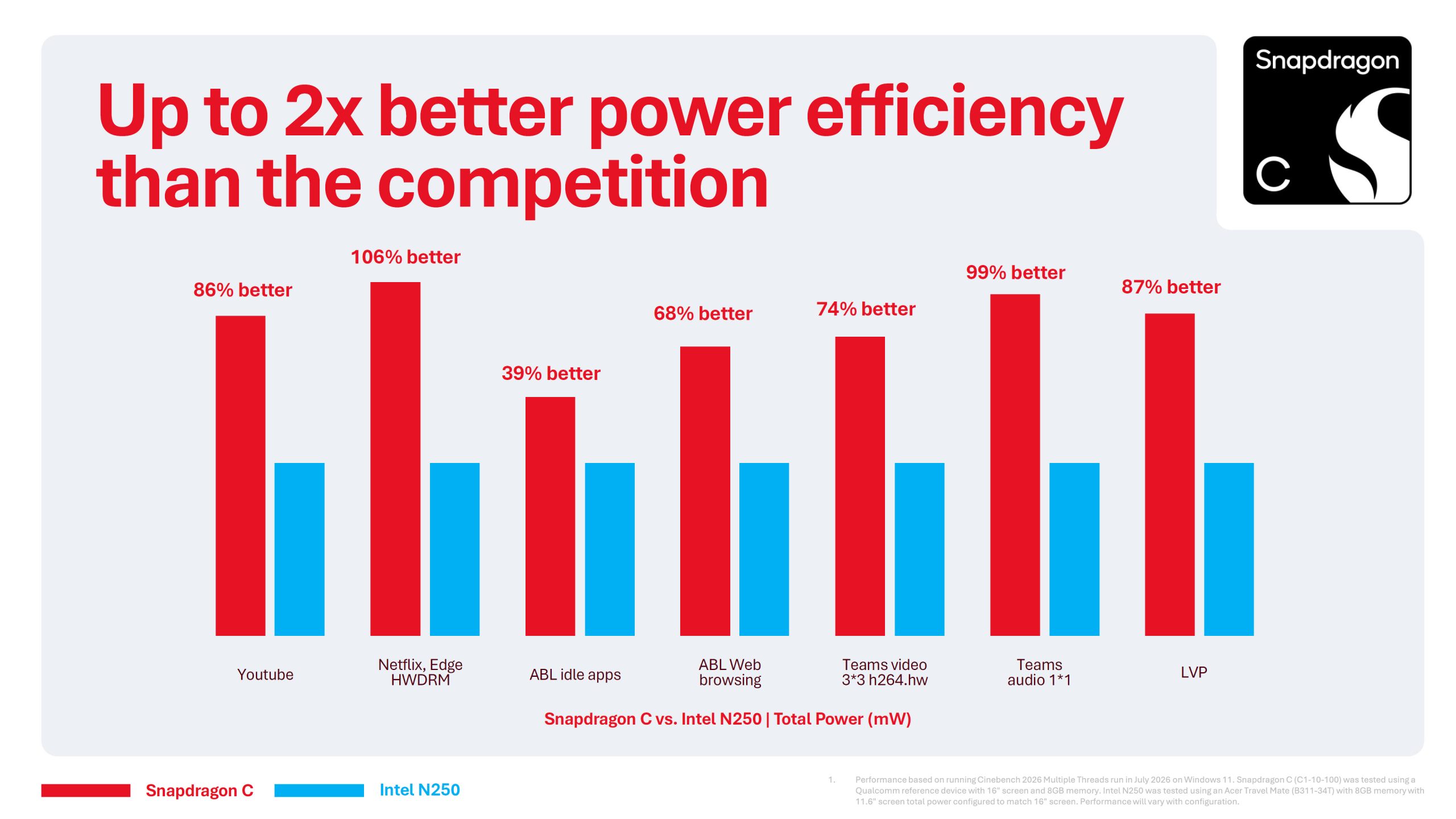
In terms of battery efficiency, the chip offers much higher efficiency, over 2x in Netflix and an 80-90% better rating while watching YouTube, Netflix, or attending a Teams Audio session.

Qualcomm states that the Snapdragon C SoCs support thousands of popular applications that are widely in use amongst PC audiences, and that makes their platform a better alternative than the rest of the options on the market.

The first devices are said to be coming soon from Acer, ASUS, HP & Lenovo, with prices targeting the $300 mark, but we will have to wait and see if the performance & battery claims really hold up for everyday productivity use cases.
Follow Wccftech on Google to get more of our news coverage in your feeds.