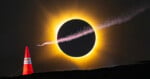
In an exclusive interview with PetaPixel , photographer Noah Wetzel details how he and Red Bull Air Force athlete Mike Brewer spent nine months preparing to photograph a wingsuit flight through a total solar eclipse. The final image was captured in Spain during just 84 seconds of totality, with Wetzel working from nearly a mile away and relying on a Canon EOS R5 II, a 600mm lens, remotely triggered flashes, and calculations that left almost no room for error to capture a once-in-a-lifetime moment.
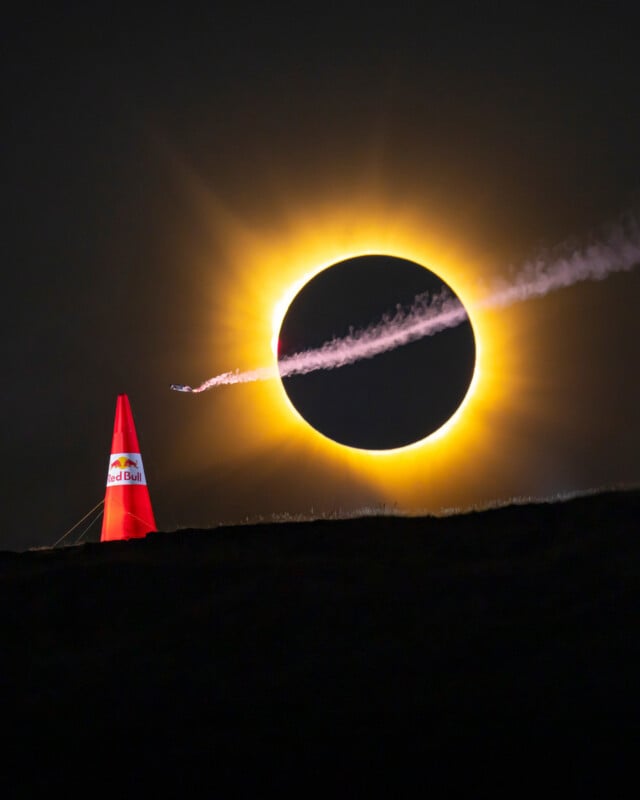
The photograph shows Brewer racing through the glowing ring of totality at roughly 150 miles per hour, his body frozen against the darkened sky. It looks like a moment that simply happened to align, but nearly every element had been engineered long before the eclipse appeared.
Wetzel had to determine exactly where the eclipse would sit above the horizon, where the athletes would fly, how much room he needed in the frame, how to illuminate them from 1,400 meters away, and how to freeze their movement in near-total darkness. Even after months of preparation, he would ultimately have only a few hundredths of a second to make the photograph.
“Literally the pursuit of this photograph was treading the fine line of photographically impossible in about five different areas, each one of them handcuffing the other scenario,” Wetzel says.
Planning An Almost Impossible Photograph
The project began with an idea that had already been proven difficult once. Wetzel had photographed a mountain biker during the 2017 total solar eclipse , an image that went on to win a category in the Red Bull Illume photography competition. This time, he and Brewer wanted to take the concept much further.
A wingsuit flyer would replace the mountain biker, and instead of photographing the athlete relatively close to the action, Wetzel would work from approximately 1,400 meters away. The athlete would also be traveling at around 150 miles per hour, while totality would last only 84 seconds.
Wetzel and Brewer spent nine months working through the variables, including four test productions. One of those tests took place before sunrise in Moab, Utah, and required the team to cross a river by raft before carrying hundreds of pounds of equipment up a mountain in the dark.
The actual location in Spain presented another set of uncertainties. Wetzel could calculate where he wanted the eclipse to appear and where the athletes needed to fly, but he could not know exactly what he would encounter until he arrived.
“To align the photo I had a specific spot calculated months before I had ever even been to the location. But I was most certainly worried that trees might be in the way, etc etc. Even using software to help plot things, and manual calculations, you still must rely upon the in the field scenario. It was absolutely brutal,” Wetzel says.
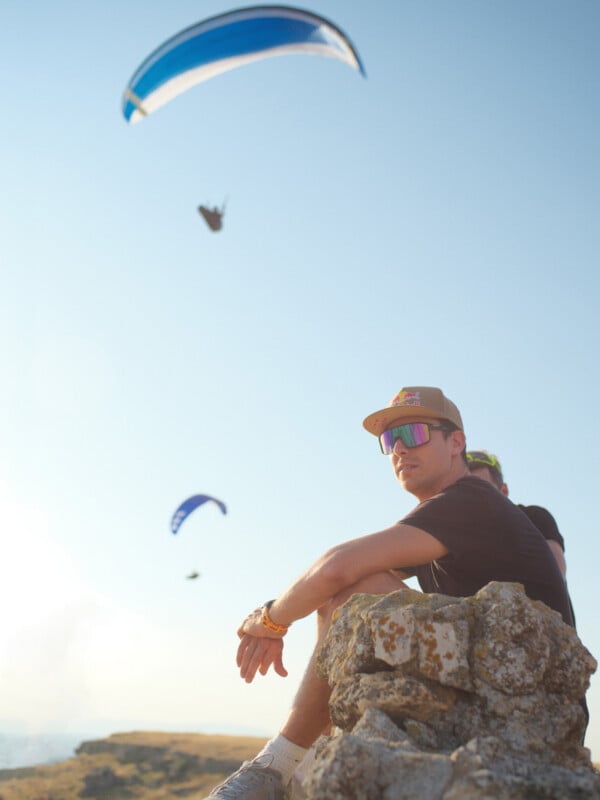
Spanish Red Bull athlete Dani Román also helped Wetzel and Brewer understand the terrain and participated in the eclipse flight, allowing the team to test the flight path during the actual event.
Why Wetzel Chose A 600mm Lens
Wetzel originally expected to photograph the flight at either 840mm or 1200mm. A tighter composition would make the relationship between the athlete and the eclipse even more dramatic, but it would also dramatically increase the consequences of even a small positioning error.
The final hero angle was shot with a Canon EOS R5 II and Canon RF 600mm f/4 lens.
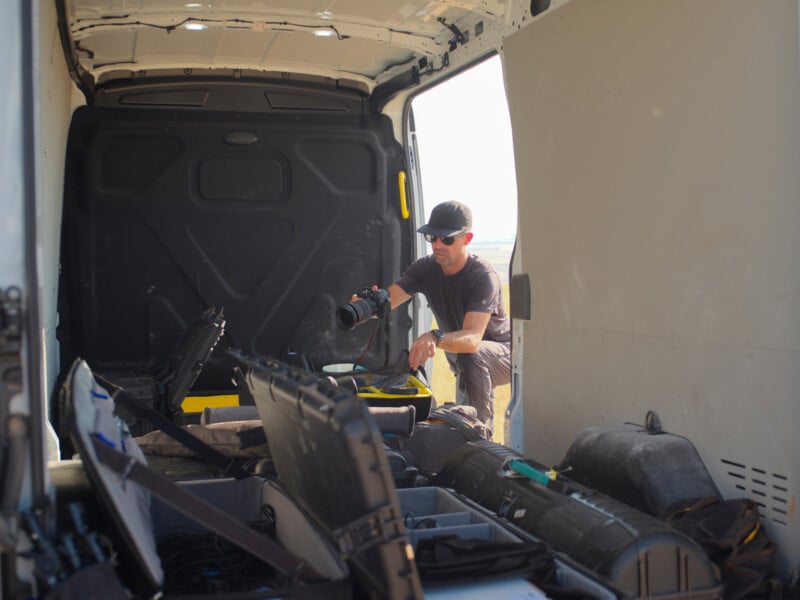
“I originally planned to shoot this at 1200mm, or 840mm. But getting to the location, I knew that I needed room for error up and down and left to right when positioning the eclipse within the frame. Also the 600mm lens would allow more light in versus having an extender on it, and it would theoretically be slightly more sharp as well,” Wetzel says.
The longer focal lengths were still possible, but Wetzel realized that the 600mm would give him more breathing room precisely when he would be trying to track an athlete he could barely see.
“The tighter the framing, the more insane pressure I’d be putting upon my shoulders trying to time two burst frames in near darkness with an athlete traveling 150 miles per hour that I couldn’t see while only wearing a small blinking bike light on his heels that seemed to drop 100 feet between blinks,” Wetzel says.
That margin became particularly important because the eclipse itself was moving across the horizon. Wetzel was not simply waiting for Brewer to enter a stationary target. He had to continuously account for the eclipse’s changing position while maintaining the predetermined flight path.
Building The Lighting System
The lighting was designed around a fundamental problem: the athletes were moving too quickly for the camera’s shutter speed alone to freeze them cleanly.
For the hero photograph, Wetzel used four wireless flashes, three Godox AD1200 Pros and one Godox AD360 II+ C. They were positioned along the horizon in the flight zone and arranged to overlap their illumination across the area where the athletes would pass.
“I’m essentially trying to evenly illuminate the sky where they are flying through the frame. When I’m positioning the flashes I’m attempting to overlap all flashes so that every bit of air space is evenly covered, yet the primary zone of where they are positioned in the sky and when want to trigger the shutter is the biggest priority,” Wetzel says.
The placement was designed to illuminate different parts of the athletes as they moved through the frame.
“I positioned one flash on the lookers left aspect of the ridgeline, once directly behind where the main spot I planned to capture them, and one 1200 flash further lookers right in the frame. The outward flashes angled in, and the center flash angled slightly towards the pilon. More or less, I wanted to light the front of the athletes, the middle of the athletes, and the back of the athletes to give myself the best chance at freezing their motion with the flash power issues and flash duration speed issues,” Wetzel says.
The flashes were hidden near the ridgeline, but they still needed to receive a wireless signal from Wetzel’s position. PocketWizard Plus IIIe receivers were mounted on light stands along the horizon and hardwired to the flashes using 100- to 200-foot auxiliary cables.
“I utilized a pocket wizard Plus Ve transmitter set to channel two, triggering the wireless flashes from 1400 meters away. I had four wireless flashes (Godox AD 1200 Pro’s) set up on channel 2 within the fly over zone. In order to receive the transmitter signal and have the flashes still hidden to backlight the subject, I positioned light stands on the horizon line, in line of sight of my transmitter. On top of the light stands I mounted Pocket Wizard Plus IIIe receivers, and hard wired the receivers to the hidden flashes via 100-200’ cables of aux cord,” Wetzel says.
The flashes were set to 1/8 power. That setting was a compromise: Wetzel needed enough output to overpower the available eclipse light, but increasing the power would lengthen the flash duration, making it harder to freeze the athletes.
The Flash, Not the Shutter, Froze the Flight
This distinction is one of the most important technical details in the entire photograph.
Wetzel was working with a 1/200s shutter speed, but it was not fast enough to eliminate all movement from an athlete traveling at approximately 200 feet per second. Instead, the extremely short flash duration provided the critical freeze.
“The flash duration speed of the flashes is actually what’s freezing the movement of the athlete at 150mph, not the shutter speed. Therefore, I wanted to keep the flash duration speed no lower than 1/2500s (which is exactly 1/8th power). The athlete is moving at roughly 200 feet per second in complete darkness, therefore At 1/2500s flash duration speed, the motion blur of the athlete within the flash duration is only one inch of movement, which I figured relatively insignificant at 1,400 meters away,” Wetzel says.
Wetzel settled on 1/200 second, ISO 2500, and f/4 for the hero camera. The shutter speed helped control ambient motion and camera shake while the flash handled the critical moment of movement.
“I then utilized a 1/200s shutter speed to limit ambient motion blur within the athlete considering rear curtain sync wasn’t an option while utilizing long distance flash triggering (an ultimate complex consideration). Basically, I fire the flash, the flash fires, yet the athlete is still moving at 150 miles per hour before the shutter closes, therefore at 1/200s shutter speed and 200 feet per second, you get 12″ of ambient motion blur which was acceptable in my opinion,” Wetzel says.
The 1/8-power setting also provided one additional advantage. The flashes could fire two consecutive frames at the R5 II’s 12fps mechanical shutter, giving Wetzel slightly more room for error.
“The 1/8 power would fire two frames in a row consecutively at the 12fps mechanical shutter on the R5 II, giving me just a little more breathing room than a single flash fire. I was worried 1/8th power wasn’t going to be enough light, but I needed to keep flash duration speeds high to freeze the action, and by having two possible frames to trigger, and hopefully two athlete attempts in 84 seconds, it’s a better chance we’re able to pull of the shot,” Wetzel says.
Even the ISO was not completely settled until totality approached.
“I had my camera set to 1/200s, ISO 2500, f/4 with flash power set to 1/8. I knew if the flash power was too bright, I could bump ISO down, a simple change under high pressure. Once the flash power was set, I couldn’t change flash power as it went into Totality, I had to 100% choose a flash power and go with it. Originally I expected my settings to be around 1600 ISO, but as it went into Totality I made the quick adjustment and bumped it up to 2500 ISO,” Wetzel says.
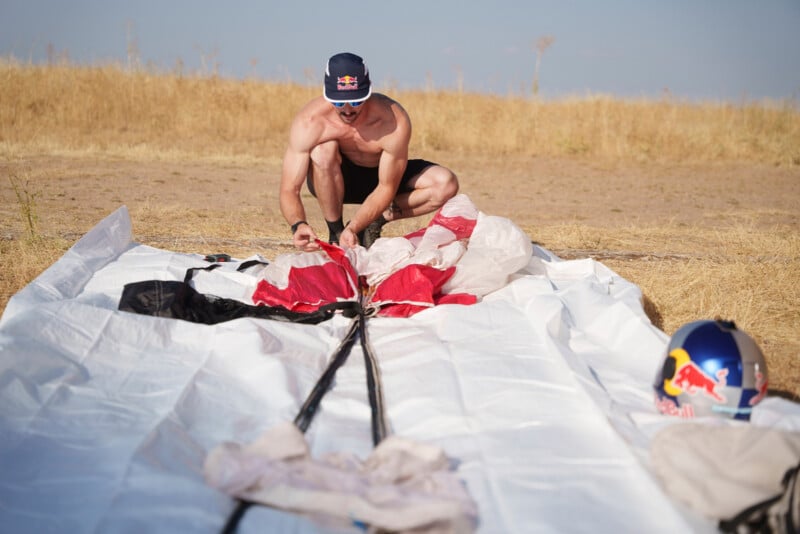
The Triggering System Had to Work From 1,400 Meters Away
Wetzel had already experimented with more elaborate remote-camera systems during earlier tests. In one setup, the hero camera could trigger a remote camera half a mile away, with multiple PocketWizard channels used to ensure the secondary camera and its flashes did not fire simultaneously with the hero system.
For Spain, he deliberately simplified the system.
The hero camera’s PocketWizard Plus Ve transmitter was set to channel two and triggered the receivers connected to the four hidden flashes. The goal was to remove as many additional failure points as possible while retaining the long-distance wireless connection.
That simplification was important because the team also needed a backup angle.
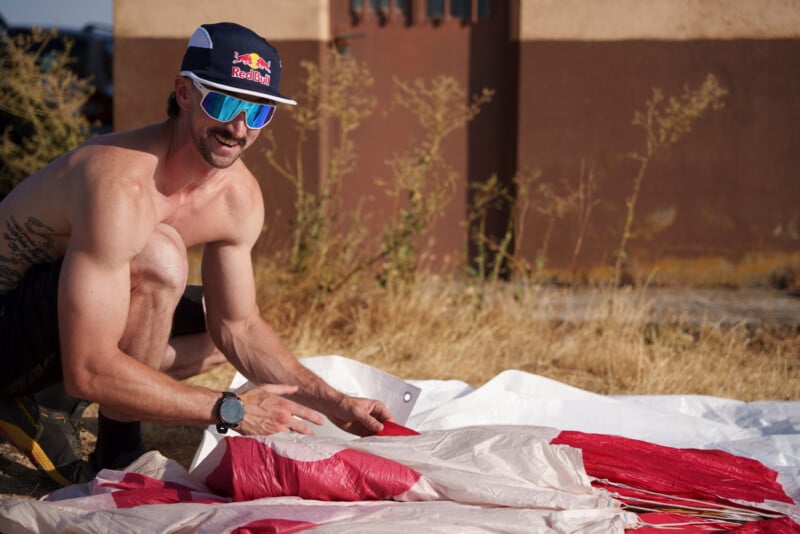
Photographer Dane Cronin was positioned near the Red Bull pylon with a Canon EOS R5, two Godox 600B flashes, and a separate setup designed to capture the flight if the hero angle failed. Cronin’s camera was set to ISO 1250, 1/25s, and f/3.2.
The secondary setup could use rear-curtain synchronization, which was not practical for Wetzel’s long-distance flash system.
“The 1/25s shutter speed would allow us to shoot in rear curtain sync to more accurately capture their speed. I wasn’t able to do that on the long range shot due to technology limitations, however for the secondary angle the rear curtain sync flash would allow the camera to open it’s shutter, absorb light for 1/25s and then fire the flash right before the closing of the shutter, to ensure the ambient ghosting of the athletes motion in the air was behind the athlete and not in front of it,” Wetzel says.
The backup was itself operating with an extremely limited number of opportunities.
“Dane also had only a couple frames to burst… so I figured between two and four frames, maybe we would at least get 1 shot per athlete per flight, hopefully four images for each flight,” Wetzel says.
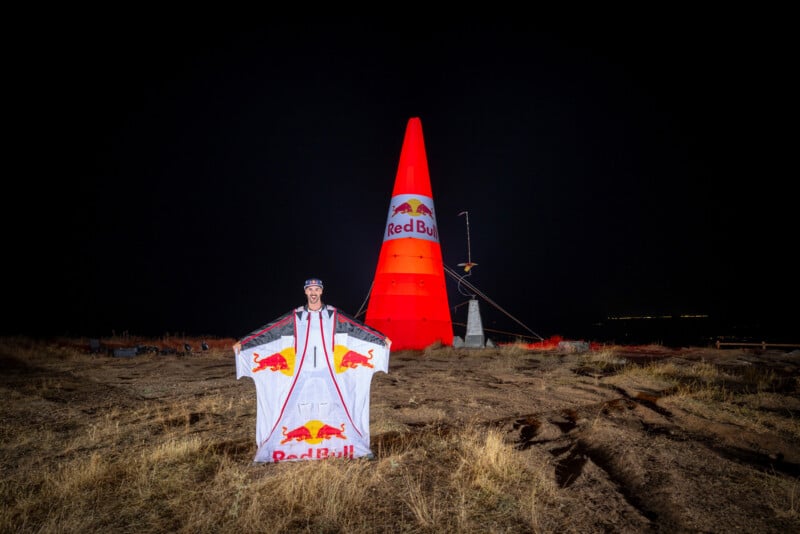
When the Calculations Met Reality
Months of calculations could only get Wetzel so far. As totality approached, he still had to physically align the camera with the landscape and the eclipse.
About 10 minutes before totality, he realized he needed to track the eclipse’s position by looking toward the Sun, something that became increasingly difficult as the eclipse progressed.
“About 10 minutes out of Totality, I realized that the only way I can track where the eclipse will be during totality, is to look at the Sun — it hurt — over and over and over. Trying to take a quick glimpse, even at 90 percent eclipsed, but not enough of a glimpse to accurately get a good visual of where it’s tracking, it was stressful. Within the final few minutes I was moving around so much, and literally leading up into the final moments before entering totality, I couldn’t focus my lens because of the solar filter,” Wetzel says.
He had preset the focus on the ridgeline using the focus preset controls available on the Canon RF 600mm, but moving several hundred feet from the originally calculated position made him question whether the preset was still accurate.
“I had focus preset on the ridgeline with the very crucial focal preset settings you can save on the Canon RF 600mm lenses, but I wasn’t confident I could trust it given I had moved a couple hundred feet since I first calculated it. Therefore, in a spur of the moment decision, I decided to pull off the solar filter and aim it at the right of the mountain where the eclipse wasn’t positioned. That gave me just enough time to lock focus in, swing back the lens and compose the shot directly as it went into totality with only a couple seconds to spare,” Wetzel says.
There was no leisurely final adjustment. Even as the flight was beginning, Wetzel was still locking the composition into place.
“I was literally adjusting the tripod locking mechanisms to lock in the composition vertically and horizontally as Dani exited,” Wetzel says.
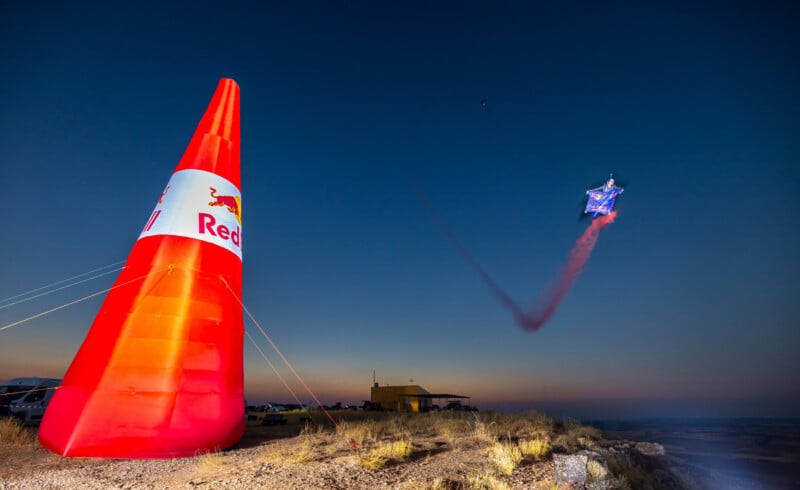
Finding Dani In the Darkness
When Dani Román began his flight, Wetzel had to find him in the sky from more than a mile away.
The athletes were equipped with small blinking bike lights and LEDs integrated into their wingsuits, but Wetzel could not see the LEDs on their wingsuits from his position. The bike light became his only practical reference.
“Immediately I stare up after hearing the call from Dante Wardlaw, ‘Dani has exited, Dani has exited.’ I’m staring at the night sky, looking for a speck from over a mile away and 2,000-plus feet in the sky. I couldn’t see anything, I couldn’t tell where he was in the air. Mike and Dani were only equipped with a small blinking bike light, and LED lights within their wingsuit. The LED Wingsuit lights I couldn’t see, and after glancing at the Sun over and over the moments leading into totality to track the eclipse, my vision was slightly impaired while attempting to notice a speck in the darkness. I stayed committed to locating him in the sky, and all of a sudden I could see his blinking light. I couldn’t see his body, but I could faintly see the smallest light, dropping 100 feet between glimpses of it blinking,” Wetzel says.
Dani’s flight gave the team its first real confirmation that the composition worked. Wetzel had positioned the eclipse just above the pylon, anticipating where it would move as the athlete entered the frame.
“To ensure Dani was going to fly through the ring of the eclipse, I positioned it just above the pylon to the right, knowing it would set into place… moving literally every second. Once Dani exited and dropped into flight, I knew it was going to be spot on, and he absolutely blasted right through the center of the ring of totality,” Wetzel says.
But the successful flight created another problem.
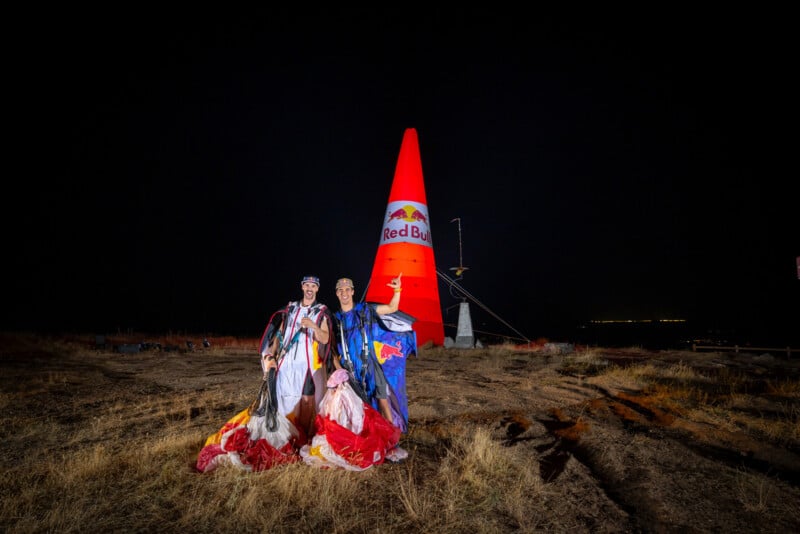
20 Seconds to Recompose for Mike
The eclipse was moving so quickly across the horizon that the composition had changed substantially between Dani’s flight and Brewer’s.
Wetzel had to move the camera and rebuild the frame almost immediately.
“What’s even more intense, is that the eclipse in 20 seconds moved so much on the horizon that I had to move in between Dani’s frame and Mike’s flight. It was so intense, I put everything on the line to make sure that Mike wasn’t going to fly over the top of the eclipse, or an eclipse that had partially set below the horizon. I quickly backed up, not hesitating a second after Dani flew through. Recomposed the frame just in time as Mike was dropping out of the sky like a heat seeking missile for the target… so absolutely intense it could bring me to tears,” Wetzel says.
The camera was now pointed at the target, but Wetzel still had to locate Brewer.
From his position, the athlete was little more than a faint moving light against the night sky. Brewer was traveling at approximately 200 feet per second from Wetzel’s perspective, leaving almost no margin for triggering the shutter too early or too late.
“His flight from our perspective, this faint light dropping on a line and gradually decreasing in flight angle. It was so intense, hoping all flashes would trigger and not misfire. I couldn’t get excited and trigger it too early as well. I had to wait for the right moment, literally only a few hundredths of seconds room for error with them passing through the frame at 200ft per second,” Wetzel says.
That was the moment nine months of preparation had been building toward.
Nine Months of Work for 84 Seconds
The photograph’s final appearance gives little indication of how much went into producing it. There is no visible flash equipment, no hint of the long-range triggering system, and no indication that Wetzel was working in almost complete darkness from 1,400 meters away.
Every major photographic decision had been made with the limited window of totality in mind. The 600mm lens provided enough room to accommodate positioning errors. The 1/8-power flashes provided the short duration needed to freeze the athletes. The 1/200-second shutter speed limited the amount of ambient movement captured in the darkness. The wireless system allowed the flashes to fire from across the landscape.
And then there were the human variables: finding an athlete who was barely visible, tracking a moving eclipse, repositioning the camera between flights, and knowing exactly when to press the shutter.
The team had invested approximately 600 hours and nine months in preparing for a window that would last just 84 seconds.
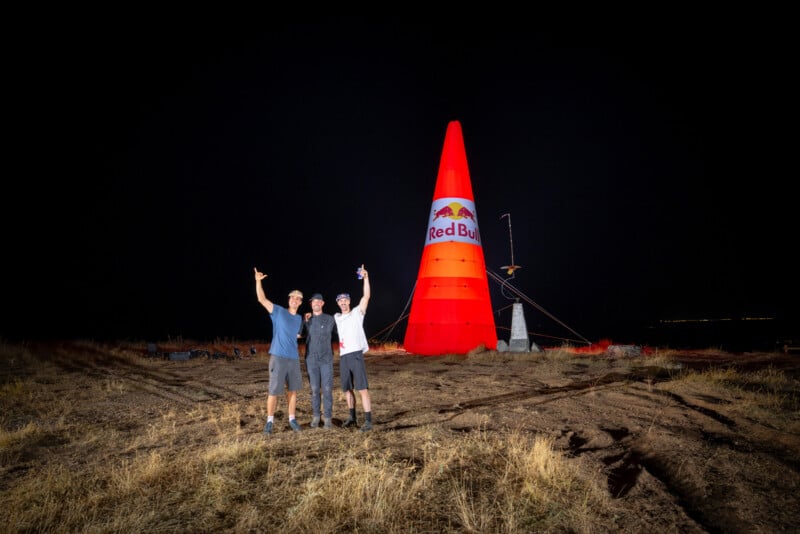
That is what makes the final photograph more than a striking eclipse image. It is the visible result of an enormous amount of invisible preparation, with the final frame depending on calculations, radio signals, flash duration, flight paths, focus, timing, and a subject moving through the sky at extraordinary speed.
For Wetzel, the intensity of the moment is inseparable from the image itself.
“To be honest I could cry at any point thinking about how intense that scenario was,” Wetzel says.
The photograph ultimately succeeded because the individual pieces of an extraordinarily complicated system came together at exactly the right moment. The eclipse was in position, Brewer was on the correct flight path, the focus held, the flashes fired, and Wetzel pressed the shutter within a window measured in hundredths of a second.
The result is an image that looks almost impossible precisely because, by Wetzel’s own description, it very nearly was.
Image credits Noah Wetzel, Red Bull Content Pool
Affiliate Disclosure PetaPixel articles may include affiliate links; we may earn a commission if you buy through one.