TechSpot means tech analysis and advice you can trust .
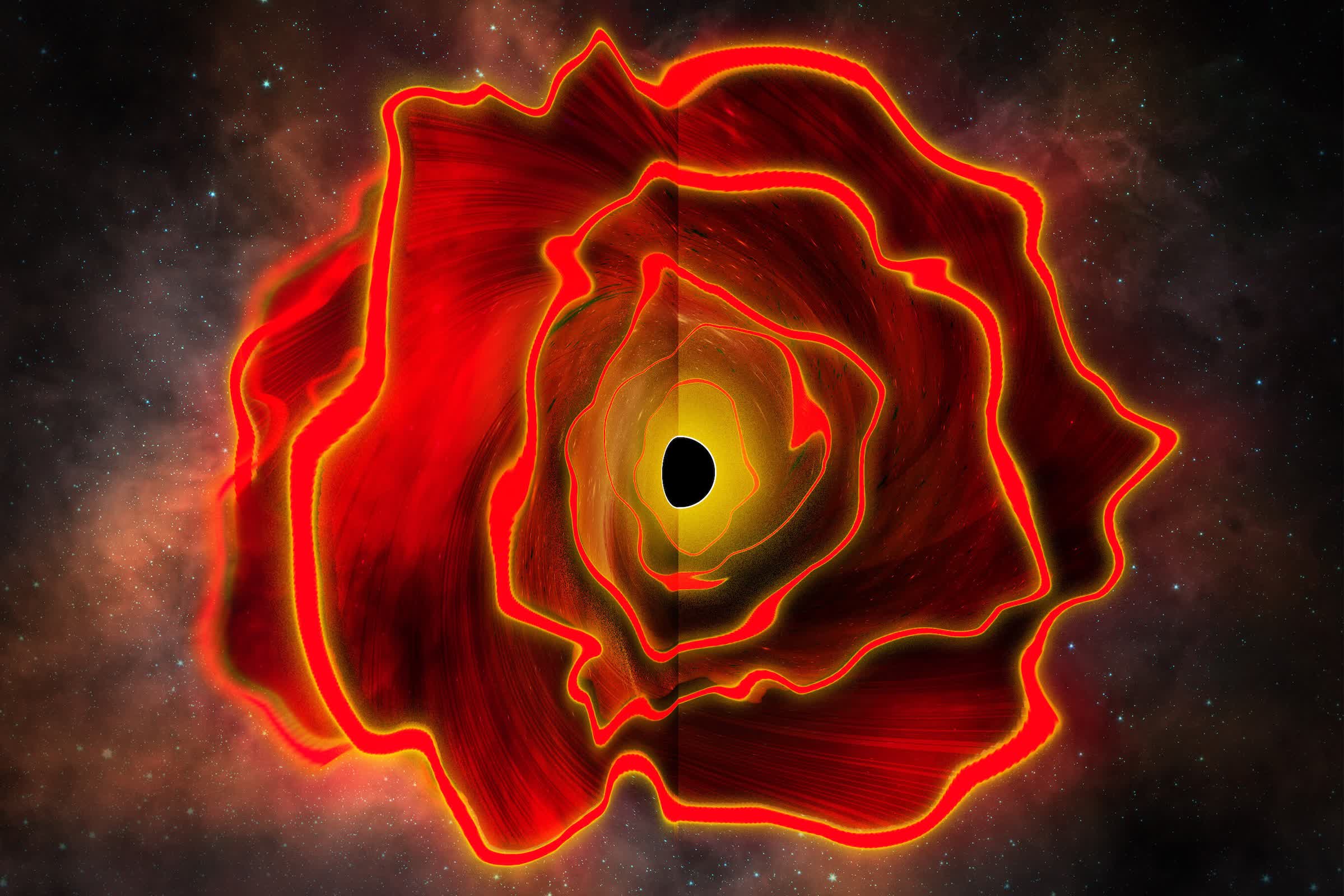
What we know so far: NASA's James Webb Space Telescope has identified a bright red object from the early universe that may be a black hole hidden inside an enormous shell of gas. The object is roughly the size of the solar system but produces more energy than any known star. Researchers say its unusual properties point to a black hole surrounded by an extended gas envelope – a proposed new type of object they call a "black hole star."
"Our picture of this object is evolving very rapidly," says lead author Rohan Naidu, a NASA Hubble Fellow and Pappalardo Fellow at MIT's Kavli Institute for Astrophysics and Space Research. "We think there is a central black hole that is 100,000 times as massive as the Sun. And around this black hole, there would be this very extended envelope of gas that looks like a star the size of the solar system. It's huge."
The finding, published in Nature , came from a survey called Mirage or Miracle, or MoM. The project uses the JWST to identify galaxies from just a few hundred million years after the Big Bang. The team was searching for distant galaxies when it detected the unusual red source.
At first glance, its red color could have suggested that dust was blocking and reddening its light. But its spectrum did not match that explanation. The researchers found a steep drop in the object's light at shorter wavelengths, a feature known as a Balmer break.
Balmer breaks are associated with dense gas absorbing photons in stellar atmospheres and can be observed in stars such as Vega. In this source, however, the break was much stronger than anything researchers have observed in ordinary stars.
Naidu said the object showed the strongest Balmer break the team has ever observed, making an ordinary star an unlikely explanation. The finding instead raised the possibility that researchers are seeing a vastly enlarged version of a stellar atmosphere, he added.

The light also showed little evidence of elements heavier than hydrogen and helium. That composition, combined with the source's unusual spectrum and extreme brightness, set it apart from typical stars and galaxies.
"It was truly singular in so many ways," Naidu says.
// Related Stories
The object may also help explain a broader mystery emerging from JWST data: the many small, red sources seen in the early universe. Often called "little red dots," these objects appear in deep-space images but seem to have largely vanished by the present day.
"These little red dots seem to be everywhere in the early universe but essentially disappear by the present day," Naidu says. "What exactly these objects are has been one of the most debated topics of the JWST era."
The MoM survey was created partly to examine whether some apparently bright early galaxies are not galaxies at all.
Naidu said astronomers have been trying to explain why so many apparently bright galaxies appear so early in the universe's history. The team's work suggests that at least some may not be galaxies at all, but objects that merely resemble them in telescope data.
MIT's Robert Simcoe and Wendy Sun are co-authors of the study, along with collaborators from other institutions.