
Last year, Kimiyasu Morikawa published the first comprehensive film usage survey conducted in Japan , giving insight into usage habits, brands, and more. It is the only publicly available recurring survey of film photographers in Japan and is now in its second year.
The study, which can be seen in full here , is based on a survey from November to December 2025 and includes 1,337 valid responses, nearly twice the size of the survey from 2024. The data in this year’s survey features identical methodology, which allows for year-over-year comparison. The survey is run by FilmFocus and is sponsored by Naniwa Group, a major Japanese photography equipment chain.
Looking over the data, there are four key takeaways from this year’s survey. Firstly, and perhaps most importantly, Kodak has overtaken Fujifilm as the primary film brand of choice in Japan. Kodak was used by 71% of respondents in the past 12 months versus Fujifilm’s 68%, reversing the data seen in 2024.
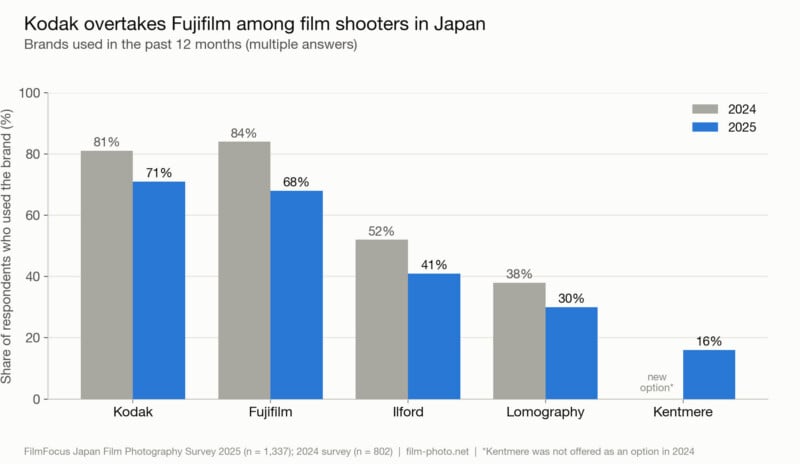
Morikawa notes that the flip follows domestic price increases for Fujifilm film that year , which translated to a roughly 20 percent increase in color negative stock prices and 30 to 50 percent increases on reversal film prices. Kodak leads in four out of five experience cohorts, and the reversal holds when standardized to the 2024 respondent mix.
The second data point worth looking at is how photographers are responding to increased prices. “Cost” is the top reason for shooting less (62 percent) for the second year straight year.
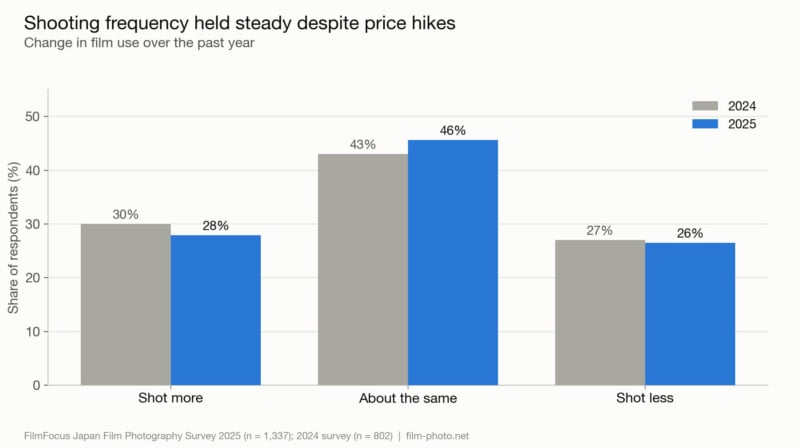
Brands used per photographer fell from 3.0 to 2.2 in one year, and usage dropped across every major brand (Ilford 52 percent to 41 percent and Lomography 38 percent to 30 percent, for example), yet annual volume is flat: about 13.9 rolls of 35mm per photographer (2024’s data showed 13.7 rolls) and 7.0 rolls of 120.
It appears that film photographers are responding to the price increases not by quitting film, but by narrowing their focus. Demand shifted to cheaper options: 61 percent shot black-and-white, and budget brand Kentmere positioned itself quite highly in the mix at 16 percent, ahead of CineStill at 12 percent.
Of note, the third data point of interest is how more veteran photographers are responding. The share of photographers who say they shot less climbs steadily with experience: six percent of first-year shooters say they cut back, but that jumps to 26 percent for those with between three and five years of experience. It jumps up again to 40 percent among those who have been photographing for 10 or more years.
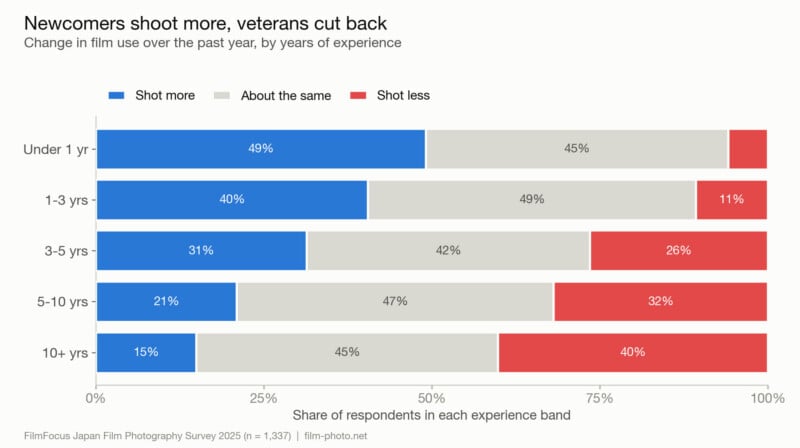
The top reason for shooting more, which is the same top reason in the last survey, is buying a new camera, with repeated spontaneous mentions of the Pentax 17 still driving usage now, even a year after launch.
Finally, the last note is that a vast majority of film photographers do not develop their own film. 67 percent of respondents only ever use film labs, while 25 percent combine using labs with some home developing. A paltry eight percent strictly develop their own film.
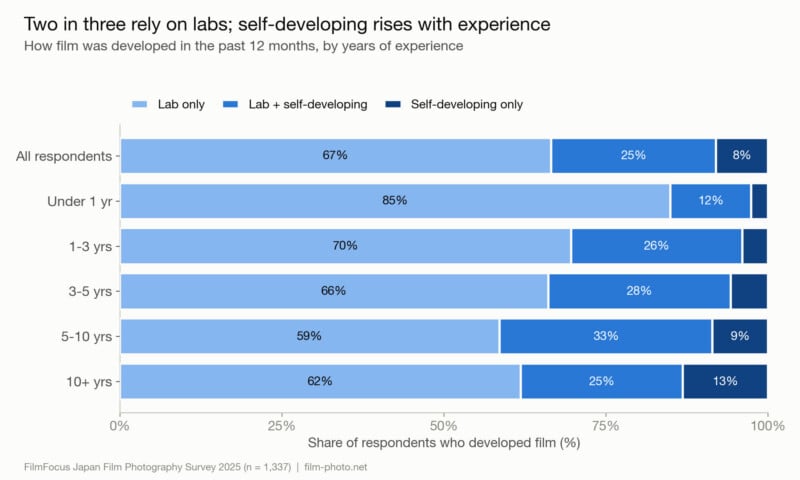
When choosing a lab, quality (41 percent) beats price (24 percent) and location (20 percent) as the most important factor.
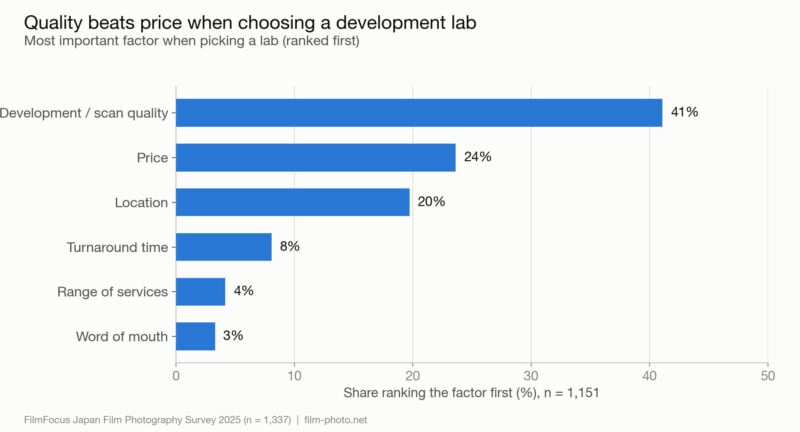
Morikawa’s takeaway is that even in the face of steeply increasing prices, Japanese film photographers are adapting rather than quitting by “consolidating on staple films, picking up cheaper stocks, and — in some cases — developing at home. New cameras and new film releases keep stimulating demand, and lab quality is emerging as the core of the after-shoot film experience.”
The full survey is available in Japanese only and can be viewed at FilmFocus .
PetaPixel ‘s Take
Anecdotally speaking, these data points (outside of Fujifilm’s popularity falling versus Kodak, which has been the case for many years outside of Japan given the relative lack of access to Fujifilm film) likely track with film photographers in North America. Film photography is still extremely popular, and Kodak’s recent sales data is in line with that. Film photographers continue to like film, and if that means shooting fewer rolls per year, they will likely tend to do that rather than quit outright.
About the Researcher: Kimiyasu Morikawa (Kimi) is a New York-based technologist. He leads the technical team building digital-archive and search systems at the New York Public Library, and volunteers at a local film lab. He runs FilmFocus, a Japanese film-photography information site.
Affiliate Disclosure PetaPixel articles may include affiliate links; we may earn a commission if you buy through one.