In what is a seminal step for China's fast-evolving space industry, LandSpace has just managed to successfully recover the booster of its Zhuque-3 (ZQ-3) rocket, becoming a viable counterpart to the state-backed CALT and its CZ-10B rocket.
China's space-related ambitions are growing by leaps and bounds. We reported recently that the Asian giant has now reserved over 200,000 orbital slots with the International Telecommunication Union (ITU), with some estimates pegging the total number at 244,000.
Well, now China is apparently becoming serious about filling its largely vacant orbital slots. And, as a case in point, consider the fact that LandSpace, a private Chinese company, has just managed to recover the booster of its Zhuque-3 (ZQ-3) reusable rocket, becoming only the second Chinese entity to achieve this feat following the state-backed China Academy of Launch Vehicle Technology (CALT) and its CZ-10B rocket.
For the benefit of those who might not be aware, LandSpace's ZQ-3 is a medium-lift, two-stage methalox (liquid methane and liquid oxygen) launch vehicle that sports a stainless steel hull, and where the first stage of the flight is powered by nine TQ-12A/B engines, while the second stage is powered by a single TQ-15A/B vacuum engine. The rocket has a payload capacity of 12,500 kg where the booster returns to the launch site and lands on its extendable legs, but increases to 21,300 kg under a fully dispensable flight mode. The booster can be reused up to 20 times.
Of course, the ZQ-3's maiden flight in December 2025 had resulted in a crash, which makes today's successful launch and recovery all the more significant.
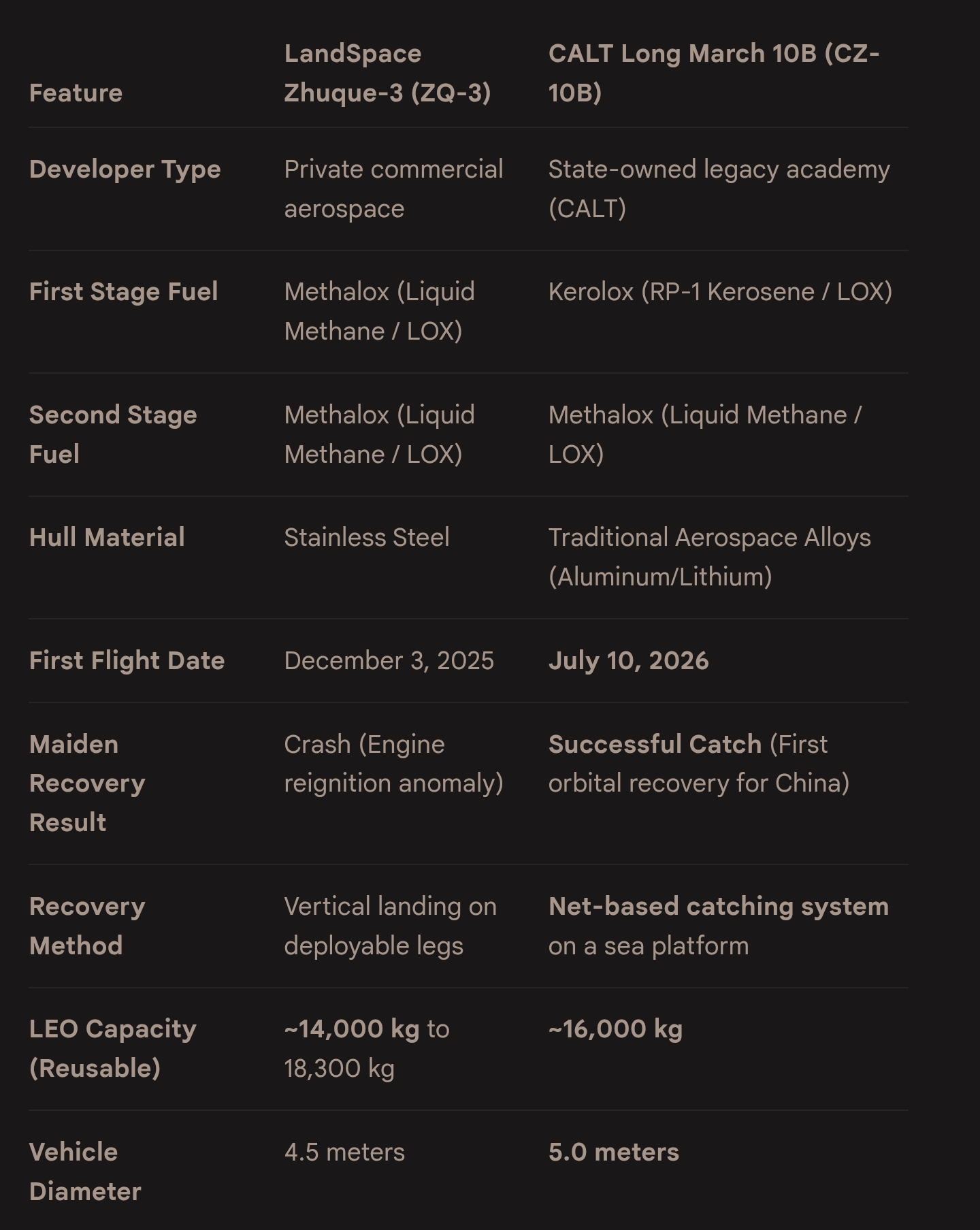
The table above gives a broad overview of China's two reusable launch vehicles. Do note that both ZQ-3 and CZ-10B rockets have roughly comparable payload capacities to SpaceX's Falcon 9 rockets at 18.3 metric tons, but fall way short of Starship's 100-150 tons of usable payload capacity .
Follow Wccftech on Google to get more of our news coverage in your feeds.