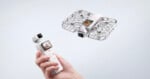
When HoverAir announced the world’s first flying pocket camera, the Versa, late last month, it did so with relatively few details. Now the unique new camera has fully launched on Indiegogo , bringing with it a wealth of new information. With 59 days left in the campaign, HoverAir has already raised over $230,000 at the time of writing.
The Versa’s primary selling point is that it looks and behaves like a relatively straightforward content creator gimbal camera, like a DJI Osmo or Insta360 Luna. It has a gimbal camera on top, a small display, and a few on-device controls.
However, what sets the Versa apart is that users can attach wings directly to its sides; inside these wings are four propellers that turn the Versa into a self-flying drone that tracks the user.
HoverAir is no stranger to self-flying drones , as that is what the company is best known for. It even has a water-friendly model, the Aqua , the world’s first waterborne self-flying drone.
The HoverAir Versa is the company’s first foray into a content creator-style pocket camera, though it admittedly serves a very similar target audience to the company’s other products. Like HoverAir’s other cameras, the Versa is built around simplicity and ease of use.
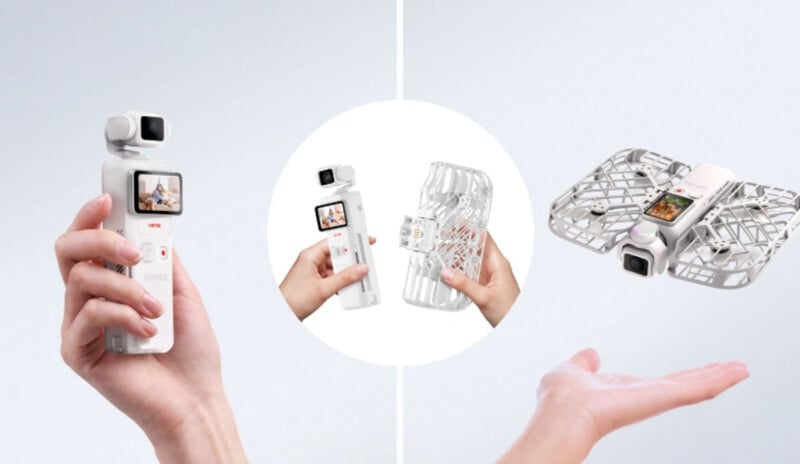
“Change from handheld mode to flying in seconds,” HoverAir promises. “Slide down the sliding cover, attach Versa to the Flight Kit, unfold the wings, and take off.”
The Versa’s “cinema-quality” 3-axis gimbal camera features a Type 1/1.3 image sensor and promises “17.5 stops of dynamic range.” It’s quite a lofty promise.
It utilizes AI to improve image quality, particularly in low-light situations, promising cleaner video. It remains to be seen whether this AI noise reduction delivers natural-looking results or ends up overly smooth, a common issue on cameras with relatively small image sensors like this.
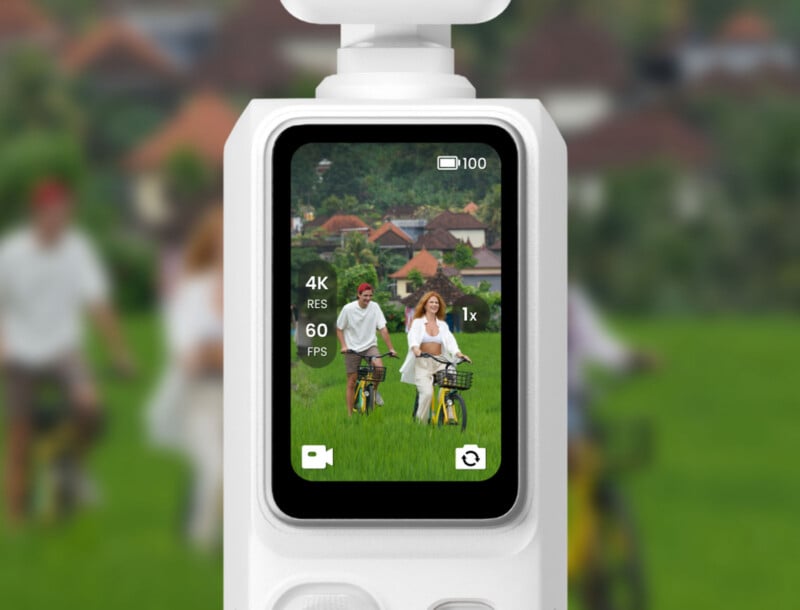
The camera can record full Open Gate video with its 4:3 image sensor, making it easier for users to crop videos for a wide variety of social media applications, including 16:9 for YouTube or 9:16 for Instagram.
When used handheld, the built-in lens has a 19mm equivalent focal length. When in aircraft mode, it is slightly wider, equivalent to a 16mm lens on a full-frame camera. The lens has an f/2 aperture and can focus as close as 0.1 meters (3.9 inches).
HoverAir notes that the standard ISO range is 100-12,800, although with AI Night Enhancement enabled, the maximum ISO is 25,600.
The HoverAir Versa captures 12-megapixel still photos in JPEG only and 4Kp60 video. HDR and H-Log video recording modes are limited to 4Kp30. The camera’s Dolly Zoom mode is also limited to 4Kp30, but the Spin (“Inception”) Mode shot is available at 4Kp60.
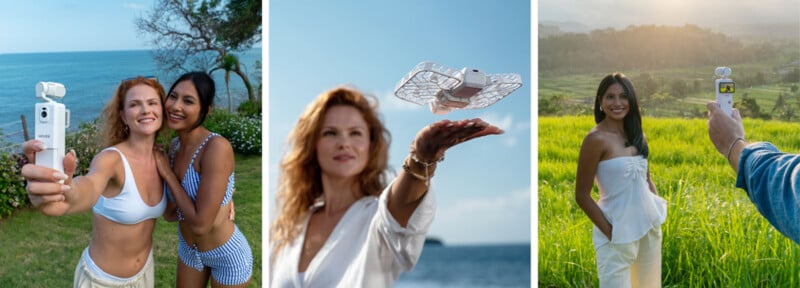
Versa uses AI to frame and track subjects automatically. It can also orbit a scene and rebuild it using 3D Gaussian Splatting, creating a 3D model of a space that can be shared as an interactive 3D file.
As for its flying specs, the HoverAir Versa can fly up to 36 kilometers per hour (22 miles per hour) and can fly up to 15 meters (49.2 feet) above the ground. It’s not a traditional drone in any real sense, as it is designed to record people on the ground.
Pricing and Availability
The HoverAir Versa is available to back now on Indiegogo, starting at $449 for the Pocket-Only version and $629 for the FlyMore Combo with the Flight Kit, extra battery, charger, and protective accessories.
There’s also the Creator Combo for $799. This includes ND filters, a case, a suction cup mount, and a compact tripod.
Some of these prices are only available for the first 48 hours of the campaign, which ends at 12 PM EDT (9 AM PDT) on August 20.
HoverAir expects mass production to begin next month ahead of an October delivery.
Complete details are available on Indiegogo .
Image credits HoverAir
Affiliate Disclosure PetaPixel articles may include affiliate links; we may earn a commission if you buy through one.