
It’s unusual for one country to hold such immense power in a single industry as Japan does in photography. Save for companies like Leica and Hasselblad, nearly all the major camera and lens makers are Japanese. It is little surprise, then, that Japan’s Ministry of Economy, Trade, and Industry (METI) has a particular interest in the health of the digital camera market.
As spotted by Digicame-Info , the Japanese Ministry of Economy, Trade, and Industry recently published an article looking at the digital camera market and how production has changed in recent years. The Ministry’s primary takeaway is that the digital camera market is showing meaningful signs of recovery.
“Digital camera production has recently been picking up. For a long time, the industry had been struggling due to the rise of smartphones,” METI writes.
PetaPixel has previously written about the dramatic effect smartphones had on the digital camera industry , including a jarring chart that shows how when smartphone sales increased, digital camera sales dropped off a cliff. METI shared a similar chart.
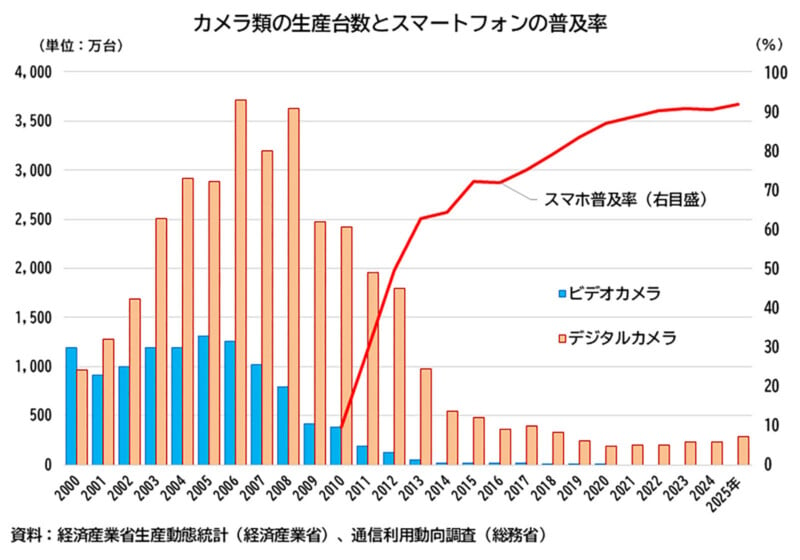
As the chart above shows, as smartphone penetration rate eclipsed 50 percent, digital camera sales plummeted.
“The advent of smartphones has affected many products, and digital cameras are said to be one of them. Looking at the domestic production figures for digital cameras and video cameras from 2000 (Ministry of Economy, Trade and Industry’s Production Dynamics Statistics), video camera production peaked in 2005 and then began to decline. Digital camera production also began to decline around 2008, when smartphones started to appear. This trend is in stark contrast to the penetration rate of smartphones,” METI explains.
However, while the drop following a very successful 2007-2009 period was a disaster for the camera industry, in recent years, the situation has not only stabilized, but improved. 2025 digital camera shipments among Japanese companies increased for the second year in a row, the first time shipments increased in back-to-back years in nearly 20 years.
METI says that while overall production of digital cameras has generally declined during the smartphone era, especially at first, there has been recent recovery, especially in the compact camera market and with mirrorless interchangeable lens cameras.
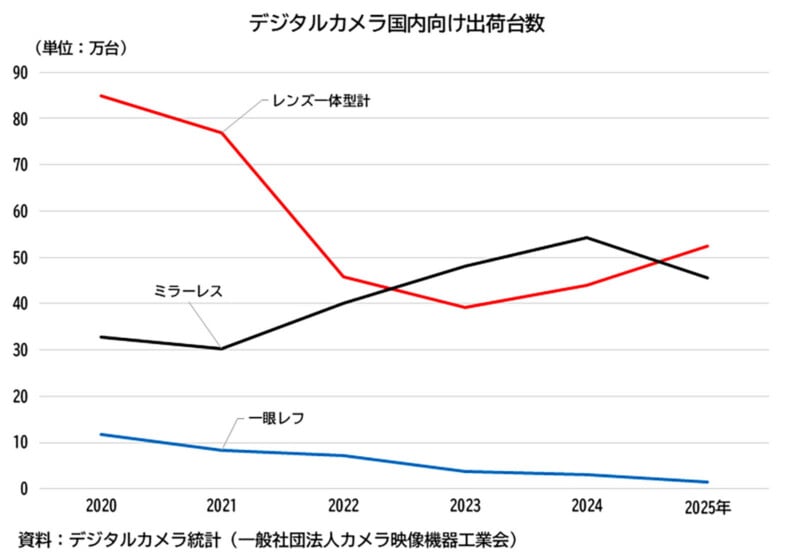
“This is likely due in part to the capture of demand from younger generations for use in social media and video sharing,” METI speculates.
This younger generation of users, especially smartphone users, is a compelling target audience for all camera makers. A common refrain among camera manufacturers is that they want to make their cameras appealing and easy to use for first-time buyers, especially those looking for improved photo and video quality compared to their smartphone.
There’s no question that the digital camera market will never reach the dizzying heights of its peak nearly 20 years ago, but there is ample reason to believe the photography industry is currently stable, with a reasonable chance of more growth. There are people who are becoming interested in photography and videography thanks to their smartphones these days, and some of them will want the versatility and improved performance of a dedicated camera.
Image credits Header photo created using an asset licensed via Depositphotos . Charts by METI.
Affiliate Disclosure PetaPixel articles may include affiliate links; we may earn a commission if you buy through one.