AMD is making big claims today on the rapid efficiency gains that its rack-scale AI offerings continue to scale in pursuit of its lofty 2030 goals, which aim to squeeze the performance footprint of as many as 570 of AMD's MI300X-based racks within just two of its 2030-launching ones.
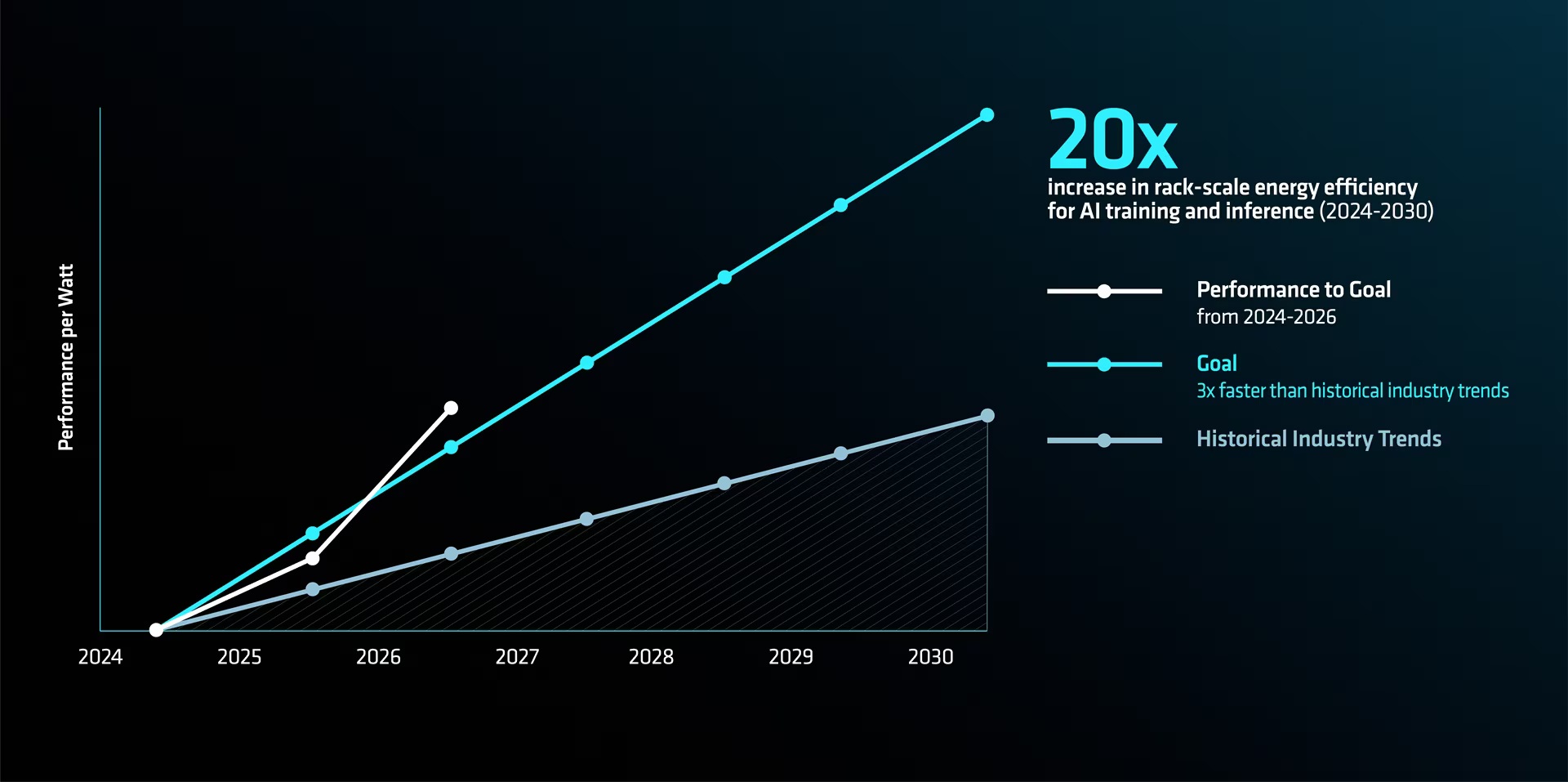
AMD has disclosed some very interesting statistics today, noting that it "has achieved an estimated 4x increase in AI energy efficiency as of mid-2026, ahead of its 3x projected target for this stage and more than double the historical trendline for the same point."
What's more, the company says that it "is building momentum toward its 2030 goal to deliver a 20x increase in rack-scale energy efficiency for AI training and inference."
AMD aims to achieve this feat by:
- Fitting billions more transistors onto next-generation AI processors using advance processes.
- Placing high-bandwidth memory (HBM) physically closer to the processing cores.
- Creating incredibly fast internal networks (like UALink) that allow chips inside the rack to share workloads instantly.
- Optimizing software so the chips do not waste electricity computing useless background tasks.
Even so, in what is perhaps the most interesting statement in the entire press release, AMD now claims that "approximately two 2030 AMD racks are expected to deliver the same compute as 570 racks in 2024, enabling a reduction in use-phase electricity by 20x and carbon intensity by 28x."
Let's parse this statement. The MI300X AI accelerators entered volume production in 2024. And so, we can presume that AMD has used its racks based on those GPUs as the reference point.
If just two of its 2030-launching AI racks will offer the same performance as 570 of its MI300-based racks, then effective rack count for the same workload decreases by 285x (570/2). However, AMD is claiming that energy consumption will fall by only 20x.
This suggests that each 2030-launching AI rack will consume 14.25x (285/20) the power load of each MI300X-based AI rack, which require anywhere between 40 and 125 KW of power. Now, to put all of this information together, this means that each of AMD's 2030-launching AI racks will consume between 570 KW and 1,781.25 KW of power.
Of course, AMD has already taken a significant step towards the densification of its rack-scale solutions with the just-launched Helios rack , which is the company's first full-stack offering for AI workloads, and features:
- AMD Instinct MI455X GPUs
- 6th Gen AMD EPYC CPUs
- AMD Pensando AI Network Interface Cards (NICs)
- AMD Pensando DPU
- AMD Infinity Fabric
- AMD ROCm Software Stack
Follow Wccftech on Google to get more of our news coverage in your feeds.