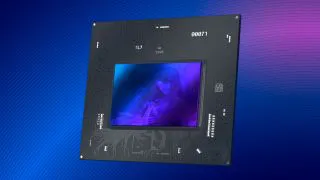
Raja Koduri, Intel's Senior Vice President and General Manager of the Accelerated Computing Systems and Graphics (AXG) Group, recently shed some light on its decision to contract TSMC to manufacture its ARC GPUs on its 6nm process. The main reason, apparently, has to do with manufacturing capacity. More specifically, Intel doesn't have enough manufacturing capacity for GPUs without cutting into the production of one of its other types of chips.
The semiconductor manufacturing market has been hit repeatedly over the last 18 months with supply issues, stemming mostly from the complexity of its long supply chain. However, Intel seems to have escaped relatively unscathed , mostly owing to its vertical strategy. Intel designs and manufactures its CPUs fully in-house, giving it more flexibility than so-called "fabless" manufacturers (such as AMD) to prioritize its manufacturing lines and adapt to shifting market conditions.
This also means that Intel is perfectly aware of how much manufacturing capacity it has available, and how much it can devote to manufacturing new products. And GPUs are entirely different beasts from CPUs.
For example, the CPU cores for AMD's Ryzen 7 5800X CPU (8-cores, 16-threads) feature a roughly 80.7 mm² surface area on TSMC's 7 nm process for a total of 4.15 billion transistors. AMD's top GPU offering, the RX 6900XT, manufactured on the same process, absolutely dwarfs that at more than six times the die size (520 mm²) and 26.8 billion transistors. In other words, GPUs are in another league, in general, when it comes to silicon manufacturing simply because they are larger, resulting in fewer chips per wafer.
"It was necessary to first determine the manufacturing capacity of the process that can be assumed at the start of design, and (Intel's) advanced process did not have sufficient capacity yet," said Raja. "Other characteristics, such as how much operating frequency can be used, are also important factors, and cost is also an issue. These three, that is, the cost-performance-capacity, is taken into consideration when deciding which process to use. "
Intel concluded that the first product, Alchemist, happened to find the best balance on TSMC's N6 node. And of course, it can't be understated that due to Intel's series of process delays, competing with AMD or NVIDIA not only with a new product but with a GPU manufactured in a not-leading-edge node would certainly bite into the performance potential for ARC.
Of course, opting for TSMC also means there's less capacity for its rivals to produce GPUs and CPUs on the best manufacturing nodes available, as well. So moving GPU production to TSMC means Intel will be able to produce more devices in a silicon-hungry market while simultaneously assuring its competition can't make as many chips as they could sell. That's one way to beat the competition.