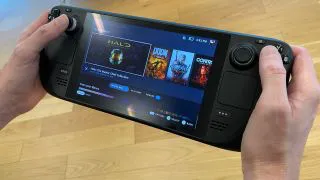
Valve's upcoming Steam Deck gaming console is set to start shipping in December of this year, and interest is high for the handheld gaming console. Steam Deck buyers have a lot of upfront questions, though, so Valve has posted a frequently asked questions (FAQs) page to share some more details about the new system.
As a reminder, the Steam Deck gaming console is Valve's attempt to enter the handheld gaming market, and it wields a custom AMD APU. Featuring four cores and eight threads of Zen 2 core IP, the chip runs at 2.4–3.5 GHz clock speeds. It also features an RDNA 2 graphics engine with eight compute units running at 1.0–1.6 GHz. The APU is rated for a thermal power budget of anywhere from 4W to 15W, and it connects to 16GB of LPDDR5 RAM running at 5500 MT/s. For external storage, there's a high-speed microSD card slot. This is all tied together by a custom Arch Linux-based operating system with Valve's Steam UI on top of it.
Valve's new FAQ has quite a bit of new information. For starters, all Steam Deck models have a glass, optically bonded IPS LCD screen, except the 512GB model, which has a screen with an additional anti-glare etching applied. The console also has dual LRA motors, with one placed under each trackpad for haptic feedback purposes.
When it comes to storage expansion, the system formats the MicroSD card with the ext4 file system, but it can also read data from exFAT formatted cards. It can also boot off a MicroSD card and supports multi-boot (you can choose which OS to run at boot time).
In addition, Steam Deck's software ecosystem functions very similarly to a traditional PC and Steam; however, the console has a custom picture mode instead of the classical Big Picture mode you see with Steam desktop client software. You can exit this mode and get access to the regular Linux desktop environment. You can also use the Steam Deck as a controller for a PC via Remote Play.
The console will use Proton to support other non-Steam games. The console doesn't officially support VR configurations, but you can use it for VR even though the system isn't optimized for that purpose. The system also doesn't support external GPUs.
Finally, the included USB-C cable is 4.9 feet long. Valve says you get the full performance while on battery — using the Steam Deck in a docked configuration doesn't improve performance.
We expect Valve to share more details as the systems move closer to market in December.