After initial rumors said that the AMD’s upcoming line of Zen 2-based APUs , codenamed Renoir, would arrive with integrated Vega 10 graphics , the latest rumor points to the chips featuring Vega 12 and potentially Vega 13 and Vega 15 integrated GPUs.
AMD Zen 2 APUs With More Powerful Integrated Graphics
The rumor comes from well-known hardware leaker Komachi_Ensaka on Twitter , who reportedly observed multiple Renoir listings with B12 included in their names, which could point which to 12 Compute Unit (CU) GPUs.
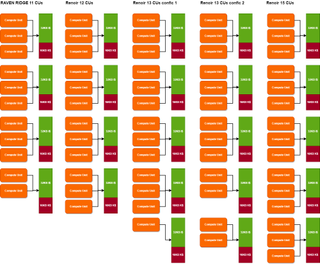
Hardware enthusiast Locuza also noted that due to AMD’s use of the 7nm process for the next-generation APUs, it may also be possible to integrate Vega 13 or even Vega 15 GPUs in there, as the newer processors allow for denser designs.
A potential Vega 13 APU could have a 3+3+3++3+1 CU configuration, with each CU getting 32 KB L1 instruction cache (L$) and 16 KB constant cache (K$). A 3+3+3+2+2 configuration may be even more probable. If those configurations exist, it could also be possible for a 3+3+3+3+3 configuration to exist in a Vega 15 integrated GPU.
Still No Navi?
The long-awaited Navi GPU microarchitecture based on the RDNA instruction finally arrived this year for desktop PCs . However, even though the new Renoir APUs are not expected to ship until the first half of 2020, it looks like they will continue to use AMD’s Vega GPU microarchitecture based on the older GCN instruction set.
AMD APUs have tended to ship with older technology in general. In fact, Zen 2 CPUs will be about a generation old by the time the Renoir APUs start shipping.
However, AMD's product naming scheme doesn't make this so apparent. The Renoir APUs are expected to officially debut with Ryzen 4000 branding, as opposed to the Ryzen 3000 naming the Zen 2-based desktop CPUs received this year. This year, AMD used the Ryzen 3000 naming scheme for its APUs based on Zen+ .
We probably won't see the Navi microarchitecture on AMD APUs until Zen 3-based APUs ship in 2021, using a naming scheme such as Ryzen 5000. However, what's most important is whether or not the APUs are able to compete with Nvidia and Intel on metrics like performance, efficiency and price. If so, then what's in a name anyway?
If you have to, call the APUs based on the actual Zen 2 (ie: first 7nm architecture) the 3x30G series or something.
Then when there are APUs based on the 4000 Ryzen, call them the 4x00G series, the ones based on the 5000 Ryzen the 5000G series, etc.
There's no good reason for this weird mismatch.
Maybe the top of the line APU will perform like an RX560 or 570 if lucky?
So i don't think it would be hard for AMD to make RX560 performance.