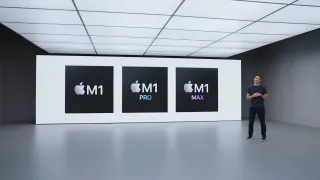
Apple today announced its next-generation SoC family designed specifically for its all-new MacBook Pro family, confirming the previous rumors . The M1, which launched late last year, is being joined by the M1 Pro and the M1 Max . Like the entry-level M1, the more powerful M1 Pro and M1 Max are built on an enhanced 5nm process node.
Starting things off is the M1 Pro. Apple claims that this new SoC doubles the width of the memory interface, delivering a total of 200 GBps of bandwidth (shared between the CPU and the GPU). This is a 3x uplift compared to M1. According to Apple, the M1 Pro is comprised of 33.7 billion transistors, which is 2x greater than what you’d find in the M1.

Apple is of course touting performance superiority over comparable Intel laptops (which we'll have to verify), saying that the M1 Pro is 1.7x faster than "the latest 8-core PC laptop chip" while consuming 70 percent less power. Confirming the earlier rumors, the M1 Pro uses up to a 10-core CPU (8 performance cores, 2 efficiency cores) along with a 16-core GPU. The GPU, which features 2,048 execution units, delivers doubles the performance over the M1. MacBook Pro systems with the M1 Pro can be configured with up to 32GB of RAM. Interestingly, the base 14-inch MacBook Pro comes with an M1 Pro equipped with 8 CPU cores and 14 GPU cores.
| M1 | M1 Pro | M1 Max | |
|---|---|---|---|
| Process Node | 5nm | 5nm | 5nm |
| Transistors | 16 billion | 33.7 billion | 57 billion |
| CPU Cores | 8 | 8 or 10 | 10 |
| GPU Cores | 7 or 8 | 14 or 16 | 24 or 32 |
| Memory Bandwidth | 68.25 GBps | 200 GBps | 400 GBps |
| Maximum Memory | 16GB | 32GB | 64GB |
But Apple isn’t stopping there; it also announced the flagship M1 Max SoC, which doubles total memory bandwidth over the M1 Pro to 400 GBps. The number of transistors onboard also swells to 57 billion transistors, while up to 64GB of RAM can be configured. That sharp increase in transistors can be partially attributed to the GPU, which jumps from 16 cores to a maximum of 32 cores (also doubling execution units to 4,096). The M1 Pro will reportedly deliver a 4x increase in graphics performance over the original M1. As for the CPU, it reportedly offers comparable performance to the Razer Blade 15 Advanced, while sipping 40 percent less power.
As for the new MacBooks , the 14-inch MacBook Pro sports a 3024 x 1964 resolution display, while its 16-inch counterpart ups that to 3456 x 2234. Both displays feature dynamic refresh rates of up to 120 Hz. As previously rumored, the Touch Bar is gone. However, users do gain MagSafe power, a full-size HDMI port, and an SD slot to go along with three Thunderbolt ports.
Pricing for the new MacBook Pros, which should compete effectively with the best ultrabooks and premium laptops , starts at $1,999, with preorders opening up today.