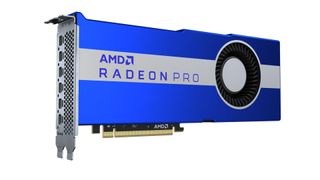
Earlier this morning, AMD revealed its new Radeon Pro VII graphics card, its latest workstation-class competitor to Nvidia’s Quadro line of GPUs. As its name suggests, this is a professional level update on last year’s Radeon VII GPU , incorporating the same Vega 20 GPU but almost doubling the base Radeon VII’s double precision performance.
| Radeon Pro VII | Radeon VII | Radeon Pro W5700 | Radeon Pro WX 9100 | |
| CUs | 60 | 60 | 36 | 64 |
| ROPs | 64 | 64 | 64 | 64 |
| Boost Clock | ~1700MHz | ~1750MHz | ~1930MHz | 1500MHz |
| Memory Clock | 2.0Gbps HBM2 | 2.0Gbps HBM2 | 14Gbps GDDR6 | 1.89Gbps HBM2 |
| Memory Bus Width | 4096-bit | 4096-bit | 256-bit | 2048-bit |
| Single Precision | 13.1 TFLOPs | 13.8 TFLOPs | 8.89 TFLOPs | 12.3 TFLOPs |
| Double Precision | 6.5 TFLOPs | 3.5 TFLOPs | 556 GFLOPs | 769 GFLOPs |
| VRAM | 16GB | 16GB | 8GB | 16GB |
| ECC | Yes | Yes | No | Yes(DRAM) |
| TDP | 250W | 300W | 205W | Less than 250W |
| GPU | Vega 20 | Vega 20 | Navi 10 | Vega 10 |
| Architecture | Vega (GCN 5) | Vega (GCN 5) | RDNA (1) | Vega (GCN5) |
| Infinity Fabric Link | Yes(2x) | No | No | No |
| Manufacturing Process | TSMC 7nm | TSMC 7nm | TSMC 7nm | GloFo 14nm |
| Release Date | 06/2020 | 02/2019 | 11/2019 | 10/2017 |
| Price | $1,899 | $699 | $799 | $2,199 |
When AMD announced the Radeon VII at its keynote last year, it was the world’s first 7nm gaming graphics card, using Vega 20 to compete with Nvidia’s RTX 2080. Now, AMD is applying Vega 20 to its workstation cards, producing a pro-level successor to the Radeon VII that takes almost the same specs and ups the double precision performance to 6.5 TFLOPs, offering support for mixed graphics/compute tasks that almost matches Nvidia’s much more expensive Quadro GV100 .
While this comes at the cost of a slightly lower boost clock and slightly lessened single precision performance, making it not quite as powerful of a gaming machine as its non pro predecessor, this will make it a boon to 3D modelers and financial analysts, who frequently run mixed graphics/compute software.
The AMD Infinity Fabric external link is also a new addition to the Radeon Pro VII, migrating over from the Radeon Instinct MI50/MI60. The purpose here is to make multi-GPU performance more efficient, enabling a total of 168GB/sex bandwidth between two connected GPUs.
All these features also make it Vega 10 Radeon Pro WX 9100, which runs on Vega 10, as well as the Radeon Pro W5700 , assuming memory clock speed isn’t a priority.
Of course, the key feature for the Radeon Pro VII compared to its Nvidia Quadro counterparts is price. Launching for $1,800, it’s primed to severely undercut Nvidia’s double precision king, the Quadro GV100, while also remaining competitive with the Quadro RTX 5000 and 6000. While its feature set is unique- the GV100 is only really a fair comparison when it comes to FP64 support- this makes it a strong buy for value, assuming it fits your needs.
The Radeon VII is set to launch later this June.