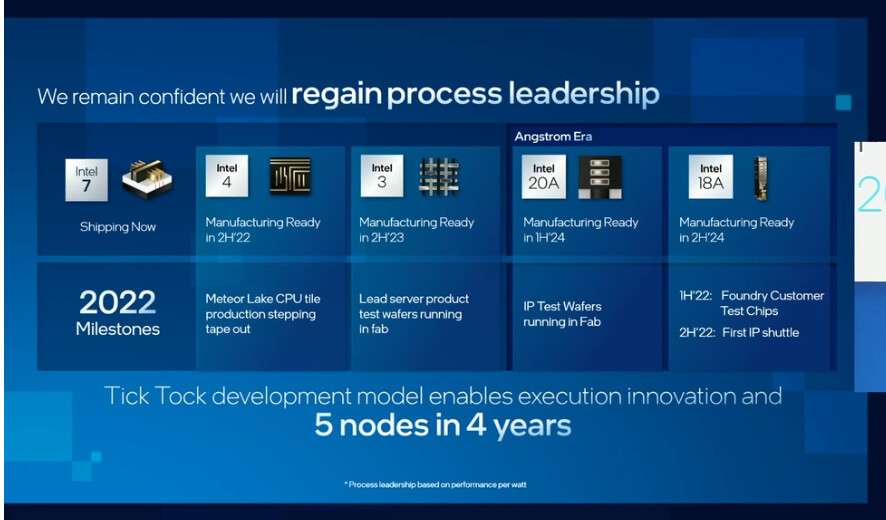
The "tick tock" product development cycle, which enabled Intel to develop a new silicon fabrication node every alternating year, a new microarchitecture every alternating year, and interleaving the two in such a way that each new microarchitecture is built on two successive nodes, and each node is used for building two succeeding microarchitectures, is back. The company has, for the first time in over 6 years, mentioned the tick-tock development cadence in its Investor Day presentation.
When laying out its upcoming foundry nodes following the current Intel 7 (10 nm enhanced SuperFin), the company mentioned its successors, starting with Intel 4 (7 nm EUV-based), which offers electrical properties and transistor densities in the league of 5 nm-class nodes by TSMC. Intel 4 debuts with "Meteor Lake" mobile architecture slated for the first half of 2023, with mass-production of wafers commencing in 2H-2022. The Intel 3 node is targeted for a year later in late-2023, with the server processor that succeeds "Sapphire Rapids" being developed for this node. Following this, Intel, along with several other foundry companies, enter the tricky sub-2 nm class.