NVIDIA introduces its slowest graphics card in 2022
GeForce GTX 1630 set to occupy the lowest tier in NVIDIA lineup.
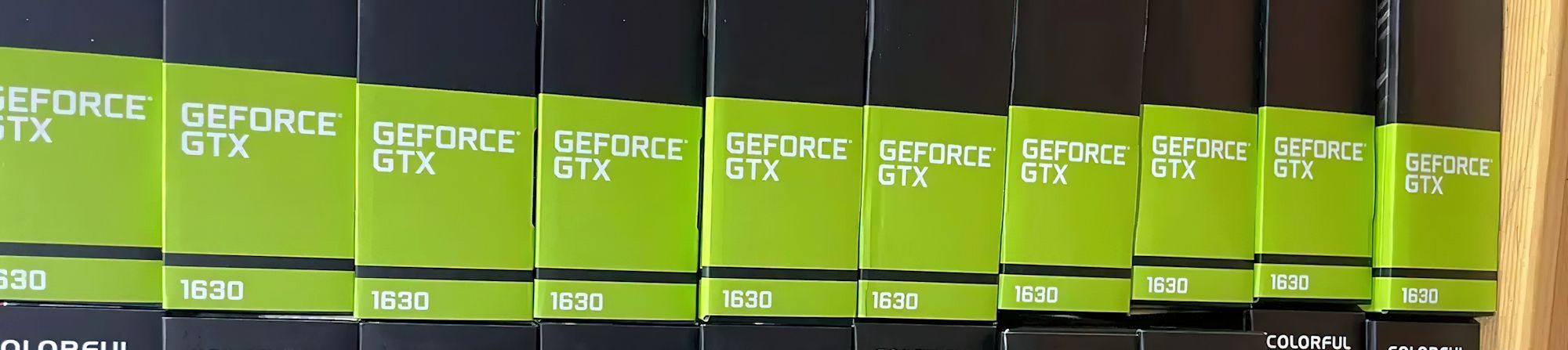
NVIDIA GeForce GTX 1630 graphics cards, Source: HXL
The GTX 1630 has officially launched. This card features a Turing TU117-150 graphics processor with 512 CUDA cores, even fewer than GTX 1650. It is otherwise a very similar graphics card based on the same architecture, similar TDP and even using the same PCB and cooling designs.
NVIDIA has reduced the memory bus on this model to a 64-bit bus. This means that the maximum theoretical bandwidth has been halved from 192GB/s to 96 GB/s. That’s even lower bandwidth than GTX 1050 Ti based on Pascal GP107 GPU released in 2016.
Bandwidth for low-end GPUs has a huge impact on performance, especially at higher resolutions. Therefore, it may be an overstatement to consider this card for gaming in 2022, yet NVIDIA thinks this is a good idea. Based on our information the GTX 1630 is also expected to be slower than GTX 1050 Ti GPU.
As expected this model will retail at 1000-1100 RMB in China, which equals to around 150 USD with VAT. We will update pricing information should NVIDIA announce official MSRP for other regions.
| NVIDIA GeForce GTX 16 Series | |||
|---|---|---|---|
| VideoCardz.com | GeForce GTX 1630 | GeForce GTX 1650 (G6) | GeForce GTX 1050 Ti |
| Picture |  |  |  |
| Launch Date | June 28, 2022 | April 3, 2020 | October 25, 2016 |
| GPU | 12nm Turing TU117-150 | 12nm Turing TU117-300 | 14nm Pascal GP107-400 |
| CUDA Cores | 512 | 896 | 768 |
| Boost Clock | 1785 MHz | 1590 MHz | 1392 MHz |
| Memory Clock | 12 Gbps | 12 Gbps | 7 Gbps |
| Memory | 4GB GDDR6 | 4GB GDDR6 | 4GB GDDR5 |
| Memory Bus | 64-bit | 128-bit | 128-bit |
| Bandwidth | 96 GB/s | 192 GB/s | 112 GB/s |
| TDP | 75W | 75W | 75W |