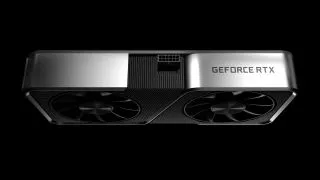
Another day and another morsel from @Kopite7kimi . This time the serial leaker provides an update on estimated core clocks for Nvidia's upcoming RTX 4070 mid-range GPU, a GPU which could one day feature in our Best Graphics Cards for Gaming list. Core frequencies are now estimated to be well above anything Nvidia has ever done before, with a base clock of 2310 MHz, a rated boost clock of 2610 MHz, and a maximum boost clock of 2800 MHz via GPU Boost 4.0 -- if there's enough power and temperature headroom to spare. As this is a leak, take news with a pinch of salt until we have official confirmation.
base 2310boost 2610max >2800TGP 285W August 10, 2022
These core clocks are significantly faster than anything we've seen from Nvidia before, and is very reminiscent of the frequency jump we saw with the Pascal-based GTX 1000 series in comparison to the 900 series Maxwell architecture -- which saw a 500 MHz core clock improvement across the board.
As a result, the RTX 4070's newly estimated clock speeds put it well ahead of its predecessor the RTX 3070, with 50% higher boost frequencies. Combine this with the new L2 cache and SM improvements rumored to be on the Ada architecture, and we could be looking at an 80% to 100% performance improvement over the RTX 3070 in some workloads theoretically.
| GPU Model Number | PG141-SKU331 |
| CUDA Core Count | 7680 FP32 |
| Base Clock | 2310MHz |
| Boost Clock | 2610MHz |
| Maximum GPU Boost 4.0 Clock | 2800MHz |
| Memory Configuration | 12G 21Gbps GDDR6X |
| Target Board Power (TGP) | 285W |
| 3DMark TimeSpy Extreme Score | 11,000 Points |
These frequencies will also outperform AMD's current RX 6000 series RDNA2 GPUs, which already feature stellar clock frequencies of around 2.2 to 2.5GHz. In real-world applications, the clock speed alone could also improve the 40 series' performance retention at lower resolutions.
When Ampere launched a few years ago, there was an "issue" with Nvidia's high-end RTX 30 series products, where AMD's RDNA2 GPUs were outperforming Nvidia's Ampere counterparts at lower resolutions thanks to the higher clock speeds found on the AMD GPUs.
The overall GPU architecture itself can also change the GPU's "performance sensitivity" to clock speeds. It just happened that Ampere behaved this way due to the immense core count changes which occurred on that architecture. But, there is a chance the same behavior might occur on 40 series as well since core counts are nearly doubling again.
Kopite also re-confirmed the 4070's new estimated power target of 285W -- which we reported on yesterday. Thankfully, the GPU's estimated TimeSpyExtreme score of 11,000 points remains true despite the new power reduction, putting the 4070 in line with RTX 3080 performance.
