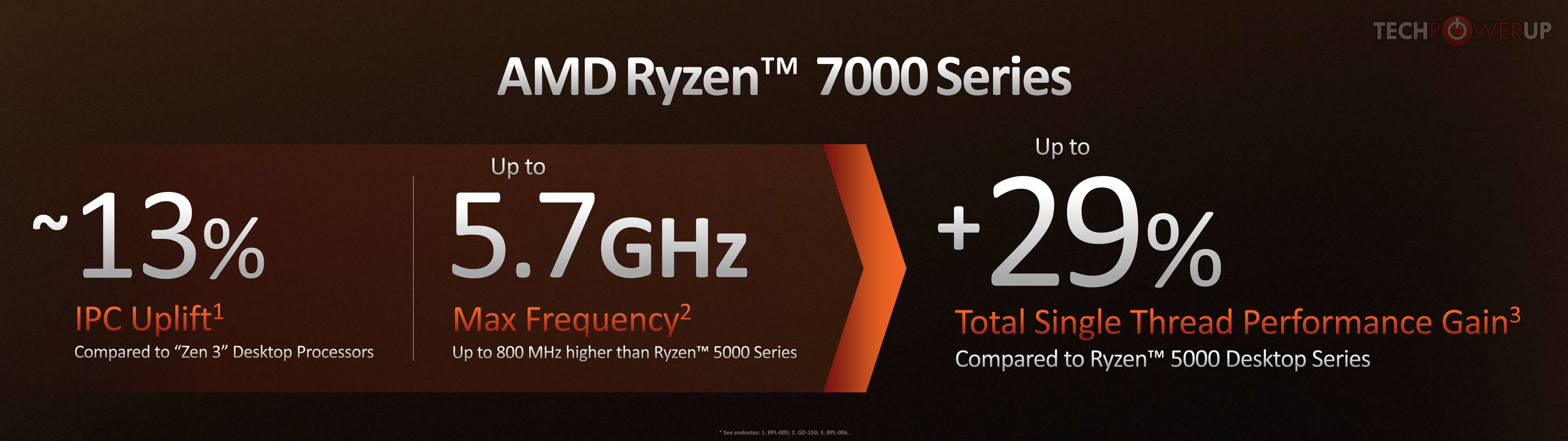
AMD today announced the Ryzen 7000 series "Zen 4" desktop processors. These debut the company's new "Zen 4" architecture to the market, increasing IPC, performance, with new-generation I/O such as DDR5 and PCI-Express Gen 5. AMD hasn't increased core-counts over the previous-generation, the Ryzen 5 series is still 6-core/12-thread, the Ryzen 7 8-core/16-thread, and Ryzen 9 either 12-core/24-thread, or 16-core/32-thread; but these are all P-cores. AMD is claiming a 13% IPC uplift generation over generation, which coupled with faster DDR5 memory, and CPU clock speeds of up to 5.70 GHz, give the Ryzen 7000-series processor an up to 29% single-core performance gain over the Ryzen 5000 "Zen 3."
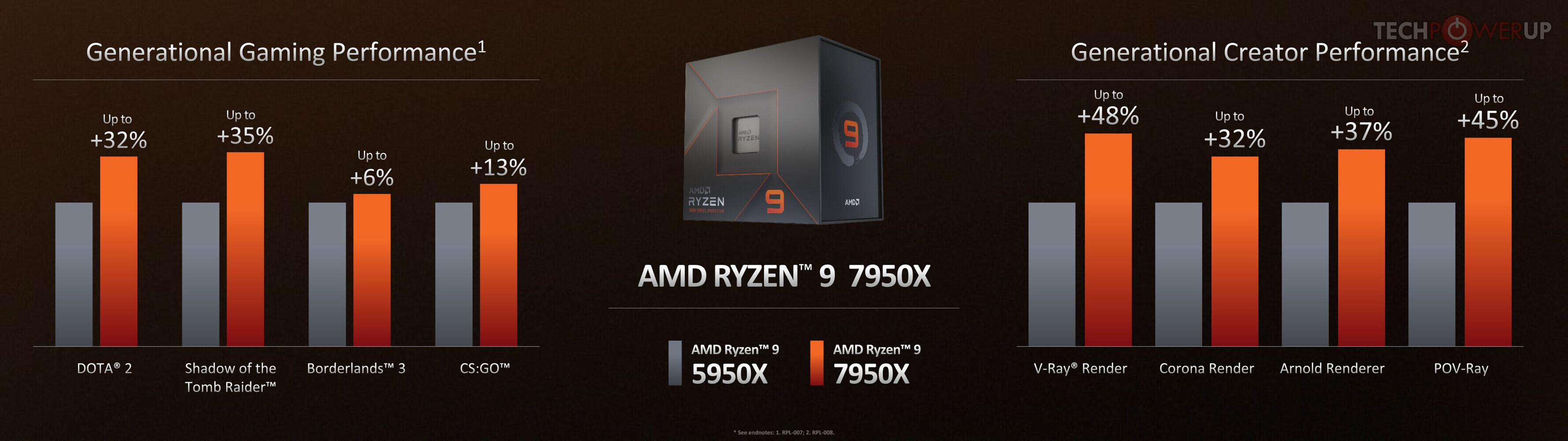
AMD claims an up to 35% increase in gaming performance over the previous-generation, and an up to 45% increase in creator performance (which is where it gets the confidence to stick to its core-counts from). The "Zen 4" CPU core dies (CCDs) are built on the TSMC 5 nm EUV (N5) node. Even the I/O die sees a transition to 6 nm (N6), from 12 nm. The switch to 5 nm gives "Zen 4" 62 percent lower performance for the same performance, or 49% more performance for the same power. versus the Ryzen 5000 series on 7 nm. The "Zen 4" core along with its dedicated L2 cache is 50% smaller, and 47% more energy efficient than the "Golden Cove" P-core of "Alder Lake."