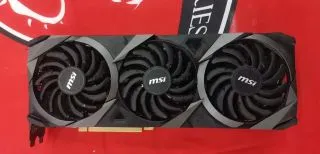
A Twitter user named @hongxing2020 recently shared photos of a mysterious MSI GeForce RTX 3080 Ventus 3X 20G OC, packing an impressive but unusual memory capacity of 20GB. The user claims that up to 100 units are available for between $432 to $576, insinuating that these could be leftover cards from mining operations. Core specifications are unknown, but the graphics card is likely the long-rumored 20GB variant of the vanilla RTX 3080 , modified to support Micron memory chips with double the capacity.
It wouldn't be the first time Nvidia has reportedly messed around doubling VRAM capacities on its high-end GPUs. Almost every generation of Nvidia graphics cards has featured some rumor or suspicion pointing to a 2x higher capacity variant well after the GPU's initial release.
In the past, Nvidia has sold different memory capacity variants of the same GPU model, with one variant featuring 2x the memory capacity over the other. Its strategy was prevalent during the Kepler generation and older models, where cards like the GTX 780 3GB and GTX 770 2GB had additional 6GB and 4GB models, respectively.
Making a new GPU with 2x the memory capacity isn't hard; it's one of the easiest ways to add additional VRAM capacity to a GPU. All Nvidia has to do is swap out memory ICs with ones featuring two times the capacity of the previous variant.
If Nvidia wanted to add varying levels of VRAM lower or higher than 2x, creating such a configuration gets much more complicated. It involves modifying the memory bus width and memory configuration. But, it is because memory manufacturers almost always choose to make memory ICs based on 512MB, 1GB, or 2GB memory configs with no capacities in between.
More often than not, you see memory configurations on some Nvidia GPUs, including the RTX 3090 and RTX 3090 Ti with a 24GB of VRAM, and the RTX 3060 with a very odd 12GB of memory - when the higher tier RTX 3060 Ti has 8GB. Often, it's easier to double VRAM capacity if additional VRAM is needed, instead of creating a new die with more or fewer memory controllers just for a specific capacity or, worse, disabling memory controllers to hit a lower than 2x capacity - which Nvidia has done before.
However, if Nvidia was thinking about an RTX 3080 20GB, it would have created more problems than benefits. The most significant factor, of course, is the RTX 3080 12GB , which would be its direct competitor - especially now that it has resurged this year.
The RTX 3080 12GB is much more than a measly 2GB capacity upgrade over the RTX 3080. As stated earlier, Nvidia had to upgrade the RTX 3080 12GB with additional memory controllers and more CUDA cores, to add the extra 2GB to the card. In addition, it brought the RTX 3080 12GB's CUDA core capacity up by an additional 256 cores, and, best of all, brought the card's bus width up to the same spec as the 3080 Ti and RTX 3090.
It would make the RTX 3080 20GB more of a downgrade for gamers than anything else. Since 20GB is a perfectly even 2x upgrade over the 10GB, Nvidia would have to run the exact core specifications and memory bus width as the 10GB model. It means the RTX 3080 12GB would be noticeably quicker than the RTX 3080 20GB in titles not using over 12GB of memory.
Another issue with the 20GB model is memory utilization in games. Only a select few titles running at very high resolutions and maxed-out texture packs can break 12GB of VRAM on an Nvidia GPU, thanks to Nvidia's superior memory compression technology. As a result, the RTX 3080 20GB's additional 8GB of VRAM would rarely be helpful for most gamers.
Technically a 20GB SKU would be a good upgrade over a 10GB model, but with a 12GB variant already existing, a 20GB model for gamers makes no sense. The only place an RTX 3080 20GB would make sense is in the prosumer side of the market, where gobs of memory capacity are beneficial for non-gaming tasks such as 3D rendering and high-resolution video timelines with tons of different visual effects. But Nvidia already has the RTX 3090 and RTX 3090 Ti to bridge this gap, making the RTX 3080 20GB even more pointless.