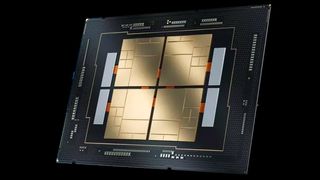
A well-known blogger has shared perhaps the first performance number of Intel's upcoming Xeon Platinum Sapphire Rapids processors with 60 cores and HBM2E cache.
Some of Intel's customers already get PRQ versions (opens in new tab) of select 4th Generation Xeon Scalable Sapphire Rapids processors. Still, the launch of high-volume models has suffered a delay to late 2022, with a full-scale ramp now scheduled for 2023 as the company had to correct certain bugs in silicon and then re-qualify those CPUs with partners. Intel keeps specifications of its upcoming products under wraps. Since there are many Sapphire Rapids processors in the wild already, not only do we know some of their alleged specifications, but their performance numbers have surfaced ahead of launch.
YuuKi_AnS (opens in new tab) , a prominent hardware leaker with a good track record and access to unreleased hardware, has laid his hands on Intel's 60-core Xeon Platinum 8490H CPU and a 52-core Xeon Platinum 8472C processor, presumably equipped with 64GB of HBM2E cache. The hardware blogger not only disclosed the specifications of the said products but also published their benchmark result. All the information is proven by screenshots (see the gallery below), so everything looks somewhat credible, while there may be some bumps. Meanwhile, since we are dealing with pre-production hardware, take the results with a grain of salt.
| Cores/Threads | Cache L2+L3 | Frequency | TDP - PBP - MTP | |
|---|---|---|---|---|
| Xeon Platinum 8472C* | 52/112 | 112MB + 97.5MB | 2.50 GHz – 3.80 GHz | 350W – 420W – 764W |
| Xeon Platinum 8490H* | 60/120 | 120MB + 112.5MB | 1.90 GHz – 3.50 GHz | 350W – 420W – 764W |
*Specifications are unconfirmed.
Last spring, Intel only planned to release Sapphire Rapids CPUs with up to 56 cores, but now the company is testing 60-core Xeon Platinum 8490H processors running at 1.90 GHz – 3.50 GHz. Furthermore, the company looks to be testing 52-core Xeon Platinum 8472C CPUs with on-package 64GB of HBM2E memory and running at considerably higher 2.50 GHz – 3.80 GHz.
| CPU-Z Single-Thread | CPU-Z Multi-Thread | |
|---|---|---|
| Xeon Platinum 8472C | 542.5 | 31,954.3 |
| Xeon Platinum 8490H | 508 | 32,747.6 |
Due to higher frequency, Intel's Xeon Platinum 8472C offers slightly higher single-thread performance than the company's Xeon Platinum 8490H CPU in the CPU-Z 2.02.0 benchmark. Yet the 60-core model scores marginally higher in multi-threaded workloads.
While core count and frequencies affect performance in virtually all workloads, adding HBM2E memory (with a 1.22 TBps peak bandwidth) benefits select memory bandwidth-bound workloads, such as computational fluid dynamics and rendering.
| Threads and Frequency | V-Ray Score (K samples) | |
|---|---|---|
| 2x Xeon Platinum 8472C | 224 @ 2.50 – 3.80 GHz | 95,014 |
| 2x Xeon Platinum 8490H | 240 @ 1.90 – 3.50 GHz | 71,830 |
| 2x AMD EPYC 7773X | 256 @ 2.20 – 3.50 GHz | 102,843 |
| 2x AMD EPYC 7763 | 256 @ 2.45 – 3.50 GHz | 109,248 |
It is precisely what we see in Chaos's V-Ray 4.10.03 benchmark, which can take advantage of both many cores and higher per-core performance. 64GB of HBM2E memory plays a more significant role here, which is why the Xeon Platinum 8472C is about 32% faster when compared to its Xeon Platinum 8490H sibling.
Interestingly, AMD's EPYC 7773X (Milan-X with 3D V-Cache) does not have any edge over the EPYC 7763 processor, which runs only a tad faster. Nonetheless, both already available CPUs are currently untouchable by Intel's offerings that have yet to come to market.
One thing that YuuKi_AnS pointed out is that new BIOS versions tend to add performance to Intel's Sapphire Rapids CPUs. So, assuming that there will be further microcode optimizations of these processors, production servers and workstations based on these CPUs will offer higher performance than current samples. But until those machines arrive, all we have left is to analyze results obtained on pre-production CPUs.