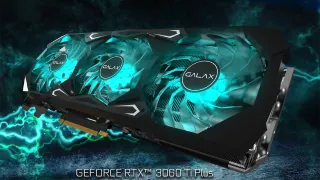
Galax has quietly introduced its first GeForce RTX 3060 Ti Plus graphics cards equipped with 8GB of GDDR6X memory. The boards feature higher memory bandwidth than regular GeForce RTX 3060 Ti boards and, therefore, offer somewhat higher performance than regular models in cases where memory bandwidth matters. In some situations, the GeForce RTX 3060 Ti Plus could rival Nvidia's GeForce RTX 3070.
Nvidia's GeForce RTX 3060 Ti Plus is based on a GA103 or GA104 graphics processor with 4864 CUDA cores (just like the regular GeForce RTX 3060 Ti) that are mated with 8GB of 19 GT/s GDDR6X memory using a 256-bit interface (vs. 14 GT/s GDDR6 on regular models). As a result, the new graphics board can offer a peak memory bandwidth of 608 GB/s, which is 36% higher than standard GeForce RTX 3060 Ti and RTX 3070 cards.
| CUDA Cores | FP32 TFLOPS (Boost) | Memory | Memory Bandwidth | MSRP | |
| GeForce RTX 3060 Ti | 4864 | 16,197 | 14GT/s 8GB GDDR6 256-bit | 448 GB/s | $399 |
| GeForce RTX 3060 Ti Plus | 4864 | 16,197 | 19GT/s 8GB GDDR6X 256-bit | 608 GB/s | ? |
| GeForce RTX 3070 | 5888 | 20,314 | 14GT/s 8GB GDDR6 256-bit | 448 GB/s | $499 |
Performance numbers demonstrated by Galax and republished by VideoCardz show that the model RTX 3060 Ti Plus can indeed be faster than the model RTX 3070 in certain cases, though these numbers need independent verification.
Meanwhile, since GDDR6X uses PAM4 encoding, this memory increases power consumption for both the GPU and memory. Furthermore, GDDR6X, which is exclusively available from Micron, tends to be more expensive than the regular GDDR6 that is sold by three major memory makers.

Speaking of Galax's GeForce RTX 3060 Ti Plus graphics cards, the company has two models: the Galax GeForce RTX 3060 Ti Plus SG with a 1695 MHz boost clock and a triple-slot triple-fan cooler, as well as the Galax GeForce RTX 3060 Ti Plus with 1680 MHz boost clock and a dual-slot dual-fan cooler. In addition, both cards have one eight-pin auxiliary PCIe power connector and four display outputs (three DisplayPort 1.4 and one HDMI 2.1 connector).
Given the somewhat odd configuration of Nvidia's GeForce RTX 3060 Ti Plus, it remains to be seen how much the graphics cards will eventually cost. In theory, the model RTX 3060 Ti Plus should sit between the regular RTX 3060 Ti ($399) and RTX 3070 ($499), but since the product will rival the latter, at least in some cases, its pricing will probably fall closer to Nvidia's reference GeForce RTX 3070.