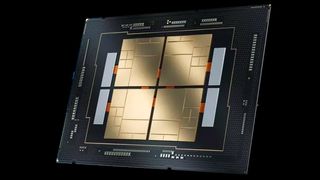
This week, Intel revealed additional details about its Software Defined Silicon (SDSi) capability of its next-generation Xeon Scalable processors and the official brand name of this technology. The tech will unassumingly sport the 'Intel On Demand' moniker and allow system administrators to enable special-purpose accelerators integrated into Intel's 4th Generation Xeon Scalable 'Sapphire Rapids' processors.
Intel this week released updates to SDSi patches (opens in new tab) merged in Linux 5.18 that reveal more details about this feature than the patches themselves, reports Phoronix (opens in new tab) . The software that will enable specific built-in acceleration capabilities of Intel's 4th Generation Xeon Scalable Sapphire Rapids (opens in new tab) CPUs (and probably their successors) will be called Intel On Demand, and it will do the following:
- Discover which features are physically present on a particular CPU.
- Offer administrators to activate them.
- Enable administrators to assess how often the feature is used.
The main intrigue about the Intel On Demand mechanism remains a mystery — we do not know which features Intel will allow for turning on post-purchase. However, we understand that Intel's Sapphire Rapids has several specific acceleration technologies. The list includes Advanced Matrix Extensions (AMX), Dynamic Load Balancer (DLB), Intel Data Streaming Accelerator (DSA), Intel In-Memory Analytics Accelerator (IAA), and Intel QuickAssist Technology (QAT) to accelerate specific workloads.
From previously uncovered beans about Intel's SDSi, or Intel On Demand if you prefer, we already know that the program enables access to the interface in the CPU to allow silicon features with an Authentication Key Certificate (AKC) and Capability Activation Payload (CAP) license. We also know that the program allows us to enable the specific feature on a particular CPU socket, not across all processors in the system or the data center itself.
Meanwhile, the fact that the software will need to discover which capabilities are physically supported by a processor and hide those not supported means that not all Intel Xeon Scalable 'Sapphire Rapids' processors will be created equal. Some CPU models may not gain support for certain features even by using Intel On Demand software.
Not all users will require AMX, DLB, DSA, IAA, and QAT at once. But which will be enabled by default on all SKUs and which will have to be activated using the IOD software is something that Intel will probably reveal on January 10 , when it launches its next-generation Xeon Scalable CPUs officially.