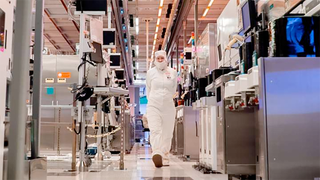
When Intel established its Intel Foundry Services division in early 2021 , it was clear that it needed the contract chipmaking unit to be on par with Samsung and Taiwan Semiconductor Manufacturing Co. in terms of scale as fabs and production nodes are getting costlier. The goal was ambitious from the start, and it looks like the company intends to be aggressive, with plans to become the second-largest foundry by 2030.
Big Ambitions
"Our ambition is to be the No. 2 foundry in the world by the end of the decade, and [we] expect to generate leading foundry margins," said Randhir Thakur, the president of Intel Foundry Services, in an interview with Nikkei Asia .
Getting to the No. 2 spot on the global foundry market means that Intel will have to beat Samsung Foundry (the current No. 2, according to TrendForce ), which generated over $20 billion in revenue in 2021 and is on track to exceed these results in 2022. As of Q1 2022, Samsung Foundry controlled some 16.3% of the global foundry revenue, being dramatically behind market leader TSMC (53.6%) but significantly ahead of its closest peers UMC (6.9%) and GlobalFoundries (5.9%)
By contrast, Intel's IFS business unit has generated $576 million in revenue so far this year. Once the acquisition of Tower Semiconductor closes in early 2023, Intel will add some $1.5 billion in revenue per year to its IFS division. This will immediately make IFS the world's No. 7 or No. 8 foundry, but it will still be considerably smaller than Samsung Foundry in terms of revenue.
To become the world's second-largest contract maker of chips, Intel will have to adopt a multi-faceted strategy that involves the following:
- Development of leading-edge process technologies that are competitive to those of Samsung Foundry and TSMC in terms of power, performance, and area (PPA); yields, and time-to-market.
- Build leading-edge capacity for IFS clients. Essentially, the company will have to own more advanced capacity than Samsung Foundry by the late 2020s.
- Maintain operations and competitive positions of Tower Semiconductor by innovating on the mature technologies front.
- Land orders primarily from clients that use TSMC and Samsung Foundry, perhaps steal someone from GlobalFoundries and SMIC too.
Need Big Actions
So far, Intel has revealed a rather aggressive process technology roadmap that involves high volume production of chips on its 18A (18 angstroms or 0.18nm-class technology) in 2025 and employing High-NA extreme ultraviolet lithography tools for 18A if possible. Intel's production node plan is considerably more aggressive than that of Samsung Foundry and TSMC, which both plan to start making 2nm-class (20 angstroms-class) chips in 2025 (which means that these will be available in very late 2025 at the earliest, or rather in 2026).

On the semiconductor capacity front, Intel's plans are no less aggressive. The company is building its 20A-capable Fab 52 and Fab 62 at its camp near Chandler, Arizona ; constructing the first two 18A/20A-capable modules of its site near Columbus, Ohio ; building its $3.5 billion facility for advanced packaging operations; finishing up a new Intel 4-capable module at its location near Leixlip, Ireland ; and constructing an all-new fab near Magdeburg, Germany . Overall, Intel plans to invest (or rather co-invest with governments and semiconductor co-investment partners like Brookfield ) around $100 billion in new semiconductor fabrication facilities in the coming years.
But Samsung is no less aggressive with its CapEx spending. While Intel recently cut its capital expenditures from $27 billion in 2022 to $25 billion, Samsung will invest over $33 billion in new semiconductor production capacity this year and will retain its spending at around the same level next year, the company announced recently. Of course, it is unclear how much of these sums are going to be invested in memory (3D NAND and DRAM) production facilities and how much will be used to expand logic capacity of Samsung Foundry, but the South Korean company is clearly very aggressive with its semiconductor business, so it will be tough for Intel to match SF's advanced capacities.
Stealing clients from TSMC and Samsung Foundry will be even harder as large customers like Nvidia or Qualcomm have supply agreements with their foundry partners that span for years. Furthermore, it remains to be seen whether Intel's fabs located in Europe and America will be able to offer the same pricing as TSMC's and Samsung Foundry's fabs located in Taiwan and South Korea.
Geographical Advantage
It is particularly noteworthy that Intel is building up production capacity in the U.S. and Europe and, so far, has not announced any plans to build fabs in Taiwan or South Korea (it will continue to operate a Tower Semiconductor fab in Japan). While operating fabs in Europe and America is costlier than in Taiwan or South Korea, building new fabs in the U.S. and Europe makes sense both from customer relationship and geopolitical points of view.
On the one hand, U.S. customers will be eager to use fabs in America due to logistics, risk management, and other factors. On the other hand, there are not so many chip designers in Europe that need leading-edge production technologies. At the end of the day, Intel's product portfolio is expanding, so it will need new fabs for itself anyway. In addition, according to Intel, many of its potential foundry clients see advantages in fabs located in America or Europe.
"As we have engaged with foundry customers since launching IFS, it has become abundantly clear that many of these companies see the need for a more resilient and geographically balanced semiconductor supply chain," Thakur told Nikkei Asia .
Yet, since both TSMC and Samsung Foundry are building up new leading-edge fabs in Arizona and Texas, the geographical advantages of Intel's new fabs in America may be overestimated.
Since politicians in Europe and the U.S. want to build domestic semiconductor supply chains so as not to rely on Taiwan so significantly, they are eager to co-invest in new facilities with Intel.
Make or Break
For Intel, the foundry business is a way to increase its production volumes quickly and therefore match its CapEx financial capabilities with those of TSMC and Samsung. Getting a new revenue stream is vital for Intel but is not as important as increasing production volumes.
Therefore, if the company succeeds in landing orders from many clients that need advanced production technologies, this will be a success by itself as it will allow it to keep investing in the development of leading-edge nodes and increasingly expensive fabs. If it does not, it may probably cease to be a leading integrated design manufacturer (IDM) and CPU supplier over time. If the company manages to become the world's second largest foundry in the process of setting up its foundry business pursuing its main target, this will be an even bigger success. But volumes is the primary target.