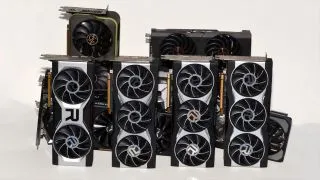
The Black Friday deals and Black Friday graphics card deals are here, and there are many great values. They're also almost universally on the AMD side of the party, as Nvidia's RTX 30-series remains overpriced, relative to AMD's RX 6000-series. It feels like Nvidia's prices are still stuck in early 2022 and haven't adjusted to the new reality, and in fact Nvidia retail prices have increased compared to September.
In terms of bang for the buck, the only place AMD doesn't currently get the win is at the very top of the bang column. We'll have to wait for AMD RDNA 3 GPUs and the Radeon RX 7900-series to launch before we see a direct competitor to the RTX 4080 , and maybe even the RTX 4090 . But let's take the matchups on a relative performance basis and run through the categories, from highest to lowest performance and price.
We'll include overall performance results from our GPU benchmarks hierarchy for both the rasterization and ray tracing performance. Nvidia — and sometimes Intel — can stake a claim on the DXR (DirectX Raytracing) side of things, and if you feel ray tracing has lived up to the hype that's fine. In general, we still find RT effects drop performance far too much for their image fidelity gains, and upscaling algorithms like DLSS, FSR 2, and XeSS are often required.

TLDR; AMD's Best Radeon Values
Below, we'll go into great detail, covering every segment of the GPU market and showing you exactly how many fps you get for each dollar spent compared to the competition. However, if you want to know the overall best AMD Radeon values, which are also the best graphics card values overall, these are the top 3:
- Radeon RX 6600: now $189 (opens in new tab) at Newegg (was $269): This card with 8GB of memory and a boost clock of 2,491 MHz delivers the best frame rate per dollar. It averaged 67.9 fps at 1080p ultra settings, which is about 0.36 frames per dollar.
- Radeon RX 6650 XT: now $259 at Newegg (opens in new tab) (was $299): A step up from the RX 6600, the 6650 XT has 8GB of GDDR6 RAM and a 2,635 MHz boost clock. On our 1080p ultra settings suite, it averaged 79.8 fps or about .31 frames per dollar.
- Radeon RX 6750 XT: now $369 at Newegg (opens in new tab) (was $549): A strong choice for 1440p gaming, the 6750 XT features 12GB of GDDR6 RAM and a 2,618 MHz boost clock. It averaged 78.2 fps on our 1440p Ultra settings test for a rate of 0.21 1440p frames per dollar.
Extreme GPUs: RTX 4090 and RTX 4080
AMD hasn't released its latest generation competing RX 7900 XTX and 7900 XT yet, so Nvidia gets to win this one by default. Official MSRPs might actually favor the RTX 4090, but street pricing sits at 35% above the $1,599 launch price for the halo card, while the RTX 4080 can now be found starting at $1,269 (opens in new tab) — just 6% above the $1,199 MSRP. That's undoubtedly because RTX 4080 costs too much for the penultimate offering, and while the initial wave may have sold out, that's seemingly not happening with the subsequent waves.
The result is that, at current prices, the RTX 4080 now represents the better value. Mind you, it's not a good value, but it's not hard to beat the value proposition offered by graphics cards that cost over two grand.
- RTX 4080 for $1,259 (opens in new tab) at 4K : 0.0726 fps/$ rasterization, 0.0295 fps/$ DXR
- RTX 4090 for $2,179 (opens in new tab) at 4K : 0.0657 fps/$ rasterization, 0.0241 fps/$ DXR
Enthusiast GPUs: RX 6950 XT, RX 6900 XT, RTX 3090 Ti, and RTX 3080 Ti
Stepping down one level from the very top of the pecking order, we get both older and more recent options. There's the RX 6950 XT that launched earlier this year alongside the RTX 3090 Ti , while Nvidia's RTX 3080 Ti from 2021 goes up against the RX 6900 XT from two years back. We can also include the OG RTX 3090 and RTX 3080 12GB , though given prices on most of these are higher than the replacement RTX 4080, obviously they won't win any prizes.
We'll stick with the 4K comparisons, since all of these cards at least average over 60 fps in our rasterization benchmarks. For DXR, we'll drop down to running comparisons at 1440p — consider it a bit of a stand-in for 4K via upscaling. And even though Nvidia does offer higher ray tracing performance, the much higher prices still end up giving AMD the overall advantage.
- RX 6900 XT for $629 (opens in new tab) at 4K/1440p : 0.1030 fps/$ rasterization, 0.0537 fps/$ DXR
- RX 6950 XT for $779 (opens in new tab) at 4K/1440p : 0.0903 fps/$ rasterization, 0.0496 fps/$ DXR
- RTX 3080 12GB for $949 (opens in new tab) at 4K/1440p : 0.0699 fps/$ rasterization, 0.0527 fps/$ DXR
- RTX 3080 Ti for $1,149 (opens in new tab) at 4K/1440p : 0.0578 fps/$ rasterization, 0.0445 fps/$ DXR
- RTX 3090 for $1,249 (opens in new tab) at 4K/1440p : 0.0551 fps/$ rasterization, 0.0421 fps/$ DXR
- RTX 3090 Ti for $1,449 (opens in new tab) at 4K/1440p : 0.0542 fps/$ rasterization, 0.0411 fps/$ DXR
High-End GPUs: RX 6800 XT, RX 6800, RX 6750 XT, RX 6700 XT, RTX 3080, RTX 3070 Ti, and RTX 3070
The high-end category spans a pretty wide range of prices yet again. We've got cards that are two years old like the RTX 3080 and RTX 3070 , plus the more recent RTX 3070 Ti from last year. On AMD's side, there's the RX 6800 XT and RX 6800 , the RX 6700 XT , and the recent RX 6750 XT refresh.
While some of these cards can arguably still handle 4K gaming okay, we're going to drop our comparisons down to 1440p for rasterization and 1080p ultra for DXR. That's the sweet spot for getting reasonably high fps out of these GPUs.
- RX 6750 XT for $369 (opens in new tab) at 1440p/1080p : 0.2119 fps/$ rasterization, 0.0975 fps/$ DXR
- RX 6700 XT for $349 (opens in new tab) at 1440p/1080p : 0.2104 fps/$ rasterization, 0.0960 fps/$ DXR
- RX 6800 XT for $514 (opens in new tab) at 1440p/1080p : 0.1985 fps/$ rasterization, 0.0962 fps/$ DXR
- RX 6800 for $479 (opens in new tab) at 1440p/1080p : 0.1897 fps/$ rasterization, 0.0881 fps/$ DXR
- RTX 3070 for $450 (opens in new tab) at 1440p/1080p : 0.1722 fps/$ rasterization, 0.1150 fps/$ DXR
- RTX 3070 Ti for $569 (opens in new tab) at 1440p/1080p : 0.1451 fps/$ rasterization, 0.0982 fps/$ DXR
- RTX 3080 10GB for $699 (opens in new tab) at 1440p/1080p : 0.1367 fps/$ rasterization, 0.0979 fps/$ DXR
Mainstream GPUs: RX 6700 10GB, RX 6650 XT, RX 6600 XT, RX 6600, RTX 3060 Ti, RTX 3060, RTX 3050, Arc A770, Arc A750
We could potentially include previous generation cards in the mainstream category, but we'll confine our comparisons to the current generation offerings. Even then, we still have a lot of potential options: The relatively new RX 6700 10GB and RX 6650 XT join AMD's 2021 releases, RX 6600 XT and RX 6600 . From Nvidia, we have the RTX 3060 Ti , RTX 3060 , and RTX 3050 . Finally, Intel joins the party with its Arc A770 and Arc A750 . (Note that we don't have performance data from the A770 8GB yet, so we'll skip that one — and we think it's worth the extra $20 to get 16GB regardless.)
Since these are all ostensibly mainstream offerings, we'll drop down to 1080p ultra for rasterization and 1080p medium for DXR — this is really the last category where it even makes any sense at all to mention ray tracing. 1080p remains the most popular resolution for gaming according to Steam, though obviously higher spec PC gamers are more likely to buy the hardware for 1440p or higher, with the requisite monitors.
- RX 6600 for $189 (opens in new tab) at 1080p : 0.3593 fps/$ rasterization, 0.1679 fps/$ DXR
- RX 6650 XT for $259 (opens in new tab) at 1080p : 0.3082 fps/$ rasterization, 0.1504 fps/$ DXR
- RX 6700 10GB for $299 (opens in new tab) at 1080p : 0.2933 fps/$ rasterization, 0.1492 fps/$ DXR
- RX 6600 XT for $289 (opens in new tab) at 1080p : 0.2699 fps/$ rasterization, 0.1308 fps/$ DXR
- Arc A750 for $274 (opens in new tab) at 1080p : 0.2607 fps/$ rasterization, 0.1773 fps/$ DXR
- RTX 3060 Ti for $380 (opens in new tab) at 1080p : 0.2408 fps/$ rasterization, 0.1773 fps/$ DXR
- RTX 3060 12GB for $315 (opens in new tab) at 1080p : 0.2282 fps/$ rasterization, 0.1630 fps/$ DXR
- RTX 3050 for $269 (opens in new tab) at 1080p : 0.1912 fps/$ rasterization, 0.1356 fps/$ DXR
- Arc A770 16GB for $349 (opens in new tab) at 1080p : 0.2301 fps/$ rasterization, 0.1721 fps/$ DXR
Budget GPUs: RX 6500 XT, RX 6400, GTX 1660 Super, GTX 1660, GTX 1650, Arc A380
Last and least, as far as prices go, we have the budget category. AMD and Intel GPUs in this price bracket still offer ray tracing hardware... but performance tends to be in the sub-20 fps range so it truly doesn't matter. We've included AMD's RX 6500 XT and RX 6400 Navi 24 GPUs, Nvidia's previous generation GTX 1660 Super , GTX 1660 , and GTX 1650 , and Intel's Arc A380 .
We'll show fps/$ for 1080p medium this round, though as noted the Nvidia cards won't have DXR results. Some games can reasonably run at higher settings and 60 fps, at least on some of these GPUs, but we need to use the same metric for the comparisons.
- RX 6500 XT for $149 (opens in new tab) at 1080p : 0.4415 fps/$ rasterization, 0.0749 fps/$ DXR
- RX 6400 for $119 (opens in new tab) at 1080p : 0.4366 fps/$ rasterization, 0.0755 fps/$ DXR
- GTX 1660 Super for $199 (opens in new tab) at 1080p : 0.4163 fps/$ rasterization
- GTX 1660 for $179 (opens in new tab) at 1080p : 0.4193 fps/$ rasterization
- Arc A380 for $139 (opens in new tab) at 1080p : 0.3938 fps/$ rasterization, 0.1142 fps/$ DXR
- GTX 1650 for $159 (opens in new tab) at 1080p : 0.3564 fps/$ rasterization