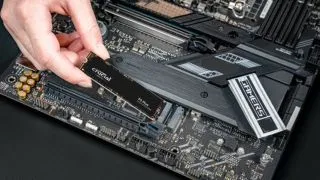
Storage industry bean counter Trendforce says that the price of 512GB SSDs are now comparable with 500GB HDDs, and roughly the same price as 256GB SSDs were six months ago. Like many computer components, SSDs were in great demand during the height of the pandemic, with the work-from-home movement at its peak. Thus, due to the laws of supply and demand, SSD pricing wasn't great. However, as we have journeyed through 2022, TrendForce has observed a dramatic decline in SSD demand and pricing. TrendForce also has other interesting observations and predictions regarding the SSD market and bit growth, higher capacity SSDs, and laptop attach rates.
The average capacity of a consumer SSD has edged past 500GB this year. One of the reasons behind this phenomenon is that 512GB SSDs are about the same price as 2.5-inch 500GB HDDs, and similar in price to 256GB SSDs six months previously.
We have checked a couple of popular SSDs and found the following on Amazon:
Product | Price six months ago | Price today |
Western Digital 500GB WD Blue SA510 SATA | $54.90 | $39.99 |
Crucial P3 500GB PCIe Gen3 3D NAND NVMe M.2 SSD | $55.20 | $39.99 |
SAMSUNG 980 PRO 500GB PCIe NVMe Gen4 | $105.50 | $95.50 |
Are 500GB SSDs Cheaper Than the Same Capacity 2.5-Inch HDDs?
The best price reduction observed in the table above is about 30%. However, we found that there were indeed a number of 250GB SATA and NVMe SSDs which were being sold for ~$50 six months previously (e.g. WD_BLACK 250GB SN770 NVMe, Crucial MX500 250GB 3D NAND SATA). Also, if you want a high performance 2.5-inch 7200RPM HDD alternative, you are also looking at Amazon pricing between $37.99 ( Seagate BarraCuda Pro (opens in new tab) SATA 500GB) and $59.27 ( Western Digital WD Black WD5000LPSX (opens in new tab) SATA 500GB). There are sluggish 2.5-inch 500GB SATA HDDs with 5400RPM at much lower prices though (<$20).

TrendForce says that there is a major stumbling block that will prevent a similar transition to the average NAND Flash content of a pre-built PC hitting 1TB of greater. It explains that PC Windows licensing costs scale up with device specifications such as SSD storage capacity, and thus it will be some time before 1TB+ SSDs come down in cost enough to justify being rolled out in economy or value-series devices - where every penny counts.
It is increasingly unlikely that laptops come with HDD storage. In 2022, TrendForce says that 92% of laptops sold will be SSD equipped. Next year HDDs will become further marginalized with the SSD attach rate for laptops reaching 96%, according to the market research firm.
For lower-storage entry-level computers, Microsoft is said to be encouraging OEMs to adopt UFS solutions. Though 128GB SSDs are getting scarcer, the recent price drops of SSDs and NAND mean that OEMs aren't keen to make the move over to UFS, especially as the faster UFS 3.1 isn't currently supported by Wintel machines.
If you are in the market for storage, please check out our recent Best SSD and Hard Drive Deals feature.