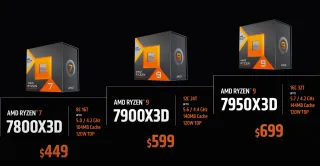
AMD announced six new Zen 4 Ryzen 7000 processors for its AM5 platform at CES 2023, and today it shared the pricing and availability for those processors in a surprise video it posted to its YouTube channel.
The first two chips will arrive on February 28: The 16-core 32-thread 7950X3D at $699, while the 12-core 24-thread Ryzen 9 7900X3D weighs in at $599. The eight-core, 16-thread Ryzen 7 5800X3D arrives on April 6 for $449.
| Price | Cores / Threads (P+E) | P-Core Base / Boost Clock (GHz) | Cache (L2/L3) | TDP / PBP / MTP | |
|---|---|---|---|---|---|
| Ryzen 9 7950X3D | $699 | 16 / 32 | 4.2 / 5.7 | 144MB (16+128) | 120W / ? |
| Ryzen 9 7900X3D | $599 | 12 / 24 | 4.4 / 5.6 | 140MB (12+132) | 120W / ? |
| Ryzen 7 7800X3D | $449 | 8 /16 | 4.2 / 5.0 | 104MB (8+96) | 120W / ? |
| Ryzen 7 5800X3D | $358 | 8 /16 | 3.4 / 4.5 | 104MB (8+96) | 105W |
The three new high-end Ryzen 7000X3D processors come with the company’s revolutionary 3D V-Cache in chips that top out at an incredible 5.7 GHz, a much higher peak boost frequency than we saw with the first-gen models. This now-proven tech should allow AMD to snatch the top spot in our list of best CPUs for gaming and our CPU benchmark hierarchy from Intel’s potent Raptor Lake when they arrive in February.
The new high-performance AMD chips come in 8-, 12- and 16-core flavors, significantly expanding the lineup of 3D V-Cache chips over the single Ryzen 7 5800X3D model that arrived with the first-gen chips. AMD claims explosive generational performance gains with these new chips, saying they will beat Intel’s fastest gaming chip by up to 24% in some games.
AMD Ryzen 9 7950X3D, Ryzen 7 7900X3D, Ryzen 7 7800X3D Pricing and Specifications
| Street/MSRP | Cores / Threads (P+E) | P-Core Base / Boost Clock (GHz) | E-Core Base / Boost Clock (GHz) | Cache (L2/L3) | TDP / PBP / MTP | Memory | |
|---|---|---|---|---|---|---|---|
| Ryzen 9 7950X3D | $699 | 16 / 32 | 4.2 / 5.7 | 144MB (16+128) | 120W / ? | DDR5-5200 | |
| Core i9-13900K / KF | $589 (K) - $564 (KF) | 24 / 32 (8+16) | 3.0 / 5.8 | 2.2 / 4.3 | 68MB (32+36) | 125W / 253W | DDR4-3200 / DDR5-5600 |
| Ryzen 9 7950X | $569 ($699) | 16 / 32 | 4.5 / 5.7 | - | 80MB (16+64) | 170W / 230W | DDR5-5200 |
| Ryzen 9 7900X3D | $599 | 12 / 24 | 4.4 / 5.6 | 140MB (12+132) | 120W / ? | DDR5-5200 | |
| Ryzen 9 7900X | $474 ($549) | 12 / 24 | 4.7 / 5.6 | - | 76MB (12+64) | 170W / 230W | DDR5-5200 |
| Core i7-13700K / KF | $409 (K) - $384 (KF) | 16 / 24 (8+8) | 3.4 / 5.4 | 2.5 / 4.2 | 54MB (24+30) | 125W / 253W | DDR4-3200 / DDR5-5600 |
| Core i7-13700 / F | $384 - $359 (F) | 16 / 24 (8+8) | 2.1 / 5.2 | 1.5 / 4.1 | 54MB (24+30) | 65W / 219W | DDR4-3200 / DDR5-5600 |
| Ryzen 7 7800X3D | $449 | 8 /16 | 4.x / 5.0 | 104MB (8+96) | 120W / ? | DDR5-5200 | |
| Ryzen 7 5800X3D | $358 ($449) | 8 /16 | 3.4 / 4.5 | 104MB (8+96) | 105W | DDR4-3200 | |
| Ryzen 7 7700X | $349 ($399) | 8 /16 | 4.5 / 5.4 | - | 40MB (8+32) | 105W / 142W | DDR5-5200 |
| Ryzen 5 7600X | $249 ($299) | 6 / 12 | 4.7 / 5.3 | - | 38MB (6+32) | 105W / 142W | DDR5-5200 |
| Core i5-13600K / KF | $319 (K) - $294 (KF) | 14 / 20 (6+8) | 3.5 / 5.1 | 2.6 / 3.9 | 44MB (20+24) | 125W / 181W | DDR4-3200 / DDR5-5600 |
As a reminder, AMD’s 3D V-Cache uses a vertically 3D-stacked SRAM chip that sits on top of the processor, thus boosting the L3 cache capacity by 64MB and enabling explosive performance gains in gaming (productivity workloads don’t benefit). This tech debuted in AMD’s Ryzen 7 5800X3D , the first ‘X3D’ model. Intel doesn’t have a comparable technology, though it does have the 6 GHz Core i9-13900KS to help hold off AMD's new models.
The Ryzen 9 7950X3D comes with 16 cores and 32 threads, marking a new high count for the 3D V-Cache-equipped chips. This chip is basically a Ryzen 9 7950X with an extra L3 cache chiplet and additional tuning. The 3D-stacked SRAM L3 chip weighs in at 64MB, so the 7950X3D comes with 144MB of total cache, with 128MB of that being gaming-boosting L3 cache. This chip will contend with Intel’s Core i9-13900K and the 6 GHz 13900KS model.
AMD has spec’d the 3D V-Cache processors at a base TPD of 120W and a max 162W PPT, which is lower than the standard 170W/230W threshold for the 7950X. That isn’t entirely surprising, as the additional cache chiplet can result in slightly higher operating temperatures. However, AMD has significantly increased the boost speeds with the new X3D models. As a result, the 7950X3D boosts to 5.7 GHz, a vast leap over the previous gen 5800X3D’s peak of 4.5 GHz and the same as the standard 7950X. We do see a slight decline of 200 MHz compared to the 7950X, a necessary accommodation for the lower 120W TDP.
The previous-gen model’s performance famously suffers in standard applications due to its lower boost clock rate, so the 7950X3D’s higher clock rate implies that we won’t see as much of a tradeoff in productivity apps with the new Zen 4 models. However, we are looking at a 50W reduction in available power, which will have an impact on threaded workloads.
Frequencies are higher for all three new X3D chips. The 12-core 24-thread Ryzen 9 7900X3D peaks at 5.6 GHz, the same as the standard 7900X, while base clocks decline a relatively minor 300 MHz (it’s rare to see the base clock in actual use). This chip comes armed with 104MB of cache, with 96 MB carved out as L3. This chip also drops to the lower 120W TDP range, so it will also lose some performance in heavily-threaded applications.


AMD shared some performance benchmarks at CES 2023, but as with all third-party tests, take them with a grain of salt. These charts also include an unlabeled axis, so it could also be a non-zero axis that visually inflates performance deltas.
AMD showed performance results in dour titles that are often CPU bound, so the benefits of the X3D architecture shine through – particularly at the 1080p resolution used for testing.
AMD claims the 16-core 7950X3D is anywhere from 13% to 24% faster than the Intel flagship Core i9-13900K in these titles. The Ryzen 7 5800X3D is a wonderful gaming processor, but it suffers tremendously in application benchmarks. That tradeoff appears to be drastically reduced with the 7950X3D, as AMD claims that it is anywhere from 4% to 52% faster than the Core i9-13900K in a selection of productivity benchmarks.
The Ryzen 7 7800X3D also appears potent, with AMD’s benchmarks showing it anywhere from 21% to 30% faster than the 5800X3D in this selection of titles. Be aware that there are a few esports class titles in this selection, and that some games will either not benefit from the extra cache as much, or not benefit at all.
This is a breaking story...more to come.