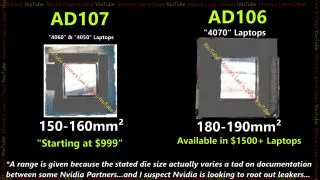
Newly revealed pictures and specifications of Nvidia's upcoming AD106 and AD107 graphics processors have been uncovered. Destined for the company's upcoming GeForce RTX 40-series solutions for desktops and laptops, they are small but may offer mighty performance.
This week Moore's Law Is Dead ( YouTube ) obtained images of Nvidia's upcoming AD106 and AD107 GPUs, while TechPowerUp published detailed specifications, including die sizes and transistor counts. Nvidia's AD106 and AD107 chips essentially flesh out the company's Ada Lovelace family and complement already-known AD102, AD103, and AD104 graphics processors.
| GPU | RTX 4080 Laptop | RTX 4070 Laptop | RTX 4060 Laptop | RTX 4050 Laptop |
|---|---|---|---|---|
| Architecture | AD104 | AD106 | AD107 | AD107 |
| Process Technology | TSMC 4N | TSMC 4N | TSMC 4N | TSMC 4N |
| Transistors (Billion) | 35.8 | ? | ? | ? |
| Die size (mm^2) | 294.5 | 190 | 146 | 146 |
| Streaming Multiprocessors | 60 | 36 | 24 | 20 |
| GPU Cores (Shaders) | 7680 | 4608 | 3072 | 2560 |
| Tensor Cores | 240 | 144 | 96 | 80 |
| Ray Tracing Cores | 60 | 36 | 24 | 20 |
| TMUs | 240 | 144 | 96 | 80 |
| ROPs | 80 | 48 | 32 | 32 |
| L2 Cache (MB) | 48 | 32 | 32 | 12 |
| Memory Interface (bit) | 192 | 128 | 128 | 96 |
| Memory Speed (GT/s) | 21 | 16 | 16 | 16 |
Regarding die sizes, all Ada Lovelace GPUs are smaller than their Ampere counterparts. This is expected, as Nvidia's latest graphics processors are made on TSMC's 4N (4nm-class) fabrication technology, whereas its previous-generation chips use Samsung's 8LPP (8nm-class node that derives from a 10nm-class tech). So, on the one hand, small die sizes cut costs, which is essential. But, on the other hand, it gets trickier for chip designers to squeeze in all necessary interfaces (such as memory and display outputs) while hitting the performance targets they need.
Since TSMC charges more for chips produced on 4N technology than Samsung charges for GPUs made using its 8LPP node (which is in line with industrial trends), we can only guess whether smaller Ada Lovelace GPUs are cheaper to produce than bigger Ampere GPUs. Yet, as yields go up, the costs of GeForce RTX 40-series processors will inevitably decrease.
When Nvidia introduced its GeForce RTX 40-series laptop graphics processors early this year, it said that entry-level AD107 and mid-range AD106 mobile Ada Lovelace GPUs would find their places in laptops that start at $999 and $1,500, respectively. A $999 gaming notebook with a discrete GeForce RTX 40 GPU sounds compelling, but the question is what else such a machine offers and how widespread such laptops will be.