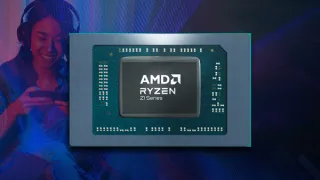
AMD's Ryzen Z1 series chips , designed for gaming handhelds like the Asus ROG Ally, and its Ryzen 7040U chips, which the company announced for ultraportables earlier this week, may be far more similar than anyone expected.
In the table below, I've compared the Z1 Extreme to the new top-of-the-line Ryzen 7 7840U with Radeon 780M, while the regular Z1 sits next to the Ryzen 5 7540U with Radeon 740M.
| Header Cell - Column 0 | AMD Ryzen 7 7840U | AMD Ryzen Z1 Extreme | AMD Ryzen 5 7540U | AMD Ryzen Z1 |
|---|---|---|---|---|
| AMD XDNA Architecture | Yes | No | No | No |
| Cores/Threads | 8/16 | 8/16 | 6/12 | 6/12 |
| Base clock | 3.3 GHz | Not specified | 3.2 GHz | Not specified |
| Boost clock (up to) | 5.1 GHz | Not specified | 4.9 GHz | Not specified |
| Cache | 24MB | 24MB | 22MB | 22MB |
| TDP | 15-30W | 15-30W | 15-30W | 15-30W |
| RDNA 3 Compute Units | 12 (Radeon 780M) | 12 | 4 (Radeon 740M) | 4 |
While AMD hasn't listed clock speeds for the Z1 and Z1 Extreme (maybe these will be released with the ROG Ally, or perhaps they'll be different depending on the system using them), everything else is identical, at least on paper, to what's being offered in upcoming ultraportable laptops. They have the same number of cores and threads, the same number of RDNA 3 compute units, identical configurable TDPs, and even the same cache.
When we asked AMD about the similarities, the company was quick to say that it has done a bit of extra work on the Z1 models, but didn't discount the likenesses between the two sets of chips.
"The Ryzen Z1 series are purpose-built with handheld gaming in mind," Matthew Hurwitz, a client PR manager at AMD, wrote to Tom's Hardware . "To accomplish this, AMD engineers had to validate entirely new power ranges and optimize the voltage curves specifically for this use case – this optimization and validation work should not be trivialized. So while the technology building blocks (like ‘Zen4’ and RDNA 3) are similar between the 7040 and Z1 series, the resulting models have very distinct characteristics customized for their use cases. In addition, the AMD Ryzen AI engine is not available on AMD Ryzen Z1 series processors."
We followed up with AMD to ask if the XDNA AI engine is removed entirely or disabled, and the company responded that it is disabled. That means the chips are likely identical at the silicon level. In the end, there will only be one way to truly suss out the differences: benchmarking them as they hit our labs. For sure, making a chip work in a handheld the size of a Steam Deck (in the case of the upcoming Asus ROG Ally, it's actually smaller) is going to take some work, as you don't get the amount of space or cooling that you do in a laptop.
We've also yet to see what the Ryzen AI engine from the XDNA architecture is capable of. That may give the laptops an edge, though it's unlikely current games would take advantage of it, which makes a case for removing it from Z1 and Z1 Extreme.
The Asus ROG Ally will have a launch event on May 11 (opens in new tab) featuring Frank Azor, AMD's chief architect of gaming solutions and marketing, so perhaps we'll learn more then. And while Hurwitz emphasizes that the design work on the Z1 series shouldn't be underplayed, we'll see the differences as people actually get their hands on both series of chips.