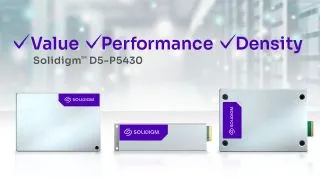
3D QLC NAND memory has apparent storage density and cost-per-GB advantages over 3D TLC NAND, but its performance and endurance were not particularly suitable for all kinds of applications, particularly in the data center space. But Solidigm believes that its controller and firmware innovations will make its QLC-based D5-P5430 SSDs solid contenders for mainstream and read-intensive datacenter applications due to their combination of capacity, performance, power consumption, and TLC-class endurance.

High Capacity, Massive Endurance
Solidigm's D5-P5430 drives rely on the company's NVMe 1.4c-compliant platform with a PCIe 4.0 x4 interface as well as 192-layer 3D QLC NAND memory.
When it comes to performance, Solidigm rates the new drives for up to 7,000/3,000 MB/s of sequential read/write speed as well as up to 971K/120K random read/write 4K IOPS, which is in line or slower than its direct predecessor (Intel's/Solidigm's D5-P5316 introduced in late 2021 that relied on 144-layer 3D QLC NAND), and which is substantially slower when compared to the write performance of 3D TLC NAND-based enterprise SSDs. For example, the new D5-P5430 SSDs feature significantly lower write speeds than Micron's 6500 ION SSDs .
| Row 0 - Cell 0 | Solidigm D5-P5430 | Solidigm D5-P5316 | Samsung PM9A3 | Micron 6500 ION |
| Memory | 192L 3D QLC | 144L 3D QLC | 128L 3D TLC | 232L 3D TLC |
| Max Capacity | 30.72TB | 30.72TB | 7.68TB | 30.72TB |
| Sequential Read | 7000 MB/s | 7000 MB/s | 6900 MB/s | 6800 MB/s |
| Sequential Write | 3000 MB/s | 3600 MB/s | 4100 MB/s | 5000 MB/s |
| Random Read (4K, QD256/QD128) | 971K IOPS | 800K IOPS | 1.1M IOPS | 1M IOPS |
| Random Write (4K, QD256/QD128) | 120K IOPS | ? | 200K IOPS | 200K IOPS |
| 70% Random Read/30% Random Write (4K, QD128) | ? | ? | ? | 400K IOPS |
| DWPD (random workloads) | 0.58 (?KB) | 0.41 (64KB) | 1 | 0.3 (4KB) |
| PBW | 32 PBW | 22.93 PBW | 14 PBW | 16.4 PBW |
Solidigm's D5-P5430 family consists of drives featuring 3.84TB, 7.68TB, 15.36TB, and 30.72TB capacity points that come in a 2.5-inch/15 mm U.2, E3.S 7.5 mm, and E1.S 9.5 mm form factor. Offering drives in different form factors enable Solidigm to address a wide range of applications and customers.
Solidigm positions its D5-P5430 SSDs for both read-intensive and mainstream workloads that consist of 80% reads (according to the company's own analysis), and the key selling point of these drives is that they enable high storage densities at 3D QLC NAND costs while offering read performance and reliability that is on par or higher than that of 3D TLC NAND-based drives. This positioning is slightly different than the 3D QLC-powered D5-P5316, and it is justified as the company has managed to significantly increase the endurance of its new 3D QLC drive.
Solidigm says that its new D5-P5430 SSDs can reduce the total cost of ownership by as much as 27% for a standard object storage system due to a 50% boost in storage density and an energy cost reduction of 18%. Moreover, compared to 'top-tier TLC SSDs,' Solidigm's latest drive promises to provide up to 14% more writes over its lifespan.
Based on the numbers published by Solidigm, the top-of-the-range D5-P5430 30.72TB can endure up to 32 PBW (petabytes written) over its lifespan, which is higher than its predecessor and even higher than Micron's 6500 ION 30.72TB drive that uses 3D TLC NAND memory. Solidigm hasn't disclosed how it increased the endurance of its drives, but one of the ways to do so is to increase the over-provisioning and implement innovative algorithms for the controller.

There Is a Catch
There is a catch about comparison of these 3D QLC NAND and 3D TLC NAND-based drives. 3D QLC NAND, which stores four bits per cell, has a lower endurance and slower write speeds compared to 3D TLC memory as it takes longer to erase and program cells, and the cells wear out faster. To mitigate these issues, high-capacity datacenter-oriented 3D QLC SSDs use Flash Translation Layer (FTL, also known as indirection layer) with a large block size (64KB in case of the D5-P5316 as opposed to standard 4KB blocks used by mainstream SSDs and HDDs) to minimize the number of program/erase cycles to preserve the longevity of the drive, reduce the amount of overhead, and increase efficiency of data management. However, there are trade-offs associated with larger block sizes.
First up, 64KB blocks can lead to higher write amplification (when the SSD writes more data to the flash memory than the amount of data the host is actually trying to write), which leads to significant wear out of SSDs.
Secondly, if the data being written or modified is smaller than the block size, the SSD controller has to deal with partially filled blocks, which leads to less efficient use of the storage space, as the remaining space in the block cannot be used for other data. This becomes a problem for applications that use loads of small random writes or has to handle loads of small files, and which is why Solidigm positions its 3D QLC SSDs for read intensive and 'mainstream' workloads.
Thirdly, an SSD with a 64KB FTL might experience more variability in performance if an application frequently modifies small amounts of data. Meanwhile, if the workload consists mainly of large, sequential writes, the SSD will perform just fine. Meanwhile, only major cloud service providers tend to support 64KB alignment, which greatly shrinks addressable market for datacenter 3D QLC NAND-based drives.
Solidigm does not explicitly say that its new D5-P5430 drives use a 64KB indirectly layer, though its relatively low performance may indicate that this is the case. If this is the case, then the new drives will be able to successfully compete against Micron's 6500 ION in datacenters operated by large hyperscalers, but in machines run by smaller companies that rely on 4KB data blocks, their actual performance will heavily depend on exact workloads.
Availability
Solidigm has already shipped PRQ parts of its D5-P5430 SSDs in a U.2 form-factor with 3.84TB, 7.68TB, and 15.36TB capacities, so its customers can order more parts now. Product Release Qualification for other D5-P5430 SKUs is set for the second half of the year.