After viewing Silicon Lottery's lackluster binning statistics for the Ryzen 9 3950X , it's no wonder why the company has established such high asking prices for its pre-binned samples.
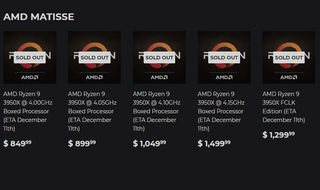
The processor binning specialist currently offers five pre-binned Ryzen 9 3950X models. The processors are guaranteed to run stably at the advertised speed on all their cores with a 100 BCLK (Base Clock) and the lowest LLC (Load-Line Calibration) setting.
For the sake of reference, a stock Ryzen 9 3950X has a 3.5 GHz base clock and a maximum 4.7 GHz single-core boost clock. The 16-core, 32-thread part typically retails for $749 — that is if you're lucky enough to find one in stock .
| All-Core Frequency | Vcore | VR Vout | Pricing |
|---|---|---|---|
| 4.15 GHz | 1.325V | 1.200V | $1,499.99 |
| 4.10 GHz | 1.312V | 1.187V | $1,049.99 |
| 4.05 GHz | 1.300V | 1.175V | $899.99 |
| 4.00 GHz | 1.287V | 1.162V | $849.99 |
The cheapest Ryzen 9 3950X in Silicon Lottery's showcase features a 4.00 GHz all-core boost and costs $849.99. The 4.05 GHz and 4.10 GHz chips retail for $899.99 and $1,049.99, respectively. The highest clocked model boosts to 4.15 GHz, but commands a eye-watering $1,499.99 price tag.
On this occasion, Silicon Lottery is also offering a special FCLK (Infinity Fabric Clock) edition. This particular chip has a pretty strong IMC to support DDR4-3800 memory and run the FCLK at 1,900 MHz with a SoC (system-on-chip) voltage of 1.10V. Given that only 12% of Silicon Lottery's tested Ryzen 9 3950X samples is able to achieve this feat, the company is asking $1,299.99 for the chip.
AMD has stated in the past that its Ryzen 3000-series processors don't leave much manual overclocking headroom on the table. This has certainly put Silicon Lottery's business model at risk as the company probably has to invest more resources to really find the best chips from the heap. As a result, we're seeing increasingly expensive pre-binned Ryzen 3000-series chips.
Also, with a less than 4% all-core overclocking difference separating the best-performing chips from the worst-performing ones, it all seems a bit pointless. And going by their data, chances are that a 3950X bought at random will manage 4.10 GHz under their test criteria, so the best-performing models they sell only manage a little over 1% higher clocks than average, but cost twice as much as MSRP.
And performing an all-core "overclock" on the 3950X seems a bit pointless in general, unless perhaps a system is only used for heavily-threaded workloads that utilize all cores, and lightly-threaded performance doesn't matter. Otherwise, you're trading a notable hit to lightly-threaded performance for minimal gains to heavily-threaded performance.