Modded Radeon PRO W7800 has been tested in gaming
Igor’sLAB has a performance simulation of a Radeon W7800 workstation card turned gaming.
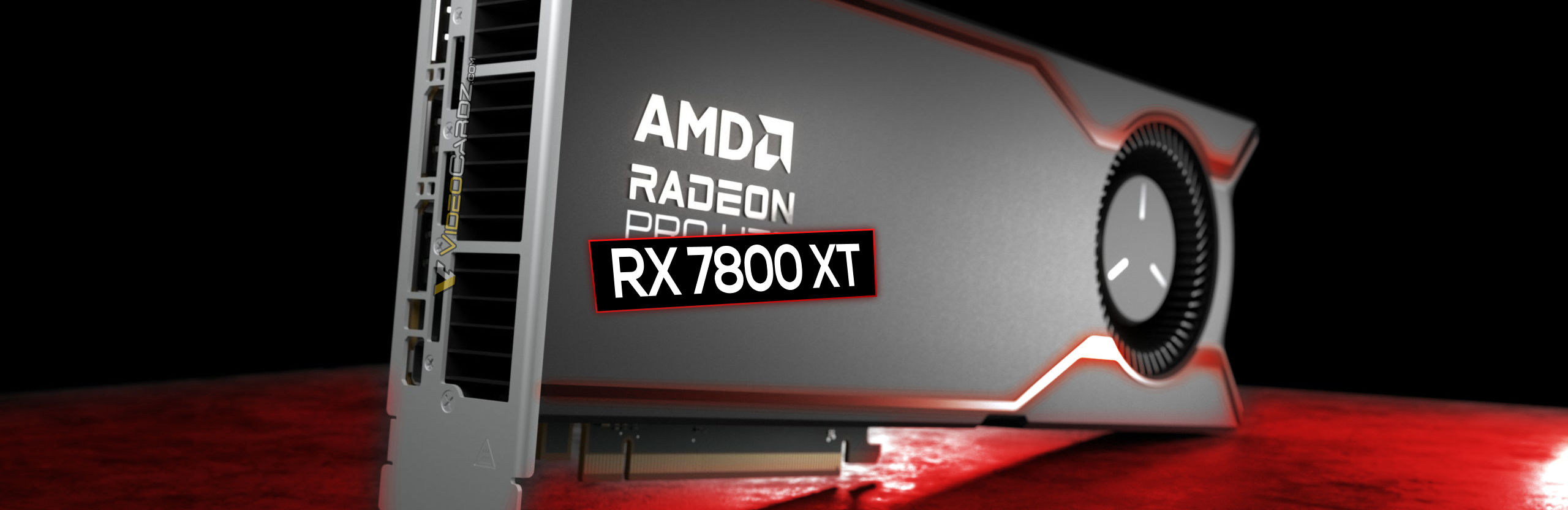
Just yesterday a first purported AMD Navi 32 GPU pictures have emerged . This unreleased GPU could be AMD’s response to the growing popularity of upper mid-range SKUs like NVIDIA GeForce RTX 4070 series. The Navi 32 remains the only graphics processor based on the RDNA3 architecture that AMD has not yet fully disclosed. This GPU might be used for graphics card series like Radeon RX 7800 and such, but there are no updates from AMD in that regard.
AMD recently launched a Radeon Pro W7800 graphics card for workstations. Contrary to what was speculated, this card features Navi 31 GPU with 4480 Stream Processors. This Pro model also uses 32GB of GDDR6 memory through a 256-bit bus interface. Although such specs could’ve easily been covered by Navi 32, AMD opted for a higher-end RDNA3 model.
The fact that we are looking at another Navi 31 model provides an opportunity to use this card for simulation. It is expected that gaming models like Radeon RX 7800XT could use very similar specs, but with some key differences. The most obvious one is the memory configuration, likely not exceeding 32GB capacity. The gaming model should feature 16GB instead.
The workstation Pro W7800 SKU has a GPU clock of 1855 MHz, but it can still be adjusted up to 2499 MHz. The memory clock requires only a slight increase in frequency as it is 18 Gbps already. There should not be an issue with feeding more power to the processor either, as the card features dual 8-pin power connectors for its maximum TBP of 260W. The simulated specs assume the card would feature 70 Compute Units, 16GB GDDR6 memory clocked at 20 Gbps and game clock likely above 2 GHz.
While overclocking and power limit increase are not a big issue for a knowledgeable reviewer like Igor Wallossek, halving the memory capacity is a bit tedious work. There is no way to disable half of the memory modules, so the next the best thing to do is to artificially allocate 16GB memory pool to limit free memory space for other workloads. That’s precisely what he did.
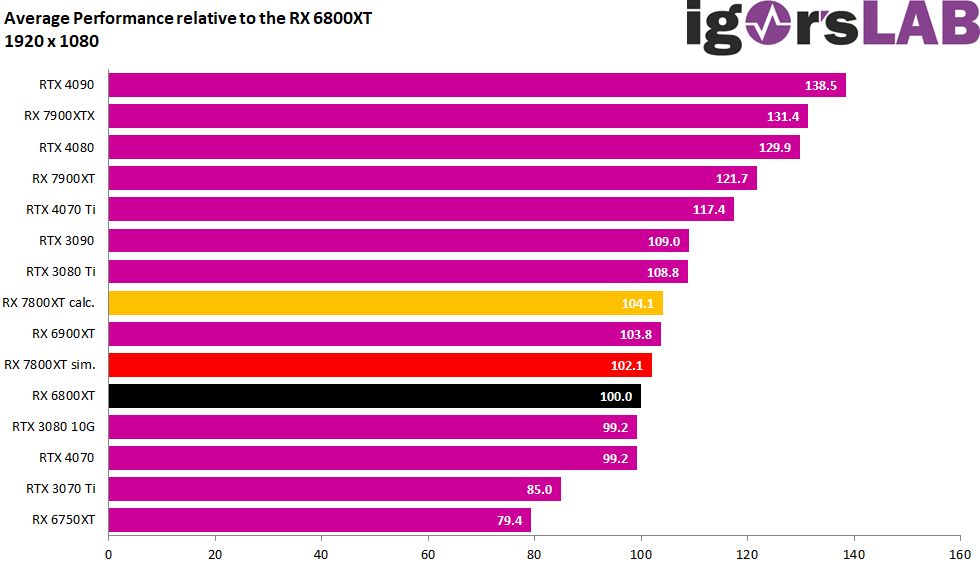

Radeon PRO W7800 (RX 7800 XT simulation), Source: Igor’LAB
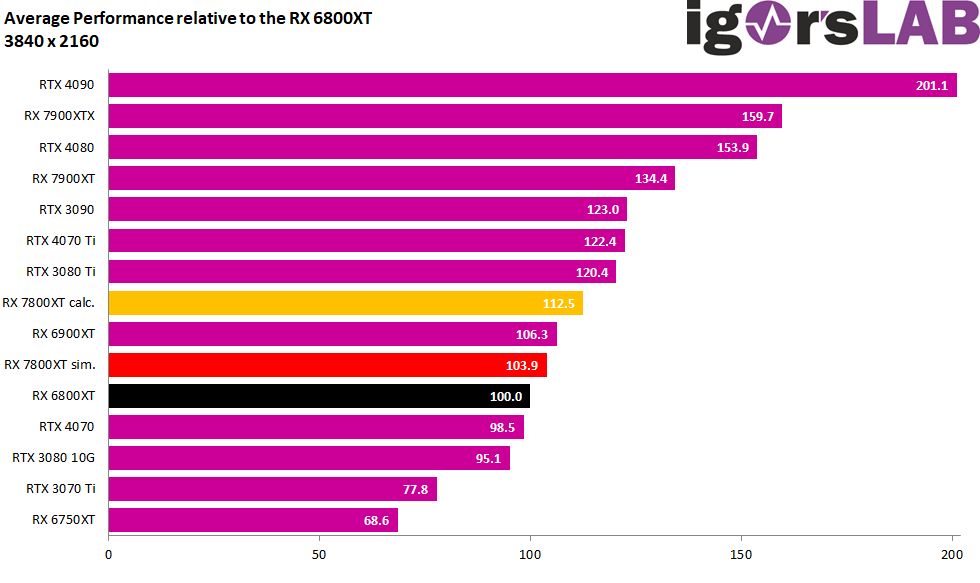
Radeon PRO W7800 (RX 7800 XT simulation), Source: Igor’LAB
The long story short, the simulated RX 7800 XT appears to be 4% (1080p), 8% (1440p) and 12.5% (2160p) faster than Radeon RX 6800 XT, which is not a big upgrade. One must not forget though that this is a simulation, so the results may not correspond to real-world product, which does not even have rumored specifications yet. AMD Radeon PRO series are designed for better power efficiency, so even by adjusting clocks and TBP, the BIOS may still be forcing lower results, simply because this card was not designed for gaming workloads.
Nevertheless, the card is no question faster than the RX 6800 XT, but maybe not fast enough for AMD to consider replacing it already. The company has an issue of large stock of Navi 21 GPUs (RX 6900/6800 series) that will only see lower interest should Navi 32 version of this card be released.
Source: Igor’sLAB