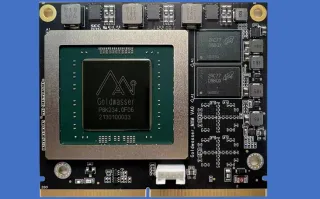
Denglin Technology, a Shanghai-based compute GPU developer established in 2017, recently secured funding from the China Internet Investment Fund, a venture initiated by the State Cyberspace Administration of China and the Ministry of Finance. This capital will advance the research and development of Denglin's full-range products, accelerating mass production and commercialization of their next-gen Goldwasser GPUs, reports Jon Peddie Research .
Denglin's product line, including its flagship Goldwasser, is designed primarily for artificial intelligence applications. Meanwhile, previously the company said that the GPU could also be used for gaming. The company asserts that Goldwasser is the first enterprise Chinese GPU to execute a large-scale commercial application successfully.

One of the features of the Goldwasser GPU is Denglin's GPU+ architecture that enables software-defined on-chip heterogeneous computing technology, according to JPR. The most intriguing part is that Goldwasser is said to be compatible with the company's own programming model, 'such as CUDA/OpenCL,' the report says. Hence, financing from the government will be used to develop a rival for Nvidia's CUDA. Of course, it remains to be seen whether Denglin will build something competitive enough to end Nvidia's dominance in the AI GPU market, but it certainly has such ambitions.
The founders of Denglin Technology, Li Jianwen and Wang Ping, are alumni of Tsinghua University, and their Vice President of Global Operations, Yang Jian, previously served in a similar capacity in Huawei's global supply chain. Denglin, with its wide-ranging experience in GPU R&D and commercialization, operates seven R&D centers in various cities, including Silicon Valley, Chengdu, and Hangzhou. The company is among 13 GPU developers in China, JPR claims.
The global GPU market was worth $33.47 billion in 2021 and is predicted to reach $477.37 billion by 2030, marking a compound annual growth rate of 34.4% from 2021 to 2030, according to data from Verified Market Research (in India)cited by JPR. This rise is primarily propelled by growing demand from professional software users, gamers, and esports fans. Meanwhile, AI is already becoming a significant contributor to this market.
