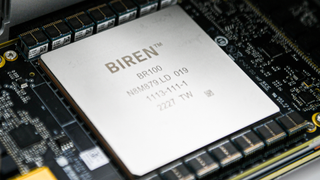
Biren, a Chinese developer of compute GPUs, is mulling an initial public offering (IPO) in Hong Kong this year. This comes as domestic clients are increasingly favoring its AI chips over those from Nvidia, which are expensive and in short supply, according to a report from Bloomberg. Hoping to seize on this opportunity, the tech startup is positioning itself to capitalize on the increased demand for its products
Biren is expected to apply for its maiden share sale in the next few week, according to the report that cites anonymous sources. Concurrently, Biren is negotiating with potential investors, including government-supported funds in Guangzhou. These discussions are focused on another independent round of funding that could garner about 2 billion yuan ($279 million). Biren was seeking to raise funds last year at a valuation of 17 billion yuan, which is approximately $2.4 billion. For now, Biren has yet to determine the scope of the IPO, along with exact timeframe.
The reason why Biren is so confident of its valuation is that the company's products look competitive compared to compute GPUs from Nvidia (at least on paper) and the market of AI-capable compute GPUs is booming these days.
Biren's debut family of compute GPUs consists of two options: the BR100 and the BR104. The 'baseline' BR104 delivers performance up to 128 FP32 TFLOPS or 1 INT8 PetaFLOPS, whereas the higher-end BR100 — which is essentially two BR104s on one silicon interposer — offers performance up to 256 FP32 TFLOPS or 2 INT8 PetaFLOPS. The mid-tier BR104 comes with 32GB of HBM2E memory, using a 2048-bit interface that provides bandwidth of 819 GB/s. By contrast, the premium BR100 is equipped with 64GB of HBM2E memory, featuring a 4096-bit interface with bandwidth of 1.64 TB/s.
| Header Cell - Column 0 | Biren BR104 | Biren BR100 | Nvidia A100 | Nvidia H100 |
|---|---|---|---|---|
| Form-Factor | FHFL Card | OAM Module | SXM4 | SXM5 |
| Transistor Count | ? | 77 billion | 54.2 billion | 80 billion |
| Node | N7 | N7 | N7 | 4N |
| Power | 300W | 550W | 400W | 700W |
| FP32 TFLOPS | 128 | 256 | 19.5 | 60 |
| TF32+ TFLOPS | 256 | 512 | ? | ? |
| TF32 TFLOPS | ? | ? | 156/312* | 500/1000* |
| FP16 TFLOPS | ? | ? | 78 | 120 |
| FP16 TFLOPS Tensor | ? | ? | 312/624* | 1000/2000* |
| BF16 TFLOPS | 512 | 1024 | 39 | 120 |
| BF16 TFLOPS Tensor | ? | ? | 312/624* | 1000/2000* |
| INT8 | 1024 | 2048 | ? | ? |
| INT8 TFLOPS Tensor | ? | ? | 624/1248* | 2000/4000* |
There is another reason for the Biren's optimism. Its fundraising efforts coincide with the Chinese government's vigorous push to advance its domestic semiconductor industry. This move is a response to a U.S.-led campaign that blocked Chinese companies from acquiring numerous compute GPUs from AMD, Intel, and Nvidia, all of which compete against Biren's products. Since Nvidia's products are expensive and in short supply, according to media reports, Biren can sell more of its GPUs, at least to companies that do not use Nvidia's CUDA software stack for their AI workloads.
But Biren is facing numerous challenges too. Last year, TSMC temporarily halted shipments of compute GPUs to Biren in a bid to make sure that they meet U.S. export rules in terms of performance and capabilities. This forced the company to slash its headcount to cut costs. Apparently, Biren can procure enough silicon for now, so its main job at the moment is to ensure that its software stack is competitive when compared to those of Nvidia, Intel, and AMD.
In this field, Nvidia is extremely hard to beat. The company has spent nearly two decades refining CUDA and in recent years invested hundreds of millions in making CUDA platform of choice for AI development. For now, numerous Chinese hyperscalers prefer to use Nvidia's GPUs for their AI products due to the superiority of CUDA and the amount of money they have already invested in this ecosystem.
