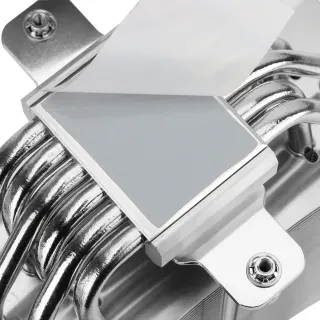
When we mention Thermalright, we think of high-performance air or liquid cooling systems as well as accessories for DIY PCs and, therefore, products aimed at enthusiasts. But it looks like even Thermalright wants to address a more mainstream market, which is why this week it quietly unveiled its first thermal pads, as FanlessTech noticed .
While thermal pads often offer lower thermal conductivity and performance than the best thermal paste , Thermalright rates the thermal conductivity of its Heilos pads at 8.5W/mK, and thermal resistance at 0.04°C cm2/W. To put the numbers into context, the thermal conductivity of Arctic's MX-4/MX-5 is also spec'd at 8.5W/mK, and this is considered to be a quite decent level of performance for inexpensive pastes, as far as our list of the best thermal pastes goes.
Thermalright offers two types of Heilos thermal pads: one measuring 40x40 mm for AMD's AM5 CPUs and another measuring 40x30 for Intel's LGA1700 processors. Both thermal pads are 0.2 mm thick.
Applying thermal paste optimally could be challenging for novices in DIY PC building, so specialists from Thermalright thought that advanced thermal pads could be a viable option for them. While thermal pads tend to offer lower performance than the best thermal pastes, which are usually designed for overclocking and tailored for particular types of cooling systems (air, liquid, liquid nitrogen, etc.), they are easy to use. Furthermore, Thermalright's Helios promises performance that is akin to good mainstream thermal pastes, so for DIY PC rookies, they might be just what the doctor ordered.