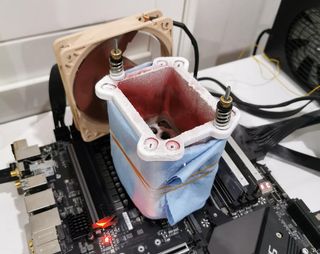
As spotted by Shaun Fosmark , Australian overclocker jordan.hyde99 has set a new world record in wPrime 1024M with AMD's Ryzen 9 3900X processor. What's fascinating is the fact that the AMD processor was running a much slower clock speed than the previous record holder, the Intel Core i9-7920X.
The Ryzen 9 3900X and Core i9-7920X are both equipped with 12 cores and 24 threads, so both chips are on even ground in terms of core counts. The first is based on AMD's Zen 2 microarchitecture and rocks a 3.8 GHz base clock and 4.6 GHz boost clock, while the latter utilizes Intel's Skylake microarchitecture and clocks in with a 2.9 GHz and 4.4 GHz base and boost clock, respectively.
| Processor | Cores / Threads | Base / Boost (GHz) | L1 Cache (KB) | L2 Cache (MB) | L3 Cache (MB) | Memory Support | TDP (W) |
|---|---|---|---|---|---|---|---|
| AMD Ryzen 9 3900X | 12 / 24 | 3.8 / 4.6 | 768 | 6 | 64 | Dual DDR4-3200 | 105 |
| Intel Core i9-10920X | 12 / 24 | 3.5 / 4.6 | 768 | 12 | 19.25 | Quad DDR4-2933 | 165 |
| Intel Core i9-9920X | 12 / 24 | 3.5 / 4.5 | 768 | 12 | 19.25 | Quad DDR4-2666 | 165 |
| Intel Core i9-7920X | 12 / 24 | 2.9 / 4.4 | 768 | 12 | 16.5 | Quad DDR4-2666 | 140 |
Overclocker jordan.hyde99 overclocked his Ryzen 9 3900X to 5,625 MHz on liquid nitrogen and finished the wPrime 1024M benchmark run in 35 seconds and 517 milliseconds to take the crown away from the Core i9-7920X.
In comparison, the Core i9-7920X previously held the record at 35 seconds 693 milliseconds while being overclocked to 5,955 MHz with the same type of exotic cooling.
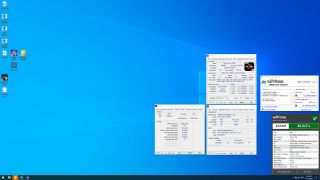
Although the Ryzen 9 3900X only managed to beat the Core i9-7920X by a negligible margin (less than one percent), the big takeaway here is the clock speed. The Ryzen 9 3900X was able to match the Core i9-7920X's score while running with a 5.8% lower operating clock. This stands as testimony that Zen 2's instructions per cycle (IPC) is higher than Skylake, and subsequent microarchitectures based on the same design, in many workloads.