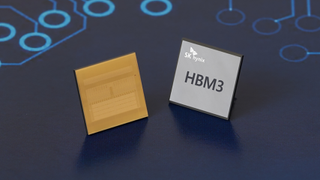
China is striving to develop its own high-bandwidth memory-like (HBM-like) for artificial intelligence and high-performance computing applications, according to a report from the South China Morning Post . ChangXin Memory Technologies (CXMT) is reportedly at the forefront of this initiative.
HBM is the indisputable leader when it comes to performance as every HBM stack features a 1024-bit memory interface and a decent data transfer rate. Because of the wide interface and vertical stacking, production of HBM devices does not require the most advanced lithography. In fact, it is believed that global DRAM leaders use time-proven technologies for their HBM2E and HBM3 memory devices.
What HBM does require is sophisticated packaging technologies — as connecting eight or twelve memory devices vertically using tiny through silicon vias (TSVs) is a complicated procedure. Yet, assembling an HBM-like known-good stacked die (KGSD) module is easier than producing a DRAM device on a 10nm-class process technology.
Despite technological limitations imposed by sanctions, industry insiders questioned by SCMP suggest that CXMT could still produce its own HBM-like memory. But it remains to be seen how wide the Chinese 'HBM' interface will be and how many DRAM devices per module it will be able to stack.
CXMT is China's leading domestic producer of DRAM, both in terms of technological prowess and in terms of manufacturing capabilities, so it is China's best bet for developing a proprietary type of memory designed to compete against industry-standard HBM in terms of bandwidth and capacity. Due to U.S. sanctions , CXMT and other Chinese chip manufacturers are constrained to use less advanced technologies for production, putting them at a competitive disadvantage globally.
AI and GPC processors are essential for various applications, including autonomous vehicles, artificial intelligence, and high-performance computing, so it is understandable why China wants to build its own HBM-like memory. Currently, companies like Biren can obtain HBM2E memory from leading DRAM suppliers, but if the U.S. government restricts access to this type of memory, China's only option will be to rely on its own technologies. As a result, development of HBM-like memory is part of a larger national agenda to become self-reliant in semiconductor technology .