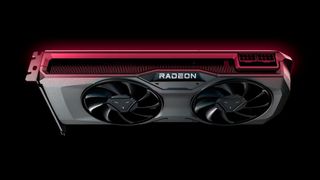
In an interview with Club386 , AMD's Scott Herkelman shared insight into the company's perception of GPU power consumption and how it believes gamers prioritize power consumption in their graphics cards. According to Herkleman, AMD believes GPU power consumption is important in the laptop segment. He goes on to note that while some gamers care about power efficiency, most gamers don't care at all.
Herkleman's answer was in response to a power efficiency question Club 386 asked regarding how concerned AMD is about RDNA3's weaker energy efficiency compared to Nvidia's RTX 40 series GPUs and the Ada Lovelace GPU architecture. Club386 specifically gave the example of the RX 7700 XT compared to the RTX 4070. The former is rated at 245W of power consumption versus the latter's 200W TGP. The RX 7700 XT also reportedly performs worse, targeting the RTX 4060 Ti.
Herkleman also discussed AMD's thought process behind energy efficiency and how it plays out in GPU development. Despite his claims that gamers don't care much about power consumption, Herlkeman says that AMD strives for good performance per watt across all its products, noting that AMD looks at perf per watt on every chart when they bring all chips to the market. He continues by saying that making a more power-efficient chip also leads to a more affordable board design, enabling AMD to reduce graphics card prices or increase graphics card performance.
Herkleman's assessment has some merit; some gamers don't care about power consumption and would rather have as much performance as possible, no matter the cost. But, we wonder how much of that assessment is due to AMD lagging in the efficiency race behind Nvidia.
For some perspective, Nvidia's RTX 40-series graphics cards generally consume far less energy than AMD's RX 7000 series competitors. Nvidia's RTX 4080 , for instance, has a 320W power rating but typically only uses around 300W in gaming, according to our tests. On the other hand, AMD's RX 7900 XTX has a higher 355W power rating and uses around 351W in gaming workloads in our testing. You'll see this trend across all of Nvidia's 40 series product stack, down to the RTX 4060 and RX 7600 .
Thankfully, AMD's competitive prices combat most of RDNA3's power disadvantages. Still, we can't help but wonder what AMD's opinion would be if it led the power efficiency race like it once did with the RX-6000 series.
While it's true that desktop gamers generally don't care a lot about GPU power consumption, opinions on GPU power consumption are not as cut and dry as they once were. With the introduction of 350W and 450W GPUs a few years ago, power consumption is significantly more impactful on gamers and DIY builders. If you want to build a system with one of these power-hungry GPUs, you'll need to ensure you have enough headroom from your power supply to run the card, or you'll run into problems.
You must also ensure that your case can handle a 350W or 450W graphics card from a physical and thermal perspective. Graphics cards with these super high power ratings put out substantially more heat and require more physical space to fit inside of a case due to extra-large triple-slot and quadruple-slot coolers. This is even more problematic with the mini-ITX systems, which are much smaller than standard ATX and micro-ATX machines.