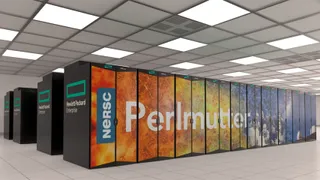
The U.S. National Energy Research Scientific Computing Center is offering to lend Nvidia A100-based compute GPU nodes of the Perlmutter supercomputer with a 50% discount till the end of September, as noticed by Glenn K. Lockwood , an HPC storage specialist from Microsoft. The offer comes as demand for compute horsepower for AI training is scarce industry-wide. Meanwhile, the proposal is available for NERSC users only.
"Using your time now benefits the entire NERSC community and spreads demand more evenly throughout the year, so to encourage usage now, we are discounting all jobs run on the Perlmutter GPU nodes by 50% starting tomorrow and through the end of September," wrote Rebecca Hartman-Baker, User Engagement Group Leader at NERSC, in an email to NERSC users. "Any job (or portion of a job) that runs between midnight tonight and the very start of October 1 at midnight (Pacific time) will be charged only half the usual charges, e.g., a 3-hour job on 7 nodes, which would normally incur a charge of 21 GPU node-hours, would be charged 10.5 GPU node-hours."
Amid the generative AI craze, there are dozens of companies willing to lend Nvidia compute GPU-based nodes to train their large language models. Still, commercial data centers are running at their maximum capacity, and Nvidia's compute GPUs are sold out for quarters to come, according to media reports. The offering from NERSC is undoubtedly generous, and the scientific center could make some easy money if it were offering its capacity commercially.
However, the problem is that they only offer it to existing NERSC users who use the Perlmutter supercomputer for scientific research. Since these users were on summer break, they were probably not running their workloads on the supercomputer and are not going to till the end of the year; at least some of the GPU nodes were idling for some time, which begs the question of why the organization does not backfill its idle capacity with commercial workloads.
While using supercomputers built by the U.S. government for commercial AI and HPC workloads would have brought a lot of money that could be spent to advance American supercomputer prowess, this is not something that institutions like NERSC do.
Supercomputers built by the U.S. Department of Energy are classified. They are meant to be used primarily for things that present national security matters or by pre-selected users, including those that use these machines for research that could be used for commercial applications. As a result, these machines are not available for everyone.