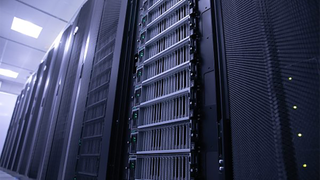
Russia has an ambitious plan to build up to ten supercomputers by 2030, each potentially housing 10,000 to 15,000 Nvidia H100 GPUs. From a computing perspective, this would provide the nation with performance on a scale similar to that which was used to train Chat GPT. Formidable in general, a system featuring so many H100 GPUs could produce some 450 FP64 TFLOPS, which is half of an ExaFLOP, a level of supercomputer performance that has only been achieved by the U.S., so far.
Spearheaded by the 'Trusted Infrastructure' team, the Russian project promises to push the boundaries of computational capabilities, with each machine potentially boasting between 10,000 to 15,000 Nvidia H100 GPUs. However, the desired compute AI and HPC GPUs would come from Nvidia, an American company.
The war Russia started in Ukraine had led the U.S. to restrict tech exports to Russia. creating a gaping hole in the procurement strategy for processors like Nvidia GPUs. Thus, the question that hangs in the air is: how could Russia bypass these restrictions since it would seem impossible to smuggle thousands of valuable AI and HPC GPUs?
The financial landscape also presents a set of challenges for the Russians. With today's hardware prices, the project's budget would be about $6 billion, making it a colossal investment. However, rapid advancements in technology have the potential to reduce costs in the coming years. Perhaps by 2030, these systems could cost $500 - $700 million.
Russia's most powerful supercomputer is Chervonenkis, it is owned by Yandex and is equipped with 1,592 nodes featuring Nvidia A100 GPUs. It ranks 27th in the world for computational power, with a performance of 21.53 PetaFLOPS. Three of the seven Russian supercomputers belong to Yandex (Lyapunov, Chervonenkis, and Galushkin), two to Sberbank (Christofari and Chrisofari Neo), and one each to MSU (Lomonosov) and MTS (GROM). All of them operate on Nvidia GPUs from previous generations.
Currently, Russia has just seven supercomputers that rank in the global top 500. For comparison: the USA has 150 machines on the list, China has 134, Germany has 36, and Japan has 33. As of June 2023, Russia was 12th in the rankings.