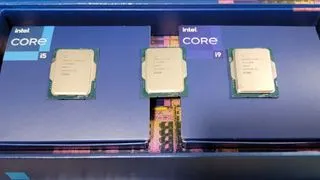
Intel announced its 14th-generation Core ‘Raptor Lake Refresh’ series today, with three top-end overclockable models, the 6 GHz $589 Core i9-14900K, $409 Core i7-14700K, and $319 Core i5-1600K arriving at retail on October 17 to take on AMD’s Zen 4 Ryzen 7000 lineup, including the powerful 7000X3D models that currently dominate our list of the best CPUs for gaming . Despite rumors of price increases, Intel kept the pricing for its three new models the same as the prior generation, thus hoping to stave off AMD's affordably-priced competitors. Intel also offers all three chips in graphics-less KF-series configurations for slightly less cash than their full-featured counterparts.
As the codename implies, Intel’s newest chips are a refreshed version of the 13th-Gen Raptor Lake processors that debuted roughly a year ago and carved out victories against AMD’s original Ryzen 7000 – at least until AMD's 7000X3D models arrived and re-took the lead in gaming. Intel says the 14th-Gen models reassert its gaming lead, claiming 'up to' 23% better gaming performance than AMD's potent Ryzen 7000X3D chips — though according to Intel's benchmarks, that works out to roughly a 2% lead on average — and up to 54% faster performance in creator workflows. Overall, Intel says its new optimizations give the 14th-Gen processors ‘mid-to-upper single-digit percentage' gains across the board over its own prior-gen models.
| Street/MSRP | Cores / Threads (P+E) | P-Core Base / Boost Clock (GHz) | E-Core Base / Boost Clock (GHz) | Cache (L2/L3) | TDP / PBP / MTP | Memory | |
|---|---|---|---|---|---|---|---|
| Core i9-14900K / KF | $589 (K) - $564 (KF) | 24 / 32 (8+16) | 3.2 / 6.0 | 2.4 / 4.4 | 68MB (32+36) | 125W / 253W | DDR4-3200 / DDR5-5600 |
| Core i9-13900K / KF | $589 (K) - $564 (KF) | 24 / 32 (8+16) | 3.0 / 5.8 | 2.2 / 4.3 | 68MB (32+36) | 125W / 253W | DDR4-3200 / DDR5-5600 |
| Core i7-14700K / KF | $409 (K) - $384 (KF) | 20 / 28 (8+12) | 3.4 / 5.6 | 2.5 / 4.3 | 61MB (28+33) | 125W / 253W | DDR4-3200 / DDR5-5600 |
| Core i7-13700K / KF | $409 (K) - $384 (KF) | 16 / 24 (8+8) | 3.4 / 5.4 | 2.5 / 4.2 | 54MB (24+30) | 125W / 253W | DDR4-3200 / DDR5-5600 |
| Core i5-14600K / KF | $319 (K) - $294 (KF) | 14 / 20 (6+8) | 3.5 / 5.3 | 2.6 / 4.0 | 44MB (20+24) | 125W / 181W | DDR4-3200 / DDR5-5600 |
| Core i5-13600K / KF | $319 (K) - $294 (KF) | 14 / 20 (6+8) | 3.5 / 5.1 | 2.6 / 3.9 | 44MB (20+24) | 125W / 181W | DDR4-3200 / DDR5-5600 |
While Intel's refresh generation doesn’t provide the massive gen-on-gen leaps we would typically see with new architectures, the new chips have higher boost frequencies across the board, with a peak of up to 6.0 GHz for the flagship Core i9-14900K. Courtesy of a newer revision of the 'Intel 7' process node, the 14th-Gen chips deliver these higher frequencies within the same power envelopes (PL1/PL2) as the previous-gen models. The Core i7-14700K is the only chip to get more cores and the accompanying extra dollop of cache via four additional E-cores. Meanwhile, the 14th-Gen Core i9 and i5 models feature the same number of cores as their predecessors.
Intel is also debuting a new AI Assist program baked into its XTU tuning utility, which leverages the power of machine learning to offer custom one-click overclocking settings for the Core i9 models, and a new Application Optimization (APO) program that detects certain games and automatically adjusts thread affinities to boost performance on the fly. Let's see how Intel says its gaming performance stacks up, then move on to specs, pricing, and more details on the new features.
Intel 14th Generation Core 'Raptor Lake Refresh' Gaming Performance

Intel shared its own internally measured gaming benchmarks, but as with all vendor-provided data, take it with a grain of salt (we have Intel's test notes at the end of the last album on the page).
Intel tested the Core i9-14900K in 25 games against AMD's Ryzen 9 7950X3D, which is currently the fastest gaming chip in our CPU benchmarks . Here we see that Intel takes a 23% lead in a few titles, like Starfield and Metro Exodus , but it trails by up to 23% in DOTA 2 and 11% in Cyberpunk 2077, with a wide range of values interspersed throughout the tested games . Intel's lead works out to a 2% overall average advantage, making the Core i9-14900K a contender for the title of the fastest gaming CPU on the market. Notably, Metro Exodus and Rainbow Six: Siege benefit from Intel's new APO feature, which we'll cover more in depth below.
Intel also shared a more select range of five titles (second slide in the above album) that show impressive gains over AMD's top gaming chips, but be aware that this is a very selective list meant to highlight the company's own strengths. Intel used those same titles to drive home its assertion that despite Ryzen's ultra-competitive performance in average framerates, it isn't quite as impressive in the 99th percentile measurements that serve as a proxy for a measurement of gaming smoothness. As expected, Intel claims its new chips deliver the smoothest gaming experience.
Naturally, we'll put all of these chips through our own tests — as always, be sure to check out independent reviews before coming to any firm conclusions.
Intel 14th Generation Core 'Raptor Lake Refresh' Specifications and Pricing
| Street/MSRP | Cores / Threads (P+E) | P-Core Base / Boost Clock (GHz) | E-Core Base / Boost Clock (GHz) | Cache (L2/L3) | TDP / PBP / MTP | Memory | |
|---|---|---|---|---|---|---|---|
| Ryzen 9 7950X3D | $660 ($699) | 16 / 32 | 4.2 / 5.7 | 144MB (16+128) | 120W / 162W | DDR5-5200 | |
| Core i9-13900KS | $729 ($699) | 24 / 32 (8+16) | 3.0 / 6.0 | 2.2 / 4.3 | 68MB (32+36) | 150W / 253W / 320W | DDR4-3200 / DDR5-5600 |
| Core i9-14900K / KF | $589 (K) - $564 (KF) | 24 / 32 (8+16) | 3.2 / 6.0 | 2.4 / 4.4 | 68MB (32+36) | 125W / 253W | DDR4-3200 / DDR5-5600 |
| Core i9-13900K / KF | $569 ($589) (K) - $536 ($564) (KF) | 24 / 32 (8+16) | 3.0 / 5.8 | 2.2 / 4.3 | 68MB (32+36) | 125W / 253W | DDR4-3200 / DDR5-5600 |
| Ryzen 9 7950X | $579 ($699) | 16 / 32 | 4.5 / 5.7 | - | 80MB (16+64) | 170W / 230W | DDR5-5200 |
| Ryzen 9 7900X3D | $549 ($599) | 12 / 24 | 4.4 / 5.6 | 140MB (12+128) | 120W / 162W | DDR5-5200 | |
| Ryzen 9 7900X | $419 ($549) | 12 / 24 | 4.7 / 5.6 | - | 76MB (12+64) | 170W / 230W | DDR5-5200 |
| Core i7-14700K / KF | $409 (K) - $384 (KF) | 20 / 28 (8+12) | 3.4 / 5.6 | 2.5 / 4.3 | 61MB (28+33) | 125W / 253W | DDR4-3200 / DDR5-5600 |
| Core i7-13700K / KF | $364 ($409) (K) - $379 ($384) (KF) | 16 / 24 (8+8) | 3.4 / 5.4 | 2.5 / 4.2 | 54MB (24+30) | 125W / 253W | DDR4-3200 / DDR5-5600 |
| Ryzen 7 7800X3D | $369 ($449) | 8 /16 | 4.2 / 5.0 | 104MB (8+96) | 120W / 162W | DDR5-5200 | |
| Ryzen 7 5800X3D | $302 ($449) | 8 /16 | 3.4 / 4.5 | 104MB (8+96) | 105W | DDR4-3200 | |
| Ryzen 7 7700X | $319 ($399) | 8 /16 | 4.5 / 5.4 | - | 40MB (8+32) | 105W / 142W | DDR5-5200 |
| Core i5-14600K / KF | $319 (K) - $294 (KF) | 14 / 20 (6+8) | 3.5 / 5.3 | 2.6 / 4.0 | 44MB (20+24) | 125W / 181W | DDR4-3200 / DDR5-5600 |
| Core i5-13600K / KF | $284 ($319) (K) - $281 ($294) (KF) | 14 / 20 (6+8) | 3.5 / 5.1 | 2.6 / 3.9 | 44MB (20+24) | 125W / 181W | DDR4-3200 / DDR5-5600 |
| Core i5-13400 / F | $207 ($221) (K) - $201 ($196) (F) | 10 / 16 (6+4) | 2.5 / 4.6 | 1.8 / 3.3 | 29.5MB (9.5+20) | 65W /148W | DDR4-3200 / DDR5-4800 |
| Ryzen 5 5600X3D | $229 | 6 / 12 | 3.3 / 4.4 | - | 99MB (3+96) | 105W | DDR4-3200 |
Here we can see how Intel's new lineup compares to AMD's competing chips, but be aware that many of these models are now selling far below MSRP, perhaps explaining Intel's decision to keep pricing static for this generation. In contrast to prior generations, Intel will forge all three of its K-series models from the same die instead of relying upon a cut-down die for some Core i5 SKUs.
The Core i7-14700K looks particularly appealing at its price point — the previous-gen Core i7-13700K provided nearly the same gaming performance as the Core i9-13900K but for a significantly lower price tag. This time around, the addition of four more E-cores will shrink the divide between Core i7 and i9 even further, particularly in productivity applications, perhaps making it a go-to choice for enthusiasts looking for bleeding-edge frame rates paired with robust performance in threaded productivity applications.
Intel 14th Generation Core 'Raptor Lake Refresh' AI Overclocking and APO
The 14th-Gen chips are backward compatible with existing 600- and 700-series motherboards and LGA 1700 coolers. True to tradition, motherboard vendors also have a refreshed lineup of Z790 boards releasing along with the new chips, with many touting more robust power delivery along with USB Gen 3.2 and Wi-Fi 7 connectivity.
The Raptor Lake Refresh processors still leverage Raptor Cove P-cores and Gracemont E-cores, so there are no IPC improvements to speak of. Still, unspecified improvements to the 'Intel 7' node provide a boost from an enhanced voltage/frequency curve. As you can see below, that results in 100 to 200 MHz in increased base/boost clocks for P-cores and E-cores on the three new models. As usual, your cooling solution will play a big part in your attainable boost speeds — a 360mm radiator will pay off for the Core i7 and i9 models. Intel recommends an H150i-class (Corsair 360mm AIO) for the best performance.
Intel's new AI Assist overclocking plug-in for its eXtreme Tuning Utility (XTU) comes from third-party company FoundationTK.com. This tool characterizes the processor using AI algorithms trained by Intel to suggest a series of optional tweaks that you can choose to enable to overclock your processor. The tool leverages Intel's math kernel libraries to run the inference algorithm. AI Assist takes roughly 35 seconds to examine the thermals, voltages, frequencies, and power delivery to determine the optimal overclocked settings. As always, manual tuning can provide higher overclocking results, and the tool only works with Core i9 SKUs for now, though support will come for the other 14th-Gen K-series models in time (Intel has no plans to bring the tool to prior generations). AI Assist works on both 600- and 700-series motherboards, and there's also an option in the BIOS to turn off the feature. You can also still use Intel's Performance Maximizer (IPM) for automatic one-click overclocking with a standard trial-and-error methodology that can take an hour (or more).
Intel's list-based Application Optimization (APO) is turned on by default, automatically detecting certain programs and directing application resources in real time to optimize thread scheduling/affinities and application threading. You can download an application from the Microsoft Store to turn off the feature for certain applications. Still, it only works on programs for which Intel has created profiles in its Dynamic Tuning Technology framework (it works alongside Thread Director). APO currently only supports two games, Rainbow Six: Siege and Metro Exodus , which Intel touts as gaining 13% and 16% more performance, respectively. Intel says it will continue to assess games and programs that will benefit from the profiles and will add more profiles in the future.
Intel continues to support dual-channel DDR4-3200 and up to DDR5-5600 for 1DPC (1R/2R) and DDR5-4400 for 2DPC (1 DIMM) setups but says that P-core, E-core, and memory overclocking see vast improvements. A range of new XMP kits will also arrive soon with up to DDR5-8000 speeds, and specialty (and probably exceptionally pricey) XMP kits will even range up to DDR5-8600. However, Intel notes that DDR5-6000 to DDR5-6600 remains the sweet spot for the best price-to-performance ratio.
Intel 14th Generation Core 'Raptor Lake Refresh' Productivity Performance
Intel provided more benchmarks to quantify its gains in productivity applications with the Core i9-14900K and Core i7-14700K over the Ryzen 9 7950X, claiming gains up to 17% and 14% in threaded applications, respectively.
The second slide contains Intel's claimed gen-on-gen improvements for the 14700K over the Core i7-12700K and 13700K in the same workloads, notching solid leads over its already-competitive performance in desktop PC applications. The 14700K's additional threaded heft from four more E-cores could make it the chip to get from the first salvo of Intel's 14th-Gen processors.
Intel's choice to continue to support DDR4 memory could prove to continue to offer a pricing advantage for lower-cost builds. However, that advantage has shrunk considerably as memory prices have plummeted.
Intel will release the rest of its locked models at a later date. If the company holds true to form, we expect those to arrive around CES. Intel's new K-Series lineup looks surprisingly solid for a refresh generation, but as always, the proof is in the final silicon. The processors go on sale tomorrow worldwide, and if tradition holds, you can expect to see reviews soon.