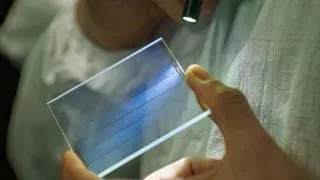
Microsoft has provided an update on its Project Silica storage research. According to a recent blog post and video, the software and devices giant is now positioning Project Silica as a sustainable storage solution to address the cloud storage server market. Using Project Silica technology, it is possible to store approximately 1.75 million songs or around 3,500 movies on a palm-sized slice of glass. Moreover, Microsoft asserts that the 7 TB storage per glass sheet maintains data integrity for 10,000 years.
Several refinements have been made to Project Silica since our last report in June 2022. At that time, the media seemed identical in dimensions, but the writing process has since been refined for speed and durability. Also, we note the focus seems to have changed from music archiving purposes to cloud server data storage.
In the new video, Ant Rowstron, a deputy lab director at Microsoft Research Cambridge, outlines the great appeal of Project Silica in addressing the ever-increasing amount of data being generated by humans and in cloud storage.
Sketching out the limitations of magnetic storage, a traditional cloud server data medium, Rowstron highlights the need to refresh the data every five years when using HDDs and up to ten years “if you are brave” with tape storage. Refreshing media can be arduous, wastes energy, and introduces the potential for data corruption.
In contrast, data stored in glass, with its natural resistance to water, electromagnetic pulses, extreme temperatures, and surface scratching, can be stable for thousands of years.
The video also takes us through the four steps to silicon storage heaven. There are four ‘labs’ involved in Project Silica data storage and retrieval, as follows:
- Write Lab: short laser pulses record data inside the glass as voxels (3D pixels)
- Read Lab: a computer controlled microscope reads data
- Decode Lab: here the data read is decoded back into standard computer readable formats using Azure AI
- Library lab: when data is requested for recall, a robot in the library goes to fetch the appropriate piece, and inserts it into a reader.

It is emphasized that the library is immutable and passive. All the complexity and power in the system is in the robot. We wondered what would happen if a robot fell or dropped a slice of glass, but Microsoft’s blog doesn’t discuss this possibility.

Last but not least, it is interesting to note Microsoft’s change of direction and some quite incredible claims for Project Silica. The firm admits it still isn’t ready for commercial use, though. It envisions glass storage as “a mainstay in Azure data centers across the globe” that needs another three of four developmental stages to secure its place and live up to its durable, sustainable, and cost-effective potential.