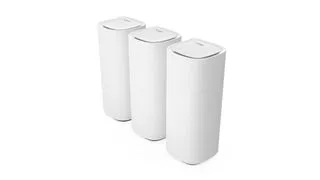
Linksys has unviled a new wireless router, the Velop Pro 7 that features Wi-Fi 7 support for a mesh network. Linksys is offering what it calls "Cognitive Mesh" technology that offers super easy and fast setup times. The new router is also one of the cheapest Wi-Fi 7 mesh capable systems to date, though that's not saying much at $399.99 for the standalone router, $749.99 with one repeater, and $999.99 with two repeaters.
The Velop Pro 7 features all of the enhancements WiFi 7 adds to the table, including channel bandwidth of up to 320 MHz and 4K QAM in the 6 GHz range. It also features 240 MHz channel bandwidth in the 5GHz range. Driving the new router is Qualcomm's state of the art Wi-Fi 7 processor, the Networking Pro 620, which offers Multi-User Traffic Management, MU-MIMO, and OFDMA to keep wireless traffic smooth and lag free.

The key feature on the Velop Pro 7 is its Wi-Fi 7 mesh capabilities , which have been greatly enhanced over previous wireless standards. Wi-Fi 7 enables wireless repeaters to connect to their host router at speeds of up to 10Gbps by more efficiently using the wireless bands Wi-Fi 7 has access to. In the past with Wi-Fi 6E routers, repeaters could only connect to their host router with a simpler backhaul system that could only use certain radio frequencies at a time, like 2.4GHz, 5GHz or 6GHz.
With Wi-Fi 7, repeaters can combined the 5 GHz and 6 GHz channels together to gain substantially more bandwidth. Enabling faster connection speeds, and lower latency when a Wi-Fi 7 mesh network is fully saturated. Linksys is also utilizing its new Cognitive Mesh technology which allows users to setup the Velop Pro 7 easily with virtually no manual configuration required.
Linksys is pricing the Velop Pro 7 is quite a bit lower than some of the competition. First generation Wi-Fi 7 capable routers were priced anywhere between $1,500 and $2,300, making them extremely expensive for early adopters. At a price of $1,000 or less with Linksys's new solution, the barrier to entry for WiFi 7 mesh networking is substantially lower, though we wouldn't call it mainstream just yet.