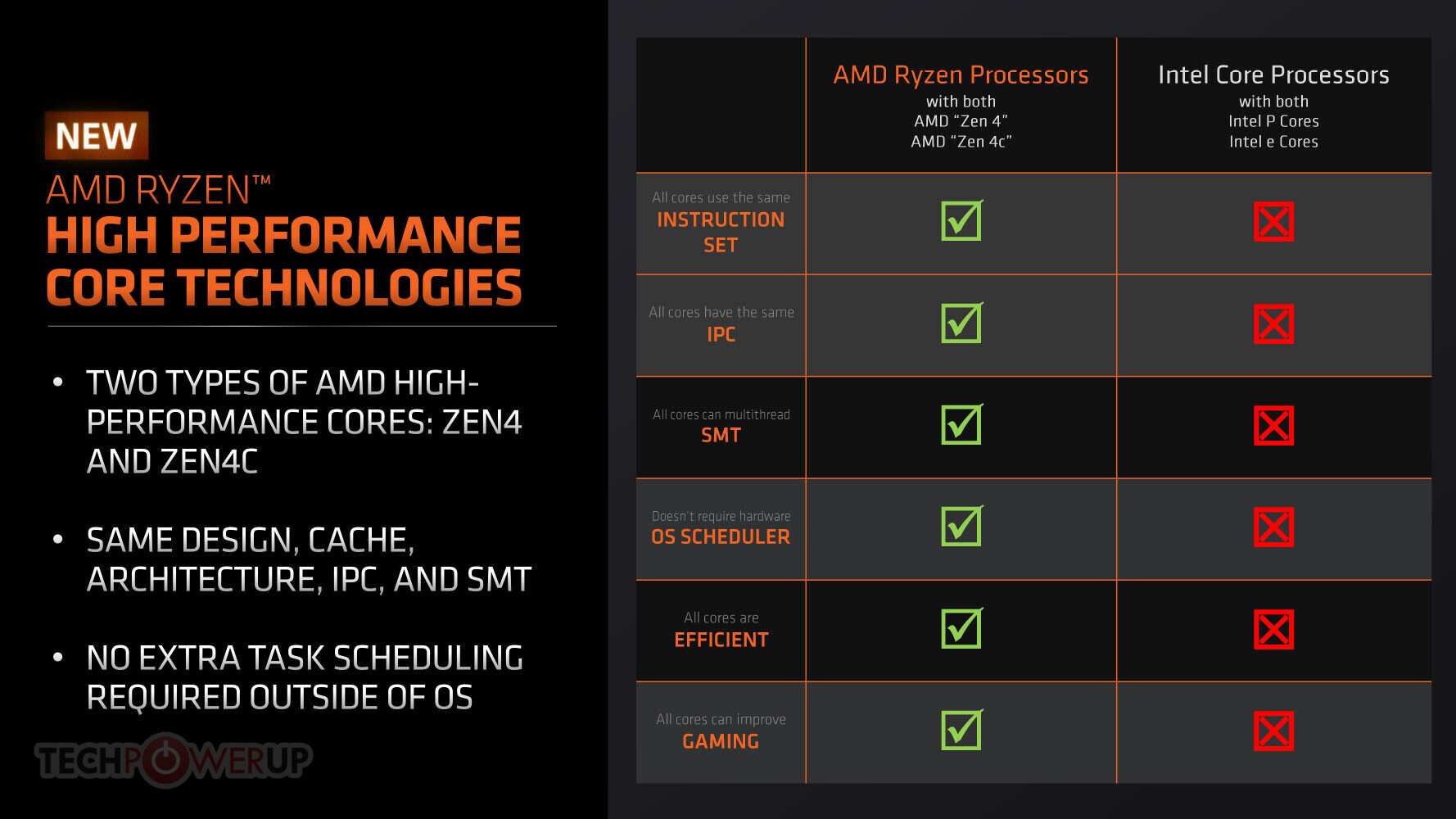
AMD today launched its first client processors that feature the compact "Zen 4c" CPU cores, with the Ryzen 5 7545U and Ryzen 3 7440U mobile processors for thin-and-light notebooks. The "Zen 4c" CPU core is a compacted version of the "Zen 4" core without the subtraction of any hardware components, but rather a high density arrangement of them on the 4 nm silicon. A "Zen 4c" core is around 35% smaller in area on the die than a regular "Zen 4" core. Since none of its components is removed, the core features an identical IPC (single thread performance) to "Zen 4," as well as an identical ISA (instruction set). "Zen 4c" also supports SMT or 2 threads per core. The trade-off here is that "Zen 4c" cores are generally clocked lower than "Zen 4" cores, as they can operate at lower core voltages. This doesn't, however, make the "Zen 4c" comparable to an E-core by Intel's definition, these cores are still part of the same CPU clock speed band as the "Zen 4" cores, at least in the processors that's being launched today.
The Ryzen 5 7545U and Ryzen 3 7440U mobile processors formally debut the new 4 nm "Phoenix 2" monolithic silicon. This chip is AMD's first hybrid processor, in that it has a mixture of two regular "Zen 4" cores, and four compact "Zen 4c" cores. The six cores share an impressive 16 MB of L3 cache. All six cores feature 1 MB of dedicated L2 cache. There is no complex hardware-based scheduler involved, but a software based solution that's deployed by AMD's Chipset Software, which tells the Windows scheduler to see the "Zen 4" cores as UEFI CPPC "preferred cores," and prioritize traffic to them, as they can hold on to higher boost frequency bins. The "Phoenix 2" silicon inherits much of the on-die power-management feature-set from the "Phoenix" and "Rembrandt" chips, and so are capable of a high degree of power savings with underutilized CPU cores and iGPU compute units.