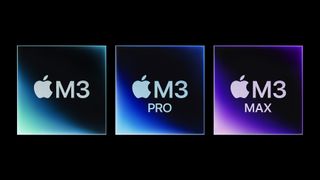
Apple's M3-series of chips have started to enter PassMark's CPU benchmark database and continued tradition of their predecessors of being ahead of all rivals in single-thread workloads. Unfortunately for Apple, its M3 Max processor does not stand a chance against flagship offerings from Intel and AMD, which are, of course, more power hungry, in multi-thread workloads.
For now, Apple's 11-core M3 Pro leads in PassMark's single-thread CPU benchmark with 4,910 points — about 1.2% faster than Intel's Core i9-14900KF with 4,852 points. Apple's M3 Pro features an eight-wide execution, a 150 GB/s memory subsystem, and a 4.05 GHz frequency, while Intel's Core i9-14900KF boasts a six-wide execution, an 89.6 GB/s memory subsystem (though most i9-based systems feature higher bandwidth as they are used with enthusiast-grade memory), and a 6.0 GHz boost clock. Apple's win seems even more impressive given that the M3 Pro is a laptop system-on-chip (SoC) with a moderate power consumption.

Apple's 12-core M3 Pro and 16-core M3 Max processors are slightly behind their younger brother, but are still ahead of Intel's 13th Generation and 14th Generation core processors. Interestingly, even Apple's smartphone-oriented A17 Pro SoC beats Intel's Core i9-13900F and Core i7-14700K in the single-thread PassMark CPU benchmark.
As far as Apple's 16-core M3 Max SoC's performance in PassMark's multi-thread CPU benchmark , it scores 39,921 points, which is enough to beat Intel's Core i7-13700F (39,825) and be more or less on par with the 20-core M2 Ultra (40,893). However, flagship desktop offerings from AMD and Intel — Ryzen 9 7950X (63,230 points) and Core i9-14900K (60,823 points) — outperform the M3 Max by 58% and 52%, respectively. Of course, these parts consume a lot more power than does Apple's M3 Max — but for those who need maximum performance, this doesn't really matter.
There might be positive news for Apple. The company's 24-core M2 Ultra system-in-package featuring two M2 Maxes shows an excellent +85% scalability compared to one M2 Max. If Apple's 32-core M3 Ultra shows similar scalability, then with around 73,000 points in multi-thread workloads in PassMark's CPU benchmark it will be able to rival AMD's 32-core Ryzen Threadripper Pro 5975WX (75,777 points) and Intel's 36-core Xeon W9-3475X (67,227 points) at a fraction of power. Yet, AMD's 96-core Ryzen Threadripper Pro 7995WX (153,301 points) and Intel's 56-core Xeon W9-3495X (98,285 points) will still be far ahead of Apple's flagship offering.
Ever since Apple released its own M-series processors for desktop and laptop computers in 2020, these SoCs have dominated single-thread performance benchmarks because of their eight-wide execution as well as an advanced caching and memory subsystem. Apple's M3 can still beat everything in single-thread workloads, but when it comes to performance in multi-threaded workloads that use all the cores and power that they can possibly get, Apple's processors lag behind their rivals severely.